Preoperative high-sensitivity C-reactive protein-to-albumin ratio predicts arteriovenous fistula failure in hemodialysis patients: a retrospective cohort study with landmark analysis - Report - MDSpire
Coming Soon: Introducing MDSpire News. Learn more
Conexiant’s news site is now MDSpire News. Learn more

Preoperative Ratio of High-Sensitivity C-Reactive Protein to Albumin as a Predictor of Arteriovenous Fistula Failure in Hemodialysis Patients: A Retrospective Cohort Analysis with Landmark Assessment

  • By

  • Shanshan Huo

  • Peng Shu

  • Zhuping Wen

  • Xiaodi Ma

  • Shuang Wang

  • Fang Xu

  • September 9, 2026

Share

Preoperative Ratio of High-Sensitivity C-Reactive Protein to Albumin as a Predictor of Arteriovenous Fistula Failure

Overview

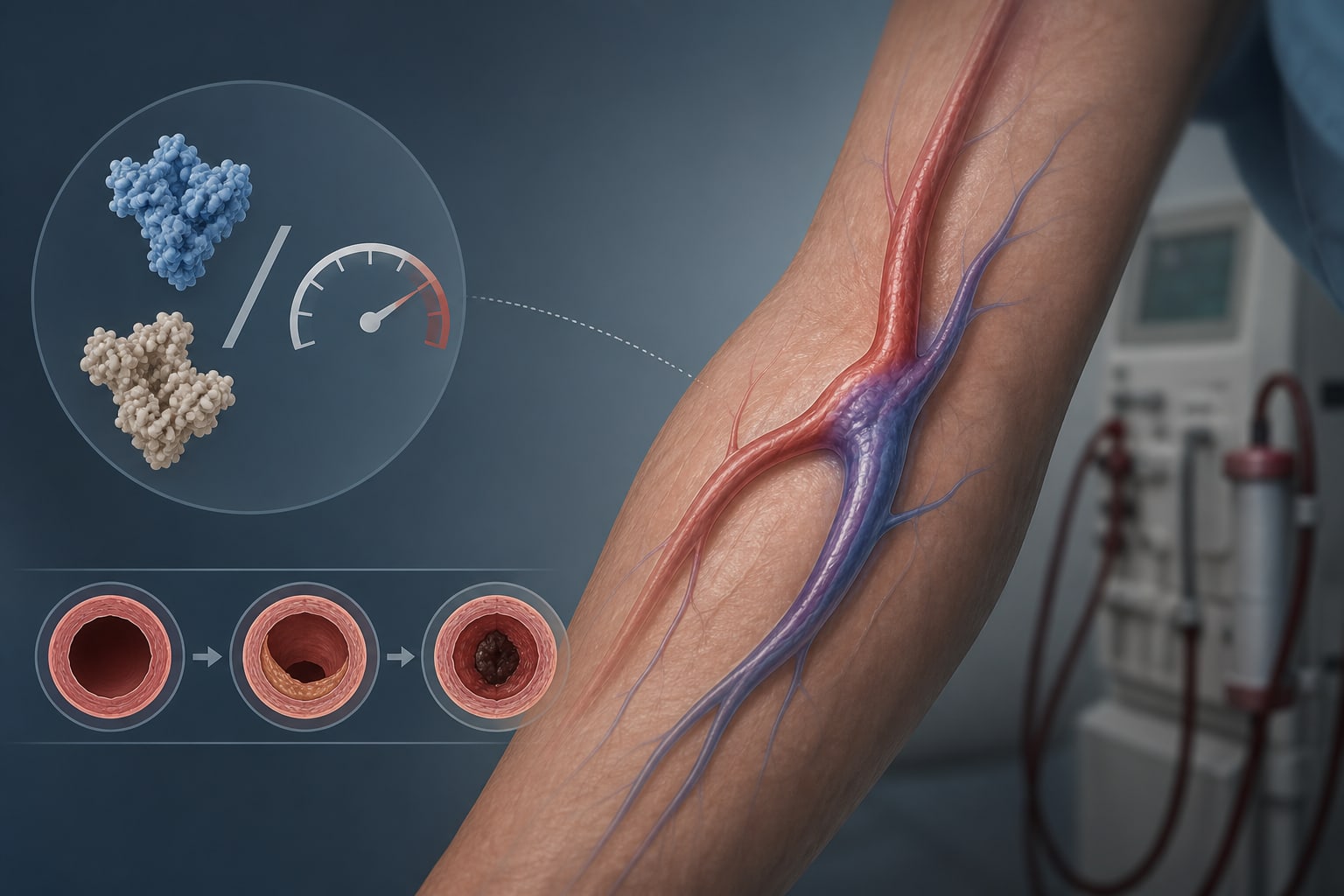
This study investigates the predictive value of the high-sensitivity C-reactive protein-to-albumin ratio (HRR) for arteriovenous fistula (AVF) failure in hemodialysis patients. The findings indicate that higher HRR is significantly associated with increased risk of AVF failure.

Background

Arteriovenous fistula (AVF) is the preferred vascular access for hemodialysis, yet failure rates can be as high as 50% within the first year. Identifying patients at risk for AVF failure is crucial for improving outcomes and optimizing resource allocation. The high-sensitivity C-reactive protein-to-albumin ratio (HRR) may serve as a marker reflecting inflammation and nutritional status, which are important factors in vascular health.

Data Highlights

OutcomeValue
AVF failure rate50.5%
HRR hazard ratio1.65 (95% CI: 1.33–2.05, P < 0.001)
24-month AUC0.608 (95% CI: 0.519–0.701)

Key Findings

  • AVF failure occurred in 141 out of 279 patients (50.5%) during a median follow-up of 50 months.
  • Each unit increase in HRR was associated with a 65% increased risk of AVF failure (HR = 1.65).
  • Vessel diameter was also a significant predictor of AVF failure (HR = 0.21).
  • Moderate model discrimination was observed at 24 months (AUC = 0.608).

Clinical Implications

The HRR may assist clinicians in identifying patients at higher risk for AVF failure, allowing for tailored surveillance and intervention strategies. Its use as a preoperative marker could enhance risk stratification in clinical practice.

Conclusion

The study demonstrates that preoperative HRR is an independent predictor of AVF failure.

Related Resources & Content

  1. Author(s)/Org, Source, Year -- Title
  2. Frontiers in Cardiovascular Medicine — Predictive value of the uric acid-to-albumin ratio for contrast-induced nephropathy after percutaneous coronary intervention and construction of a clinical prediction model in patients with coronary artery disease
  3. Critical Care (Springer) — Utilizing Albumin-Corrected Calcium Ratios to Enhance Detection of Citrate Accumulation and Improve Mortality Forecasting in Continuous Kidney Replacement Therapy
  4. Frontiers in Endocrinology — Association of the serum uric acid to high-density lipoprotein cholesterol ratio with in-hospital mortality in patients with acute kidney injury: a retrospective cohort study
  5. Intensive Care Medicine — Preoperative Right Heart Hemodynamics as Predictors of Acute Kidney Injury Following Heart Transplantation
  6. KDOQI Clinical Practice Guideline for Vascular Access: 2019 Update
  7. European Society for Vascular Surgery (ESVS) 2023 Clinical Practice Guidelines on Antithrombotic Therapy for Vascular Diseases
  8. The predictive value of inflammatory biomarkers for arteriovenous fistula failure: A systematic review and meta-analysis - PubMed

Original Source(s)

Related Content