The missing microbial link in triclosan toxicity: comment on mechanism of liver fibrosis induced by life-long triclosan exposure in offspring rats - Report - MDSpire
Coming Soon: Introducing MDSpire News. Learn more
Conexiant’s news site is now MDSpire News. Learn more

Uncovering the Microbial Connection to Triclosan-Induced Toxicity: Insights into Liver Fibrosis Mechanisms from Lifelong Exposure in Offspring Rats

  • By

  • Yajun He

  • Ruifang Wang

  • Fang Wang

  • September 8, 2026

Share

Clinical Report: Uncovering the Microbial Connection to Triclosan-Induced Toxicity

Background

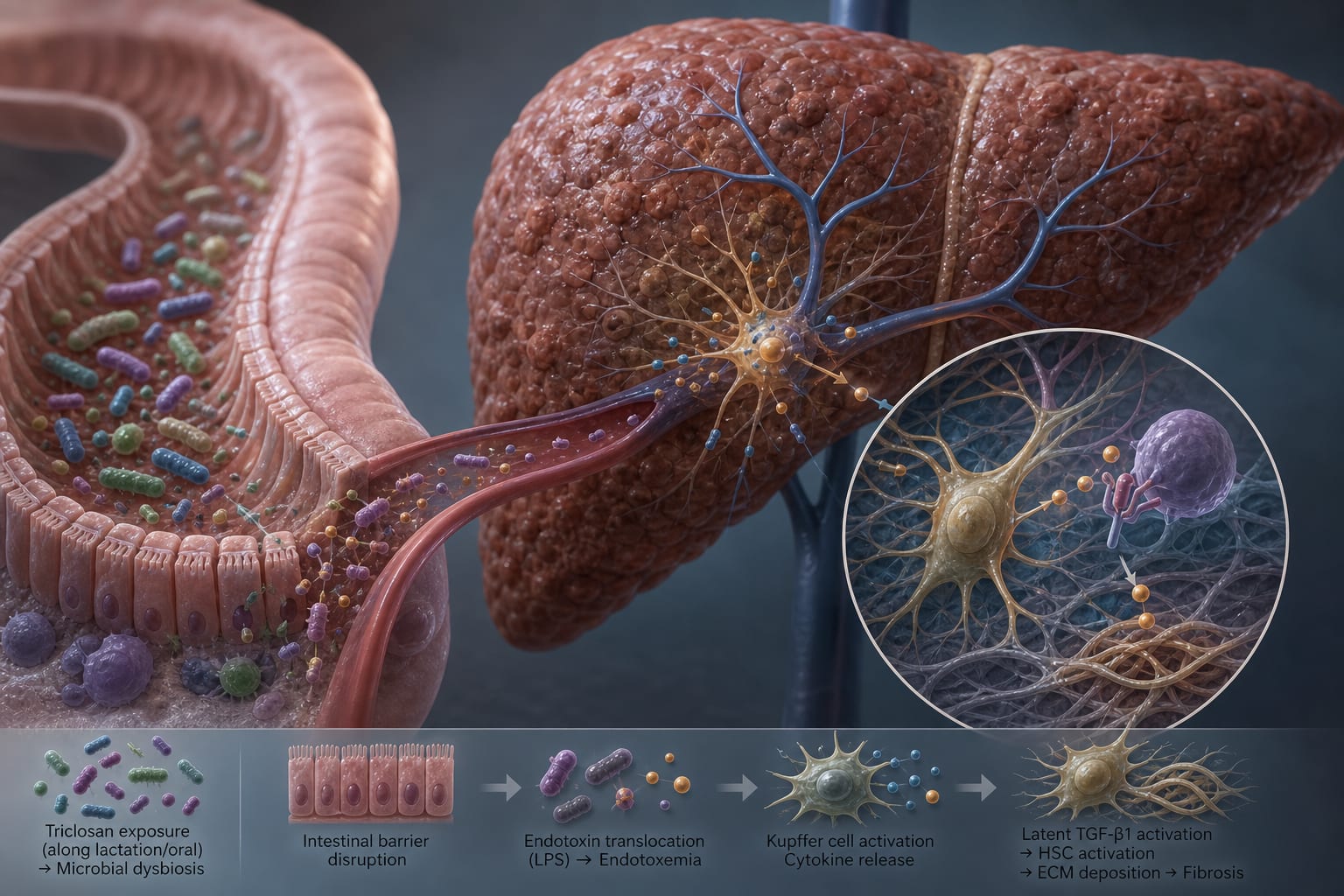
Triclosan (TCS) is a widely used antimicrobial agent, yet its long-term exposure has been linked to liver fibrosis in offspring rats as reported by Liu et al. (2026). Understanding the mechanisms of TCS-induced toxicity is critical for evaluating its environmental and health risks, particularly regarding the gut-liver axis and microbial health.

Data Highlights

No numerical data or trial data available in the source material.

Key Findings

  • Triclosan exposure leads to liver fibrosis through TGF-β1 and AGEs-RAGE pathways.
  • Microbial dysbiosis from TCS exposure disrupts the gut-liver axis.
  • Endotoxemia may serve as a preceding Molecular Initiating Event driving TGF-β1 surge.
  • Current models overlook the microbiome's role in evaluating antibacterial agents.
  • Future adverse outcome pathways should integrate gut microbiome considerations.

Clinical Implications

Healthcare professionals should be aware of the potential hepatic risks associated with triclosan exposure, particularly in the context of microbial health.

Conclusion

The findings indicate the importance of understanding triclosan's effects on microbial interactions and liver health.

Related Resources & Content

  1. Liu et al., 2026 -- Mechanism of liver fibrosis induced by life-long triclosan exposure in offspring rats: an adverse outcome pathway framework validated by in vivo and in vitro experiments
  2. Peng et al., 2024 -- Toxicant Exposure Echoes for Generations
  3. Seki et al., 2007 -- Role of Kupffer cells in liver fibrosis
  4. Archives of Toxicology — Prolonged Oral Exposure to TCDD Alters Gut Microbial Glycosylation in Female C57BL/6 Mice, but Not in Males
  5. Archives of Toxicology — Maternal probiotic intake mitigates PBDE-related developmental, behavioral, and metabolic alterations with sex-specific effects: The influence of gut microbiota
  6. Clinical care pathway for the risk stratification and management of patients with MASLD
  7. AASLD Announces Update to Metabolic Dysfunction‐Associated Steatotic Liver Disease (MASLD) Practice Guidance
  8. label
  9. Diagnostic Performance of Non-invasive Tests for Hepatic Fibrosis Using Liver Biopsy As the Reference Standard: A Systematic Review and Meta-Analysis - PMC
  10. Mechanism of liver fibrosis induced by life-long triclosan exposure in offspring rats: an adverse outcome pathway framework validated by in vivo and in vitro experiments - PubMed
  11. Mechanisms and reversal strategies of liver fibrosis: from regulation of cell fate to clinical translation | Journal of Translational Medicine | Springer Nature Link
  12. From bench to bedside: Molecular mechanisms, diagnostic tools, and therapeutic strategies in liver fibrosis - ScienceDirect
  13. Association between gut microbiota composition and liver dysfunction in school-aged children exposed to triclosan - ScienceDirect
  14. Skip the Antibacterial Soap; Use Plain Soap and Water | FDA
  15. Questions & Answers about Triclosan Reregistration Eligibility Decision | US EPA
  16. OECD Series on Adverse Outcome Pathways | OECD

Original Source(s)

Related Content