Type-1 inflammatory imprinting and programmed responsiveness to CD40L enhance Siglec-1-dependent HIV-1 trans-infection by dendritic cells - Report - MDSpire

Type-1 inflammatory imprinting and programmed responsiveness to CD40L enhance Siglec-1-dependent HIV-1 trans-infection by dendritic cells

  • By

  • E. Grace Bothwell

  • Allison E. DePuyt

  • Colleen R. Zaccard

  • Renee. R. Anderko

  • Peter E. J. Shoucair

  • Holly A. Bilben

  • Tatiana M. Garcia-Bates

  • Abigail D. Gerberick

  • Simon C. Watkins

  • Nicolas Sluis-Cremer

  • Charles R. Rinaldo

  • Robbie B. Mailliard

  • June 4, 2026

  • 0 min

Share

Clinical Report: Inflammatory Type-1 Imprinting Enhances HIV-1 Trans-Infection

Overview

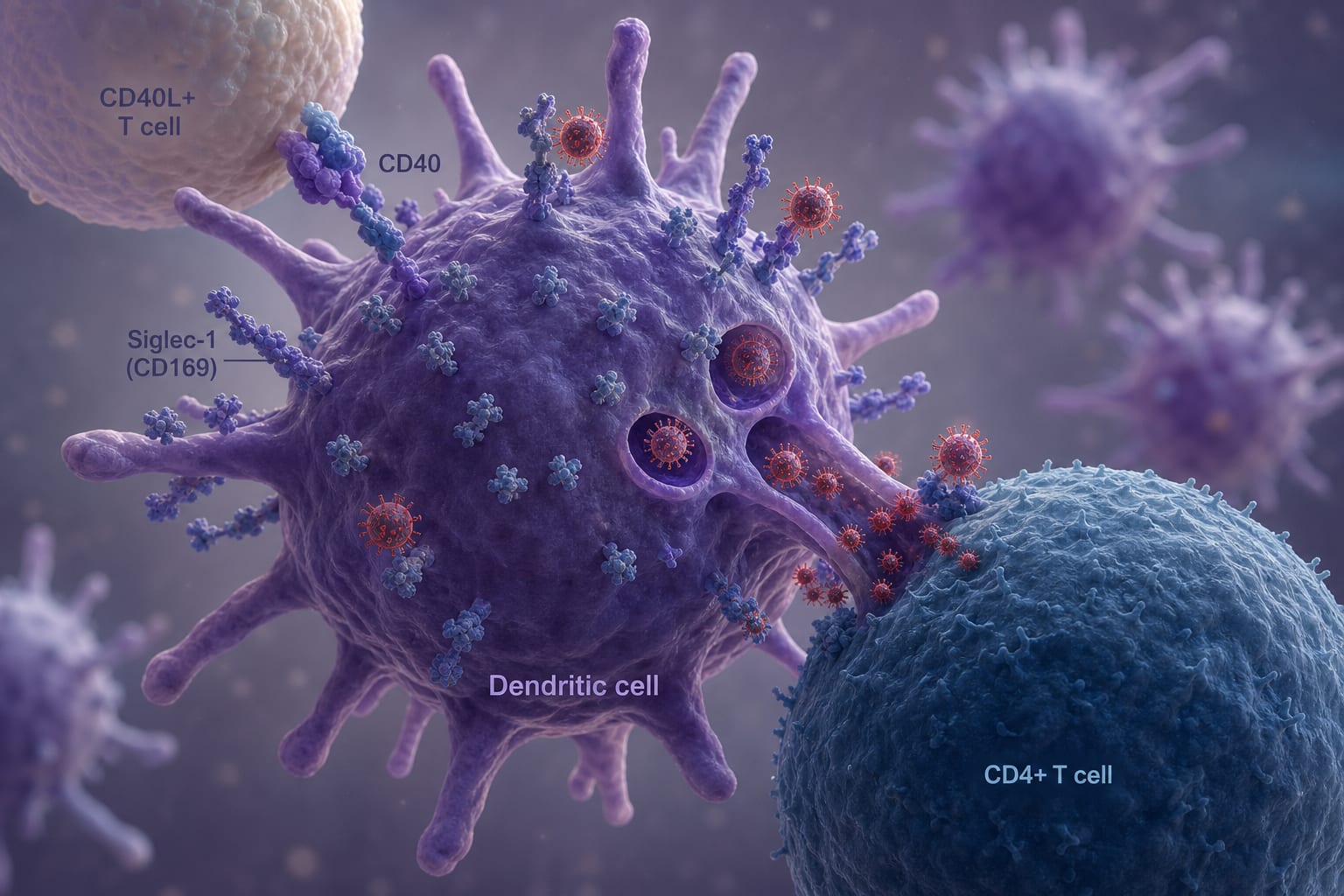
This study reveals that monocyte-derived dendritic cells (DC) matured under specific type-1 proinflammatory conditions exhibit enhanced capacity for HIV-1 trans-infection of CD4+ T cells. The findings highlight the role of Siglec-1 upregulation and CD40L-mediated responses in facilitating this process.

Background

Dendritic cells are pivotal in orchestrating immune responses, acting as a bridge between innate and adaptive immunity. Their ability to mediate HIV-1 trans-infection poses significant implications for viral dissemination and infection dynamics. Understanding the mechanisms behind this process is crucial for developing targeted interventions in HIV management.

Data Highlights

No numerical data or trial data presented in the article; qualitative observations include enhanced binding and morphological changes in DC.

Key Findings

['Monocyte-derived DC matured under type-1 inflammatory conditions show increased HIV-1 trans-infection capacity.', 'Prostaglandin E2 exposure reduces the trans-infection ability of DC.', 'Upregulation of Siglec-1 enhances HIV-1 binding on proinflammatory DC.', 'CD40L signaling induces morphological changes in DC and increases CCL20 chemokine release.', 'Environmental signals during DC maturation significantly influence their trans-infection capabilities.']

Clinical Implications

The findings suggest that manipulating the inflammatory environment during DC maturation could be a strategy to reduce HIV-1 trans-infection rates. Clinicians should consider the role of dendritic cells in HIV transmission dynamics when designing therapeutic interventions, potentially focusing on specific inflammatory mediators.

Conclusion

This study underscores the importance of understanding dendritic cell maturation in the context of HIV-1 trans-infection, which may inform future therapeutic strategies aimed at interrupting viral spread and enhancing immune responses.

Related Resources & Content

  1. Frontiers | Type-1 inflammatory imprinting and programmed responsiveness to CD40L enhance Siglec-1-dependent HIV-1 trans-infection by dendritic cells
  2. Nature Cancer — Coupling dead cell recognition to Fcγ receptors augments anticancer immunity
  3. Frontiers in Immunology — Pannexin-1–mediated ATP signaling as a driver of immune communication and chronic inflammation in HIV infection
  4. The Journal of Infectious Diseases — When PD-1 Meets Plaque: Making CD8 Senescence Signals Clinically Actionable in Treated HIV
  5. CDC Recommends New Injectable HIV PrEP | HIV.gov
  6. Cabotegravir Maintains Protective Efficacy in the Setting of Bacterial Sexually Transmitted Infections: A Secondary Analysis of HPTN 083 - PubMed
  7. Frontiers in Immunology — The CD40-CD154 axis in transplantation: from immunobiology to therapeutic targeting
  8. CDC Recommends New Injectable HIV PrEP | HIV.gov
  9. Cabotegravir Maintains Protective Efficacy in the Setting of Bacterial Sexually Transmitted Infections: A Secondary Analysis of HPTN 083 - PubMed
  10. Frontiers | Type-1 inflammatory imprinting and programmed responsiveness to CD40L enhance Siglec-1-dependent HIV-1 trans-infection by dendritic cells

Original Source(s)

Related Content