Commentary: PCP4 inhibits the progression of prostate cancer through Ca2+/CAMKK2/AMPK/AR pathway - Report - MDSpire

Commentary: PCP4 inhibits the progression of prostate cancer through Ca2+/CAMKK2/AMPK/AR pathway

  • By

  • Wujie Chen

  • Fajiang Qian

  • Fengtong Wang

  • Fuquan Yang

  • Yuqing Shen

  • Mingxia Ding

  • Yuan Liu

  • July 3, 2026

  • 0 min

Share

Clinical Report: The Role of PCP4 in Suppressing Prostate Cancer Progression

Background

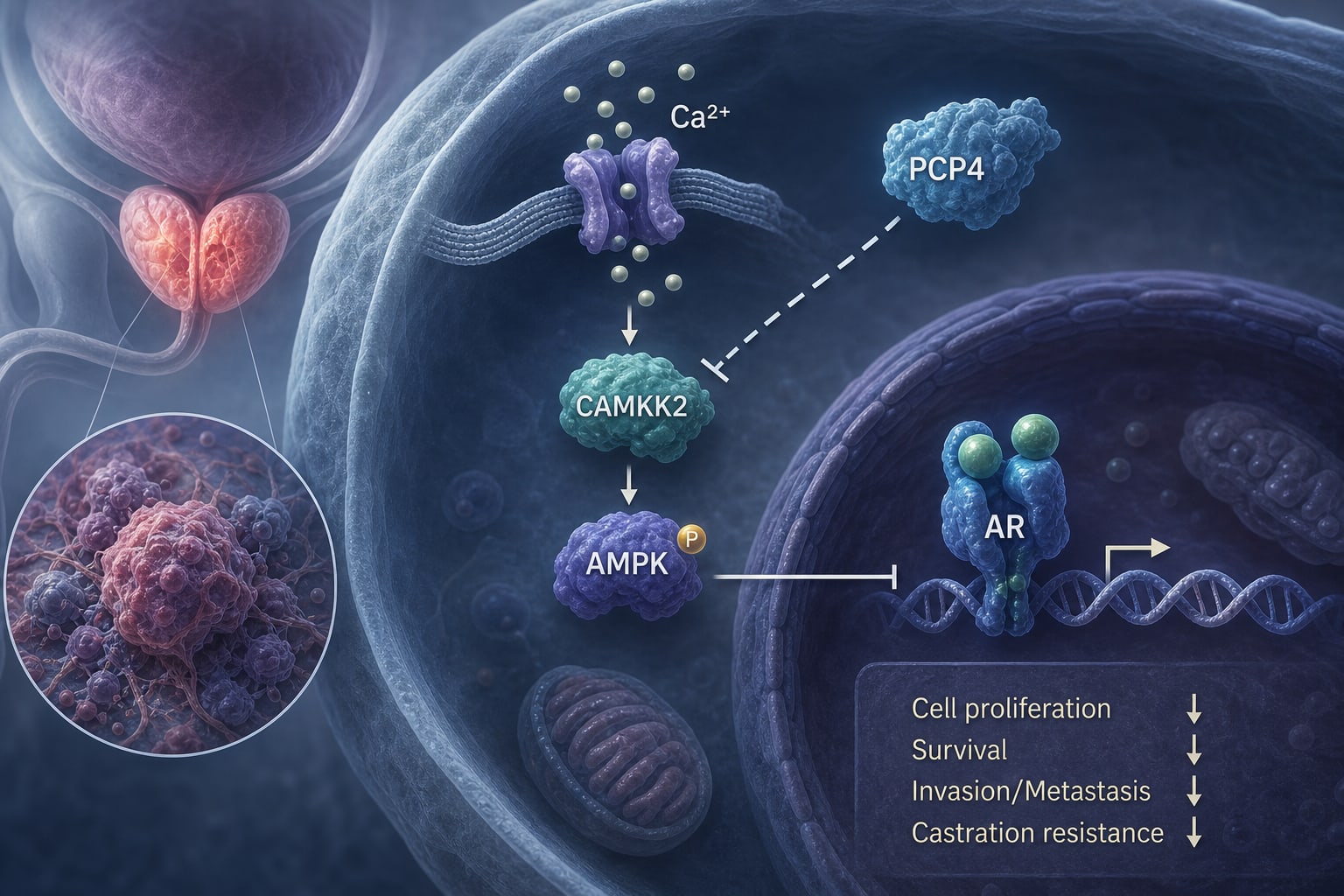
Castration-resistant prostate cancer (CRPC) poses a major challenge in urologic oncology, as it often leads to limited treatment options and poor patient outcomes. Understanding the molecular mechanisms that drive CRPC progression is crucial for developing effective therapies. The study by Jia et al. identifies PCP4 downregulation as a factor that promotes prostate cancer progression through the activation of the Ca2+/CAMKK2/AMPK/AR signaling axis.

Data Highlights

No numerical data available in the source material.

Key Findings

  • PCP4 downregulation promotes prostate cancer progression by activating the Ca2+/CAMKK2/AMPK/AR signaling axis.
  • Low PCP4 expression correlates with higher T stage, higher Gleason score, and shorter disease-free survival (DFS) and biochemical recurrence-free survival (BCRFS).
  • The CAMKK2 inhibitor STO-609 can reverse the proliferative effects induced by PCP4 knockdown.
  • PCP4 is identified as a repressive target gene of androgen receptor (AR) with a bidirectional feedback regulation between PCP4 and CAMKK2.
  • PCP4 deletion co-occurs with TMPRSS2-ERG fusion in CRPC, suggesting implications for patient stratification.

Clinical Implications

The findings suggest that further investigation into the PCP4-CAMKK2 axis may provide insights into the mechanisms of CRPC progression.

Conclusion

The study emphasizes the role of PCP4 in prostate cancer progression and highlights the need for further exploration of this pathway.
Related Resources & Content

  1. Jia, W, Yu, Z, Sun, F, et al., Front Immunol, 2025 -- PCP4 inhibits prostate cancer progression via the Ca2+/CAMKK2/AMPK/AR signaling pathway
  2. The Role of Androgen Receptors in the Progression of Prostate Cancer
  3. Frontiers in Oncology — The role of lysophosphatidic acid metabolism in castration-resistant prostate cancer progression
  4. Increased Expression of miR-3195, miR-3687, and miR-4417 Linked to Castration-Resistant Prostate Cancer
  5. Frontiers in Oncology — Androgen receptor reactivation in castration-resistant prostate cancer: mechanisms, epigenetic adaptation, and therapeutic vulnerabilities
  6. The Role of Androgen Receptors in the Progression of Prostate Cancer
  7. The role of lysophosphatidic acid metabolism in castration-resistant prostate cancer progression
  8. Increased Expression of miR-3195, miR-3687, and miR-4417 Linked to Castration-Resistant Prostate Cancer
  9. Systemic Therapy in Patients With Metastatic Castration-Resistant Prostate Cancer: ASCO Living Guideline
  10. Prostate Cancer, Version 3.2026, NCCN Clinical Practice Guidelines In Oncology - PubMed
  11. EAU - EANM - ESTRO -
  12. 2026 update on EAU Guidelines for prostate cancer - UROONCO Prostate Cancer
  13. Advanced and metastatic prostate cancer: ESMO Clinical Practice Guideline for diagnosis, treatment and follow-up - PubMed
  14. Darolutamide and Survival in Metastatic, Hormone-Sensitive Prostate Cancer | New England Journal of Medicine
  15. Abiraterone plus prednisone added to androgen deprivation therapy and docetaxel in de novo metastatic castration-sensitive prostate cancer (PEACE-1): a multicentre, open-label, randomised, phase 3 study with a 2 × 2 factorial design - PubMed
  16. Efficacy and safety of treatments for metastatic castration-sensitive prostate cancer: A comprehensive network meta-analysis including final ARANOTE data
  17. Frontiers | A network meta-analysis of the safety of systemic treatments in patients with metastatic hormone-sensitive prostate cancer
  18. Regulation and role of CAMKK2 in prostate cancer | Nature Reviews Urology
  19. PCP4 inhibits the progression of prostate cancer through Ca2+/CAMKK2/AMPK/AR pathway
  20. Coregulators determine androgen receptor activity in prostate cancer - PubMed

Original Source(s)

Related Content