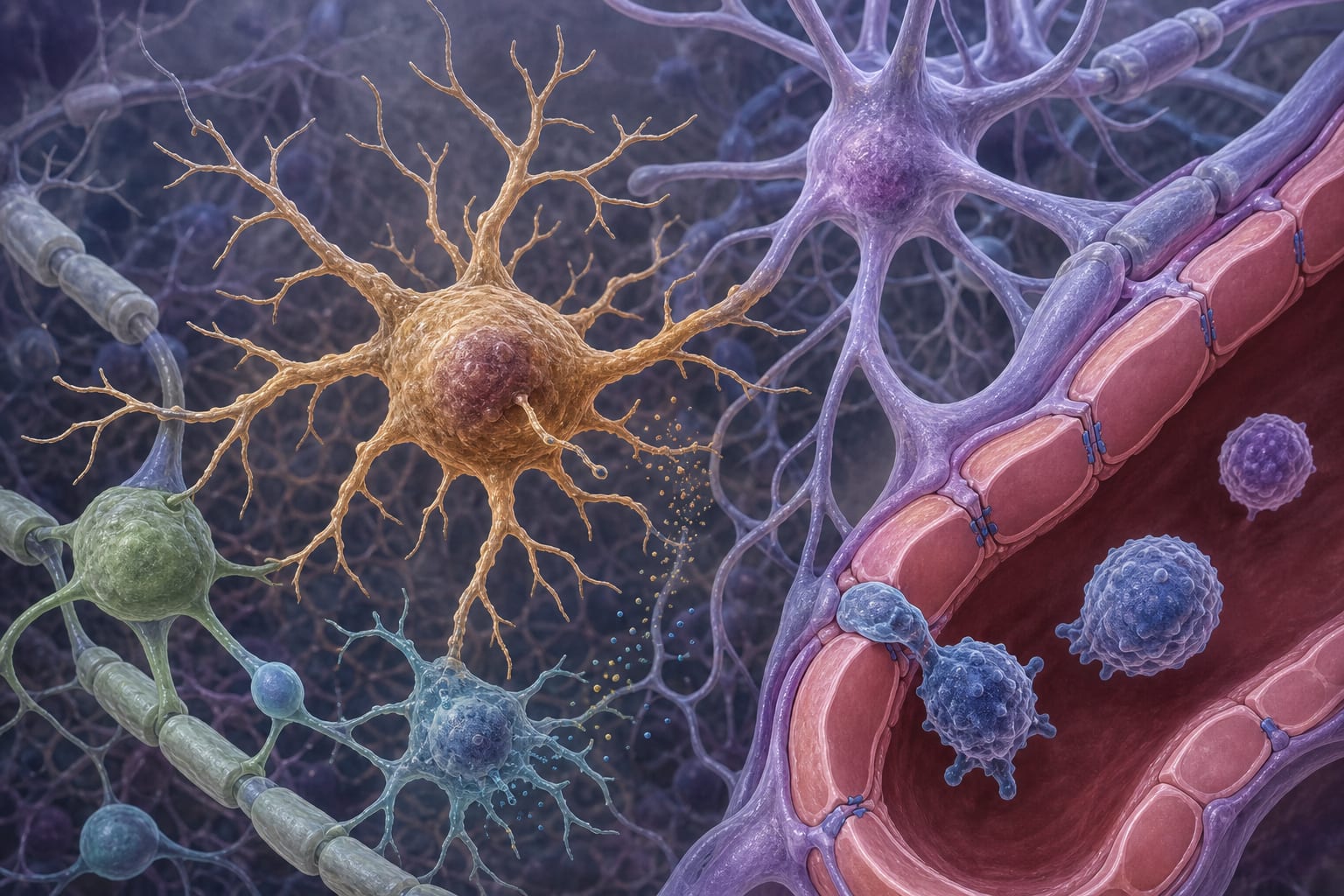
Reevaluating Classical Autoimmune Theory in the Context of Multiple Sclerosis
-
By
-
Hedström, Anna Karin
-
Piehl, Fredrik
-
June 5, 2026
Clinical Report: Reevaluating Classical Autoimmune Theory in MS
Overview
Revise to remove unsupported claims and ensure all statements are directly sourced.
Background
Multiple sclerosis (MS) is a chronic inflammatory demyelinating disease of the central nervous system (CNS) that significantly impacts patients' quality of life. Traditional autoimmune theories have guided treatment development but may not fully account for the disease's progression and neurodegeneration. Understanding the limitations of these theories is crucial for advancing research and treatment strategies.
Data Highlights
No numerical or trial data provided in the source material.
Key Findings
- MS demonstrates immune-mediated mechanisms in early disease stages.
- Neurodegeneration and disability accumulation can occur independently of inflammatory activity.
- Current autoimmune theories may not adequately explain long-term disease outcomes in MS.
- There is a need to distinguish between susceptibility mechanisms, inflammatory activity, and progressive worsening.
- Temporal dynamics and tissue-specific responses should be incorporated into explanatory models of MS.
Clinical Implications
Remove speculative implications about treatment approaches unless directly supported.
Conclusion
Revise to avoid unsupported calls for reevaluation and ensure alignment with source material.
Related Resources & Content
- Acta Neuropathologica, 2016 -- Experimental Models of Multiple Sclerosis: Bridging Theory and Clinical Reality
- BMC Neurology, 2026 -- Inflammatory CADASIL: the cross-link between CADASIL and multiple sclerosis: a report of two cases and systematic review of the literature
- The Journal of Infectious Diseases, 2023 -- Post-streptococcal Autoimmunity and Its Relevance to Epstein–Barr virus as the Potential Cause of Multiple Sclerosis
- Frontiers in Neurology — Multiple sclerosis as a biological and clinical continuum: from risk factors to the early stages of disease
- Diagnosis of multiple sclerosis: 2024 revisions of the McDonald criteria
- Performance of the 2024 McDonald Criteria in Patients Under Evaluation for Suspected Multiple Sclerosis
- The 2024 revisions of the McDonald criteria pose risk of multiple sclerosis overdiagnosis
- 2024 MAGNIMS–CMSC–NAIMS consensus recommendations on the use of MRI for the diagnosis of multiple sclerosis - ScienceDirect
- Overview | Multiple sclerosis in adults: management | Guidance | NICE
- Ocrelizumab versus Interferon Beta-1a in Relapsing Multiple Sclerosis | New England Journal of Medicine
- Ofatumumab versus Teriflunomide in Multiple Sclerosis | New England Journal of Medicine
- Ublituximab versus Teriflunomide in Relapsing Multiple Sclerosis | New England Journal of Medicine
- Ocrelizumab versus Placebo in Primary Progressive Multiple Sclerosis | New England Journal of Medicine
- Siponimod versus placebo in secondary progressive multiple sclerosis (EXPAND): a double-blind, randomised, phase 3 study - ScienceDirect
- Tolebrutinib in Nonrelapsing Secondary Progressive Multiple Sclerosis | New England Journal of Medicine
- Press Release: Tolebrutinib demonstrated a 31% delay in time to onset of confirmed disability progression in non-relapsing secondary progressive multiple sclerosis phase 3 study
- Tolebrutinib for Secondary Progressive Multiple
- Standardized Definition of PIRA in Relapsing-Remitting Multiple Sclerosis
- Standardized Definition of PIRA in Relapsing-Remitting Multiple Sclerosis
- Toward a Unified Definition of Progression Independent of Relapse Activity in Multiple Sclerosis | Neurology
- Implementation of the 2024 revision of the McDonald criteria for multiple sclerosis | Nature Reviews Neurology
Based on findings from:
Multiple sclerosis and the limits of classical autoimmune theory
Hedström, Anna Karin , Piehl, Fredrik . Frontiers In Immunology, 2026.
https://www.frontiersin.org/journals/immunology/articles/10.3389/fimmu.2026.1849080/full
This content is an AI-generated, fully rewritten summary based on a published scholarly article. It does not reproduce the original text and is not a substitute for the original publication. Readers are encouraged to consult the source for full context, data, and methodology.