Combining Anisotropic Heat Transfer and Transformer Encoding within Convolutional Neural Networks for the Classification of Skin Cancer
-
By
-
Sanad Aburass
-
Osama Dorgham
-
Ibrahim Aljarah
-
June 9, 2026
Combining Anisotropic Heat Transfer and Transformer Encoding within CNNs
Overview
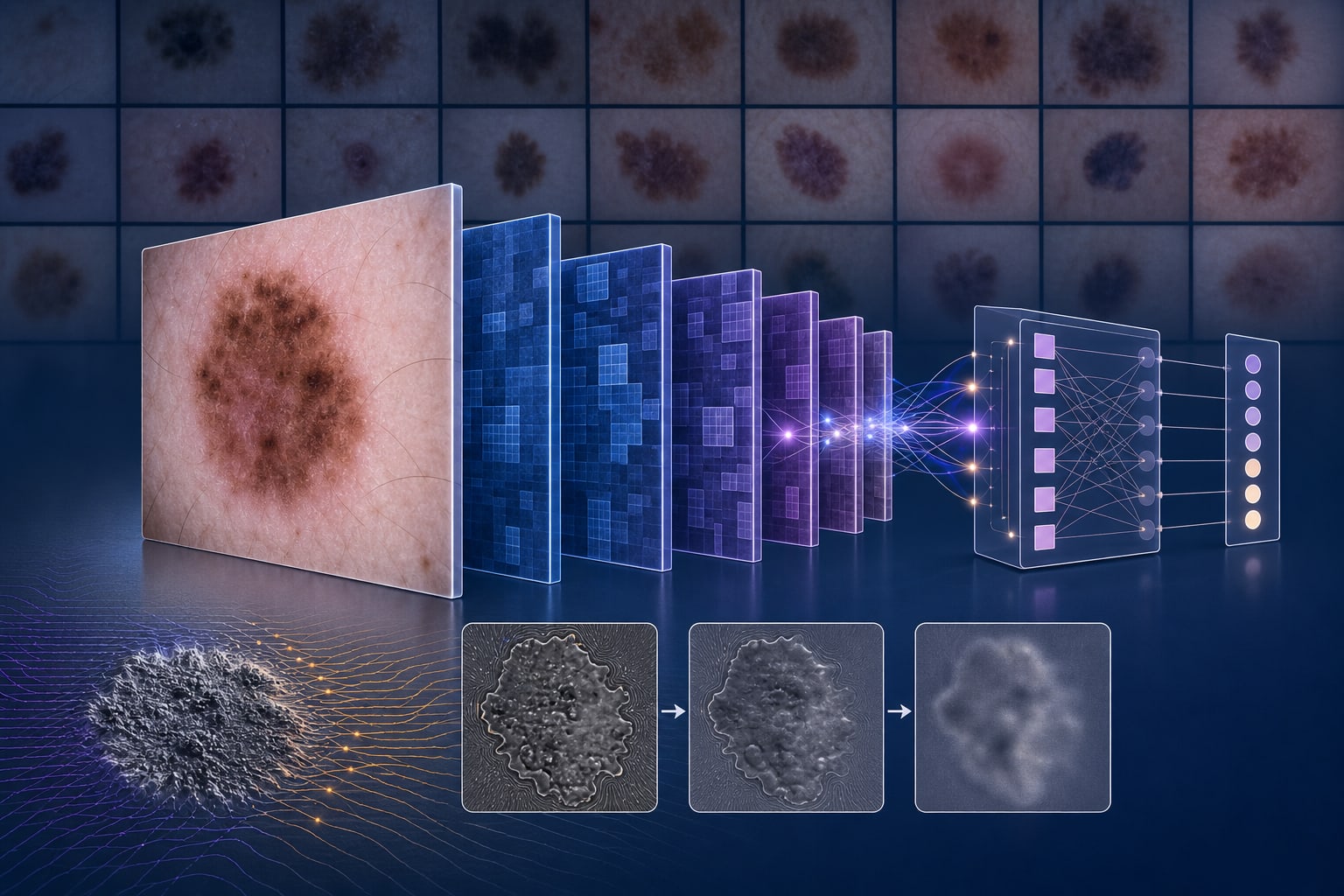
This study presents a novel approach integrating an Advanced Heat Flow Layer into CNNs for skin cancer classification, demonstrating superior performance compared to traditional models. Utilizing the HAM10000 dataset, the model showed significant improvements in accuracy, precision, recall, F1 score, and AUC, particularly with augmented data.
Background
The early detection and classification of skin cancer are crucial for improving patient outcomes. Traditional deep learning models often face challenges in accurately differentiating skin lesions due to their complex morphological characteristics. This study aims to enhance diagnostic capabilities through advanced computational techniques, specifically by integrating anisotropic diffusion and transformer layers into CNN architectures.
Data Highlights
No numerical data or trial data provided in the source material.
Key Findings
- The Advanced Heat Flow Layer employs anisotropic diffusion for edge-preserving image smoothing.
- Integration of DenseNet121 with transformer encoder layers enhances the model's ability to capture long-range dependencies in skin lesion images.
- The model outperformed benchmark deep learning models across key metrics, particularly with augmented data.
- The HAM10000 dataset provided a diverse range of skin lesions for model validation.
- Ensemble Learning techniques were applied to improve predictive performance.
Clinical Implications
The integration of advanced computational techniques in skin cancer classification may improve diagnostic accuracy and efficiency. This approach could potentially enhance the early detection of skin malignancies, impacting patient management and outcomes.
Conclusion
The study introduces a promising method for skin cancer classification that leverages advanced deep learning techniques, showing significant improvements over traditional models. Further validation in clinical settings may be warranted.
Related Resources & Content
- Frontiers in Oncology, 2026 -- Skin tumor identification by means of convolutional neural network and improved gray wolf optimizer
- Assessing Various Combination Techniques for Automated Analysis of Ultrasound and Shear Wave Elastography Images Using Discriminative Convolutional Neural Networks in Breast Cancer Imaging
- Frontiers in Digital Health, 2026 -- A patient-aware benchmarking of CNN and transformer architectures for breast cancer histopathology classification
- Enhanced Classification of Prostate Disorders Utilizing Transformers with Discrete Representations
- Skin Cancer: Screening | United States Preventive Services Taskforce
- NCCN GUIDELINES® INSIGHTS Melanoma: Cutaneous
- Prospective Evidence on Artificial Intelligence−Assisted Melanoma Diagnostics: A Systematic Review and Meta-Analysis | Oncology | JAMA Dermatology
- Diagnostic accuracy of artificial intelligence compared to family physicians and dermatologists for skin conditions: a systematic review and meta-analysis - PMC
- 3D Total-Body Photography in Patients at High Risk for Melanoma: A Randomized Clinical Trial - PMC
- Position statement of the EADV Artificial Intelligence (AI) Task Force on AI‐assisted smartphone apps and web‐based services for skin disease - Sangers - 2024 - Journal of the European Academy of Dermatology and Venereology - Wiley Online Library
- Equity and Generalizability of Artificial Intelligence for Skin-Lesion Diagnosis Using Clinical, Dermoscopic, and Smartphone Images: A Systematic Review and Meta-Analysis - PubMed
Based on findings from:
Integrating anisotropic heat flow and transformer encoders in convolutional neural network for skin cancer classification
Sanad Aburass, Osama Dorgham, Ibrahim Aljarah. Frontiers In Medicine, 2026.
https://www.frontiersin.org/journals/medicine/articles/10.3389/fmed.2026.1834696/full
This content is an AI-generated, fully rewritten summary based on a published scholarly article. It does not reproduce the original text and is not a substitute for the original publication. Readers are encouraged to consult the source for full context, data, and methodology.