Loss of ST8Sia6 mediated α-2,8-linked di-sialylation enhances T cell-dependent antibody responses and promotes autoimmunity in aged mice - Report - MDSpire

Loss of ST8Sia6 mediated α-2,8-linked di-sialylation enhances T cell-dependent antibody responses and promotes autoimmunity in aged mice

  • By

  • Ronja Brüchert

  • Michael Hinzpeter-Schmidt

  • Bettina Röder

  • Mareike Krause

  • Stefanie Brey

  • Thomas H. Winkler

  • Falk F. R. Buettner

  • Martina Mühlenhoff

  • Lars Nitschke

  • July 2, 2026

  • 0 min

Share

Clinical Report: Decreased ST8Sia6 Activity Enhances T Cell-Dependent Antibody Production

Overview

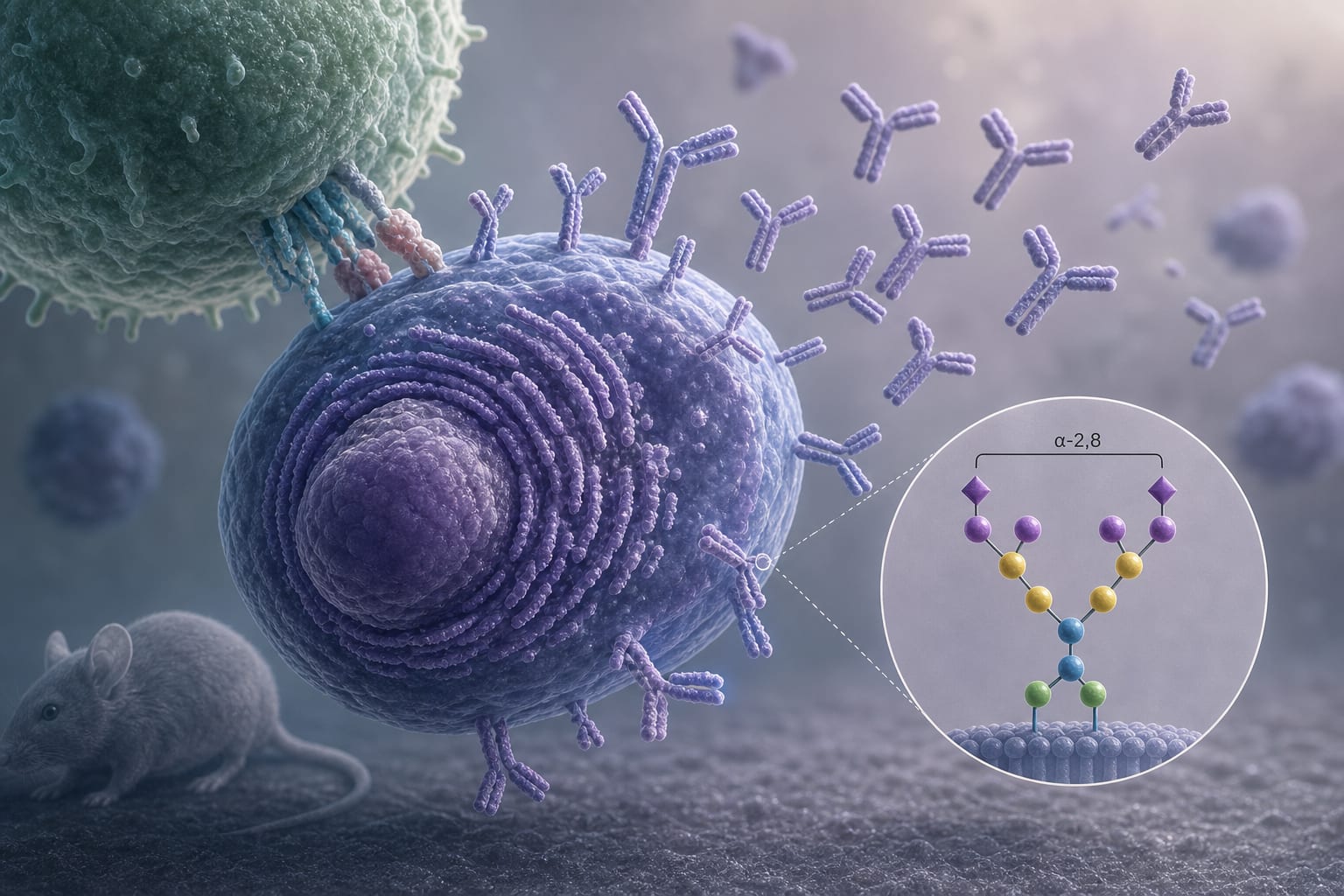
The study investigates the role of ST8Sia6 in immune responses, revealing that its absence leads to increased T cell-dependent antibody production and signs of autoimmunity in aged mice.

Background

Sialic acids are critical for immune function, influencing cell interactions and immune responses. The enzyme ST8Sia6 is responsible for synthesizing α-2,8-linked di-sialyl motifs, which are important for B cell activation.

Data Highlights

No numerical data or trial data provided in the source material.

Key Findings

  • St8sia6-/- mice exhibited normal B cell and plasma cell development.
  • Increased proliferation of B cells was observed in response to T cell-dependent stimuli in St8sia6-/- mice.
  • Elevated IgG1 responses were noted upon T cell-dependent immunization in St8sia6-/- mice.
  • Aged St8sia6-/- mice showed increased populations of germinal center B cells and plasma cells.
  • St8sia6-/- mice displayed elevated levels of anti-nuclear IgG autoantibodies, indicating autoimmunity.

Clinical Implications

The findings highlight the importance of ST8Sia6 in regulating B cell activation and antibody production.

Conclusion

The absence of ST8Sia6 enhances T cell-dependent immune responses and contributes to an autoimmune phenotype in aged mice.

Related Resources & Content

  1. Frontiers in Immunology, 2026 -- Loss of ST8Sia6 mediated α-2,8-linked di-sialylation enhances T cell dependent antibody responses and promotes autoimmunity in aged mice
  2. Frontiers in Immunology — Ligature-induced periodontitis in mice potentially accelerates CD4+ T-cell senescence and exacerbates rheumatoid arthritis
  3. Frontiers in Immunology — Development of an improved preclinical humanized mouse platform representing the diverse clinical phenotypes of Sjögren’s syndrome
  4. Brain — Altered T-cell reactivity in the early stages of Alzheimer's disease
  5. Basic Research in Cardiology — Serum Amyloid A's Role in HFpEF and Associated Cardiometabolic Disorders
  6. Frontiers | Loss of ST8Sia6 mediated α-2,8-linked di-sialylation enhances T cell dependent antibody responses and promotes autoimmunity in aged mice
  7. 2025 American College of Rheumatology (ACR) Guideline for the Treatment of Systemic Lupus Erythematosus
  8. Understanding and improving vaccine efficacy in older adults | Nature Aging

Original Source(s)

Related Content