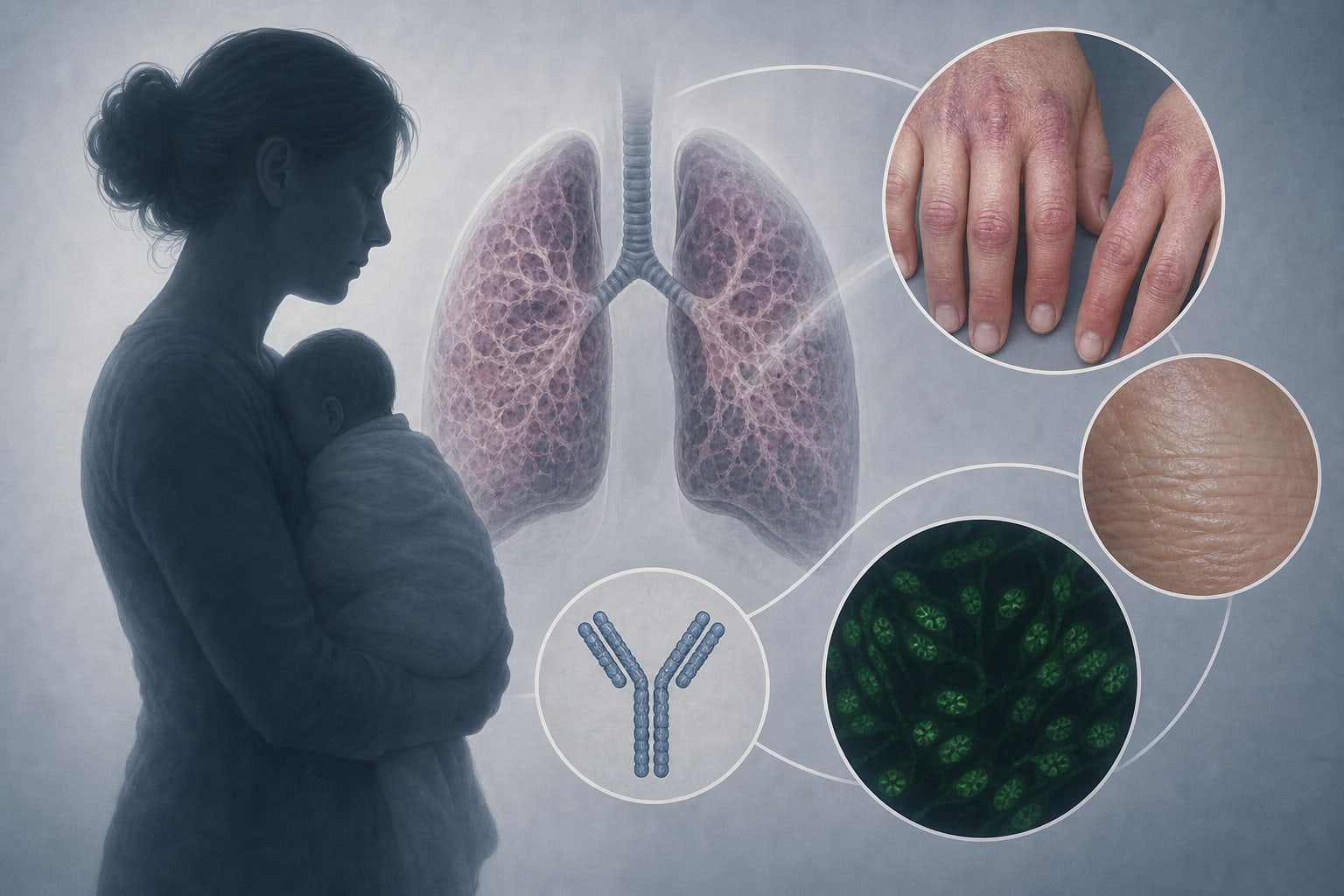
Circulating Biomarker Profiles Associated with Skin, Lung, and Gastrointestinal Involvement in Systemic Sclerosis
-
By
-
Huichen Luo
-
Danhui Hu
-
July 17, 2026
Clinical Report: Circulating Biomarker Profiles in Systemic Sclerosis
Overview
This study characterizes circulating biomarker patterns associated with skin, lung, and gastrointestinal involvement in systemic sclerosis (SSc).
Background
Systemic sclerosis (SSc) is a complex autoimmune disease that affects multiple organ systems, often leading to significant morbidity. Understanding the biomarker profiles associated with varying degrees of organ involvement can enhance clinical assessment and management strategies. This study aims to elucidate the relationship between organ burden and circulating biomarkers in SSc.
Data Highlights
| Group | Anti-Scl-70 Positivity | hs-CRP (mg/L) | Albumin (g/L) |
|---|---|---|---|
| 0-Axis | 51.4% | 4.50 [1.79–12.03] | 34.30 [31.80–37.50] |
| 1-Axis | 71.9% | 9.60 [3.13–19.40] | 31.70 [27.10–33.60] |
| 2-Axis | 83.1% | 9.60 [3.13–19.40] | 31.70 [27.10–33.60] |
| 3-Axis | 91.3% | 9.60 [3.13–19.40] | 31.70 [27.10–33.60] |
Key Findings
- Anti-Scl-70 positivity increased across burden groups, from 51.4% in the 0-Axis group to 91.3% in the 3-Axis group (p<0.001).
- hs-CRP levels were higher in the 2-Axis group compared to the 1-Axis group (9.60 vs 4.50 mg/L, p=0.012).
- Albumin levels decreased with increasing burden, being lower in the 3-Axis group than in the 0-Axis group (31.70 vs 34.30 g/L, p=0.005).
- In adjusted models, Anti-Scl-70 positivity was significantly associated with higher burden groups (OR 3.86 for 2-Axis vs 0-Axis; OR 12.78 for 3-Axis vs 0-Axis).
- Lower albumin was associated with higher burden groups (OR 0.52 for 2-Axis vs 0-Axis; OR 0.38 for 3-Axis vs 0-Axis).
- Unsupervised clustering identified three biomarker-defined clusters with differing axis-burden distributions.
Clinical Implications
The findings provide data on the association of Anti-Scl-70 positivity and albumin levels with the extent of organ involvement in SSc.
Conclusion
This study highlights the structured biomarker patterns associated with increasing organ involvement in systemic sclerosis.
Related Resources & Content
- Clinical Rheumatology, 2024 -- Biomarkers Indicating Pathogenesis, Clinical Features, and Therapeutic Strategies in Systemic Sclerosis: A Comprehensive Review
- conexiant, 2024 -- Anti-CD146 Linked to Silica in Systemic Sclerosis
- Clinical Rheumatology, 2026 -- Longitudinal clinical response to Janus kinase inhibitors in systemic sclerosis: a real-life multicentric study across multiple clinical domains
- Clinical Rheumatology, 2026 -- Identification of Th17-associated genes PGAP1 and TMBIM1 as promising biomarkers for diagnosis and prognosis in systemic sclerosis: Insights from bioinformatics and murine studies
- ERS/EULAR clinical practice guidelines for connective tissue disease-associated interstitial lung disease | European Respiratory Society, 2026
- ERS/EULAR clinical practice guidelines for connective tissue disease-associated interstitial lung disease | European Respiratory Society
- Interstitial lung disease biomarkers: a systematic review and meta-analysis - PubMed
This content is an AI-generated, fully rewritten summary based on a published scholarly article. It does not reproduce the original text and is not a substitute for the original publication. Readers are encouraged to consult the source for full context, data, and methodology.