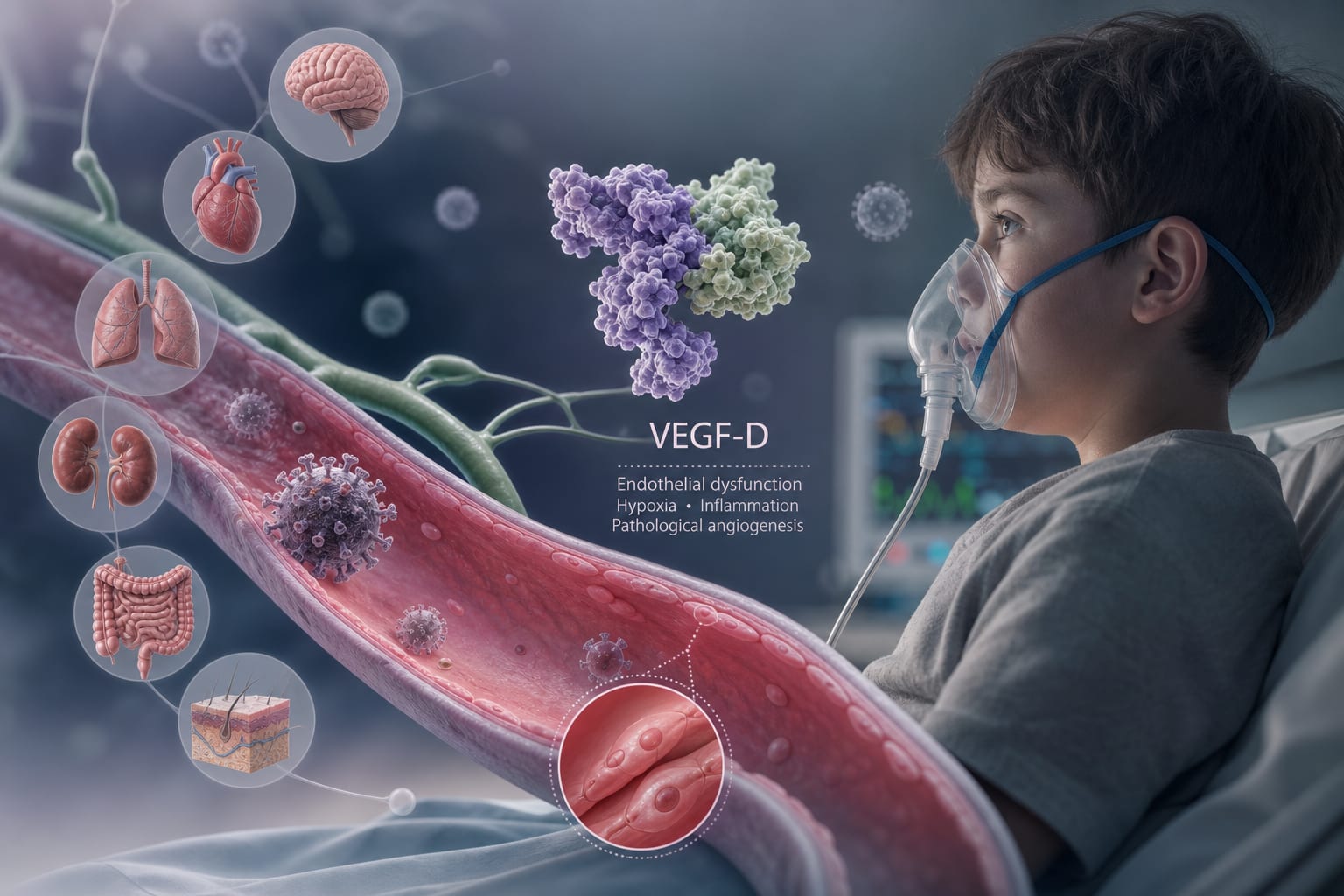
Evaluating the Role of Vascular Endothelial Growth Factor D in Assessing Severity of Pediatric COVID-19 and Multisystem Inflammatory Syndrome in Children
-
By
-
Kateryna Kozak
-
Halyna Pavlyshyn
-
July 8, 2026
Clinical Report: Evaluating the Role of Vascular Endothelial Growth Factor D in Assessing Severity of Pediatric COVID-19 and Multisystem Inflammatory Syndrome in Children
Overview
This study investigates the role of vascular endothelial growth factor D (VEGF-D) as a biomarker for assessing the severity of COVID-19 and multisystem inflammatory syndrome in children (MIS-C). Findings indicate that VEGF-D levels are significantly elevated in affected children compared to healthy controls.
Background
The emergence of COVID-19 and its associated complications, particularly MIS-C, has raised concerns regarding effective biomarkers for disease severity in pediatric populations. VEGF-D has been identified as a potential indicator of endothelial dysfunction and inflammation, which are critical in the pathophysiology of severe COVID-19 and MIS-C.
Data Highlights
| Group | VEGF-D Levels (pg/ml) |
|---|---|
| COVID-19 | 325.61 (189.93; 535.85) |
| MIS-C | 920.92 (473.45; 1157.70) |
| Control | 195.88 (115.58; 256.70) |
Key Findings
- VEGF-D levels were significantly higher in children with COVID-19 and MIS-C compared to healthy controls.
- The highest VEGF-D levels were observed in patients with MIS-C and severe COVID-19.
- Multivariable logistic regression analysis indicated that VEGF-D is independently associated with severe COVID-19 and MIS-C.
- Clinically relevant cut-off values for VEGF-D were established: 387.87 pg/mL for severe COVID-19 and 461.96 pg/mL for differentiating MIS-C from acute COVID-19.
- Increased VEGF-D levels correlated with more severe hypoxia and higher acute-phase markers in COVID-19 patients.
- Principal component analysis suggested that VEGF-D contributes to an integrated inflammatory-endothelial profile in both conditions.
Clinical Implications
VEGF-D could serve as a biomarker for assessing disease severity in pediatric patients with COVID-19 and MIS-C.
Conclusion
VEGF-D is identified as an independent marker associated with disease severity in pediatric COVID-19 and MIS-C.
Related Resources & Content
- International Journal of Infectious Diseases, 2023 -- Incidence trends, outcomes, and factors associated with mortality in multisystem inflammatory syndrome in children: A nationwide study in Thailand during 2021-2023
- Pediatric Cardiology, 2025 -- Distinguishing Kawasaki Disease from Multisystem Inflammatory Syndrome in Pediatric Patients Through Blood Composite Scores: Implications for Clinical Outcomes and Predictive Measures
- Infection, 2023 -- Assessment of TRAIL, IP-10, and CRP Levels in Pediatric Patients with Suspected COVID-19 and the Influence of a Computational Signature on Clinical Decision-Making: A Prospective Cohort Investigation
- Clinical Rheumatology, 2022 -- Differentiating Multisystem Inflammatory Syndrome in Children from Kawasaki Disease: A Scoring System Developed from an Inception Cohort Analysis
- Clinical Overview of Multisystem Inflammatory Syndrome in Children | MIS | CDC, 2025
- Six-Month Outcomes in Children With COVID-19 or Multisystem Inflammatory Syndrome in Children | Hospital Pediatrics, 2026
- Frontiers, 2026 -- Diagnostic Performance of Vascular Endothelial Growth Factor D in Severity Stratification of Pediatric COVID-19 and Multisystem Inflammatory Syndrome in Children (MIS-C)
- Clinical Overview of Multisystem Inflammatory Syndrome in Children | MIS | CDC
- Six-Month Outcomes in Children With COVID-19 or Multisystem Inflammatory Syndrome in Children | Hospital Pediatrics | American Academy of Pediatrics
- Frontiers | Diagnostic Performance of Vascular Endothelial Growth Factor D in Severity Stratification of Pediatric COVID-19 and Multisystem Inflammatory Syndrome in Children (MIS-C)
Based on findings from:
Diagnostic performance of vascular endothelial growth factor D in severity stratification of pediatric COVID-19 and multisystem inflammatory syndrome in children
Kateryna Kozak, Halyna Pavlyshyn. Frontiers In Immunology, 2026.
https://www.frontiersin.org/journals/immunology/articles/10.3389/fimmu.2026.1799910/full
This content is an AI-generated, fully rewritten summary based on a published scholarly article. It does not reproduce the original text and is not a substitute for the original publication. Readers are encouraged to consult the source for full context, data, and methodology.