Integrative and interpretable machine learning framework for early non-invasive detection of clinically significant liver fibrosis - Report - MDSpire

Integrative and interpretable machine learning framework for early non-invasive detection of clinically significant liver fibrosis

  • By

  • Dong Cao

  • Junjie Wang

  • Chenxi Hou

  • Jingyu Zeng

  • Baiyue Tian

  • Yuan Liu

  • Xing Luo

  • Jiaxin Tian

  • Mingbo Zhou

  • Pan Li

  • Huilong Fang

  • Ze Liu

  • Zheng Gong

  • June 23, 2026

  • 0 min

Share

Clinical Report: Machine Learning for Early Identification of Liver Fibrosis

Overview

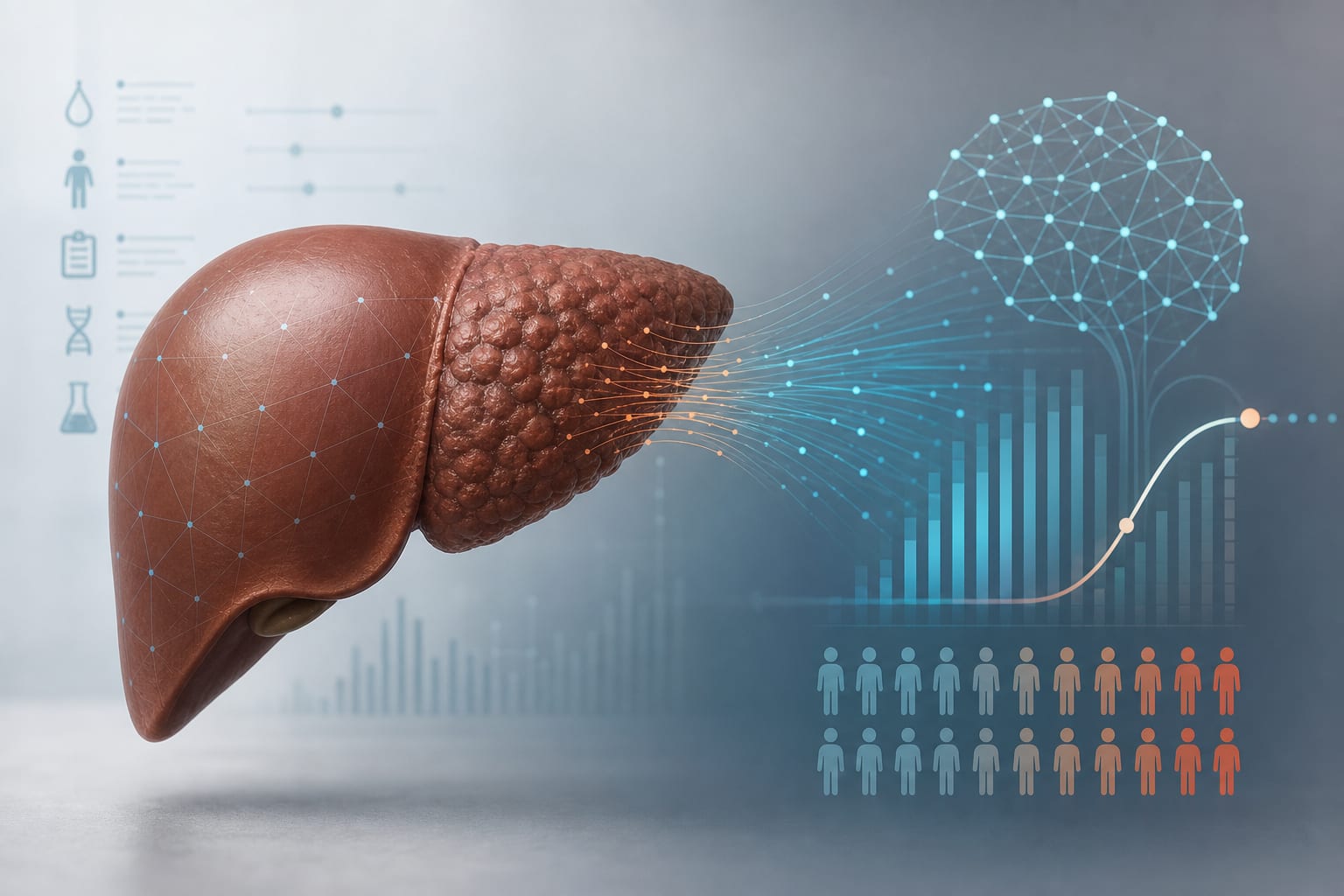
This study developed a machine learning model for the early identification of clinically relevant liver fibrosis using NHANES data. The Gamboost model demonstrated strong predictive performance, achieving an AUC of 0.872 in the testing cohort.

Background

Liver fibrosis is a critical indicator of chronic liver disease progression, potentially leading to severe complications such as cirrhosis and hepatocellular carcinoma. Early detection is essential for timely intervention and management, yet existing diagnostic methods often rely on invasive techniques with limited accuracy.

Data Highlights

Model PerformanceAUC95% CI
Training Cohort0.8240.798–0.849
Testing Cohort0.8720.838–0.905
External Validation0.8480.798–0.898

Key Findings

  • The Gamboost model was selected for its efficacy in predicting liver fibrosis.
  • Primary predictors included body mass index (BMI), aspartate aminotransferase (AST), and waist circumference (WC).
  • The model achieved an AUC of 0.872 in the testing cohort, indicating strong predictive performance.
  • SHAP and PDP analyses showed that increased AST and WC raised the estimated risk of fibrosis.
  • The model's reliability was confirmed with an external dataset of 684 samples.

Clinical Implications

The interpretable machine learning model can be utilized for the non-invasive detection of liver fibrosis using commonly available clinical data.

Conclusion

The study presents a machine learning approach for the early identification of liver fibrosis.

Related Resources & Content

  1. European Radiology, 2026 -- Development and validation of a deep learning model for liver shear stiffness regression using abdominal multiparametric MRI across multiple sites and vendors
  2. Frontiers in Immunology, 2026 -- Identification of mitochondria-related biomarkers in liver fibrosis via interpretable machine learning and WGCNA: transcriptomic analysis and In Vivo validation
  3. European Radiology, 2026 -- Noninvasive prediction of severe histopathology in drug-induced liver injury using a dual elastography-based machine learning model
  4. Noninvasive Liver Disease Assessment | AASLD
  5. Global Bivariate Meta‐Analysis of FIB‐4 Cut‐Offs to Rule Out Advanced Fibrosis in MASLD - Ghosal - 2026 - International Journal of Hepatology
  6. the asco post — AI-Backed Liquid Biopsies Identify Liver Diseases
  7. AI-Backed Liquid Biopsies Identify Liver Diseases
  8. Noninvasive Liver Disease Assessment | AASLD
  9. Global Bivariate Meta‐Analysis of FIB‐4 Cut‐Offs to Rule Out Advanced Fibrosis in MASLD - Ghosal - 2026 - International Journal of Hepatology - Wiley Online Library
  10. FIB-4-based Referral Pathways Have Suboptimal Accuracy to identify Increased Liver Stiffness and Incident Advanced Liver Disease - ScienceDirect

Original Source(s)

Related Content