Feasibility study examining the short-term effects of Sonic Augmentation Technology™ - Report - MDSpire

Feasibility study examining the short-term effects of Sonic Augmentation Technology™

  • By

  • Lourdes P. Dale

  • Audrey N. Dana

  • Carrie E. Lee

  • Hannah Lamont

  • Donnalea Van Vleet Goelz

  • Caitlin V. Dale

  • Parmida Nazarloo

  • Mark McIntosh

  • Steven P. Cuffe

  • June 8, 2026

  • 0 min

Share

Clinical Report: Assessment of the Immediate Impact of Sonic Augmentation Technology™

Overview

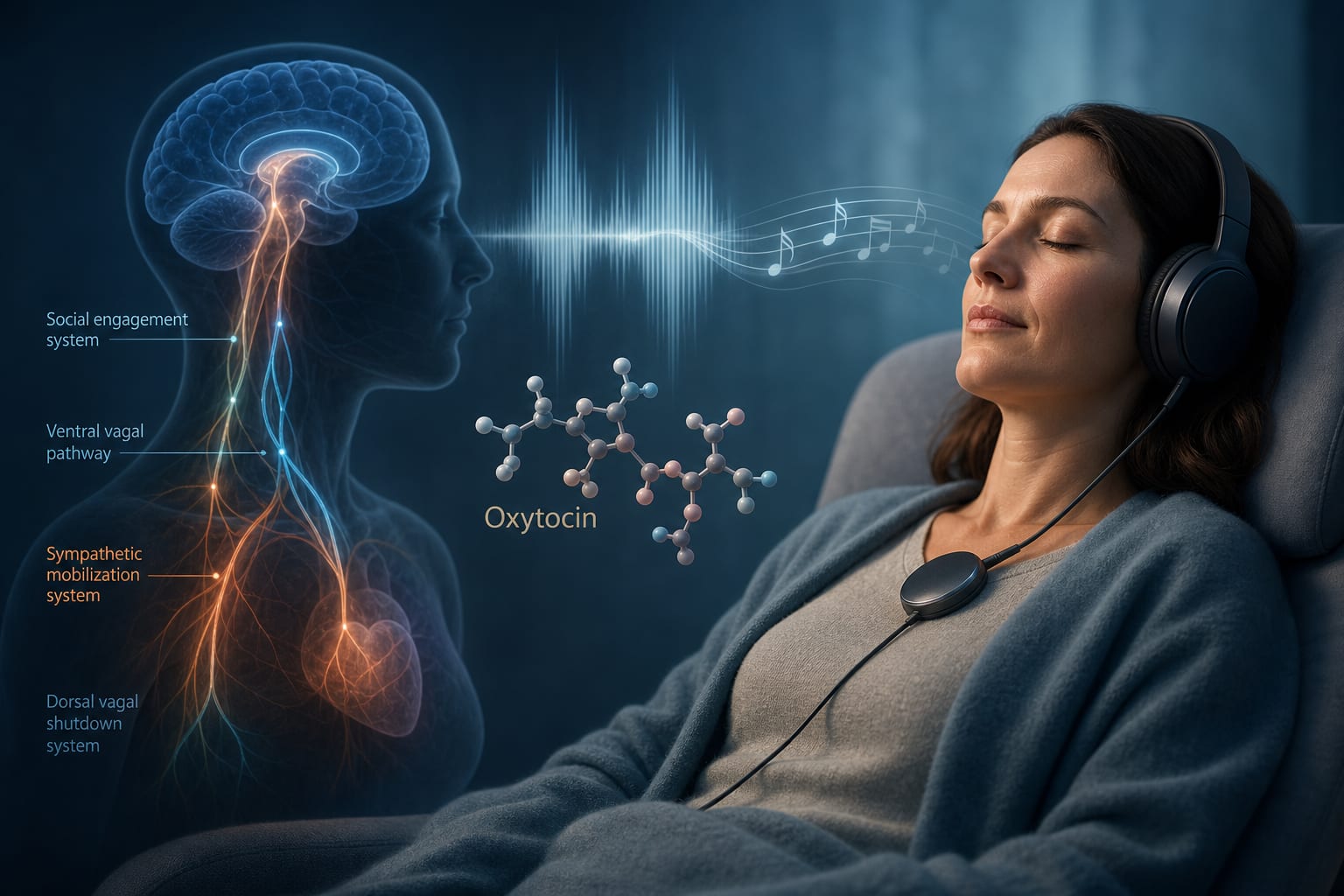
The study evaluated Sonic Augmentation Technology™ (SAT) and its effects on self-reported biobehavioral states and salivary oxytocin levels. Participants with higher baseline anxiety and depression showed greater improvements in biobehavioral states post-intervention.

Background

Sonic Augmentation Technology™ represents an innovative approach to enhancing wellbeing through auditory stimulation. Given the increasing prevalence of anxiety and depression, particularly in clinical populations, exploring non-invasive interventions like SAT is crucial for improving patient outcomes. This study contributes to the understanding of how structured sound can influence autonomic regulation and emotional health.

Data Highlights

MeasureOutcome
Total Biobehavioral StateSignificant improvement post-SAT
High Arousal SubscaleDecreased in participants with anxiety
Low Arousal SubscaleGreater decreases in anxious participants
Salivary OxytocinIncreased in subset of participants

Key Findings

  • SAT led to significant improvements in total biobehavioral state.
  • Participants with higher baseline anxiety and depression reported greater improvements post-SAT.
  • Salivary oxytocin levels increased in participants who completed the study in person.
  • Improvements were noted in both low and high arousal subscales of biobehavioral state.
  • Participants with autonomic reactivity showed greater decreases in high arousal symptoms.

Clinical Implications

Sonic Augmentation Technology™ may serve as a valuable adjunctive intervention for patients experiencing anxiety and depression. Its non-invasive nature and potential for rapid autonomic down-regulation make it a promising tool in clinical settings focused on enhancing patient wellbeing.

Conclusion

The findings support the use of SAT as a low-cost, non-invasive auditory intervention to improve biobehavioral states, particularly in individuals with autonomic dysregulation. Further research is warranted to establish its efficacy and broader applications.

Related Resources & Content

  1. Frontiers, 2026 -- Feasibility Study Examining the Short-Term Effects of Sonic Augmentation Technology™
  2. Society for Integrative Oncology–ASCO Guideline, 2023 -- Integrative Oncology Care of Symptoms of Anxiety and Depression in Adults With Cancer
  3. Innovative Microscope-Enhanced Visual Interface and Nasopharyngeal Mapping for Auditory Brainstem Implantation: A Feasibility Assessment in an Ex Vivo Setting
  4. In-vitro Quantitative Evaluation of an Innovative Robot-Assisted System for Inserting Cochlear Implant Electrodes
  5. Preliminary Insights from Surgical Experience with a Novel Implantable Epicranial Stimulation Device for Chronic Focal Cortex Stimulation in Patients with Drug-Resistant Epilepsy
  6. npj Digital Medicine — A randomized controlled study evaluating a WeChat-integrated AI system for postoperative management in orthopedic patients
  7. Sonic Augmentation Technology Overview
  8. Integrative Oncology Care of Symptoms of Anxiety and Depression in Adults With Cancer: Society for Integrative Oncology–ASCO Guideline | Journal of Clinical Oncology
  9. The Effect of Slow-Paced Breathing on Cardiovascular and Emotion Functions: A Meta-Analysis and Systematic Review | Mindfulness | Springer Nature Link

Original Source(s)

Related Content