Diagnosis and treatment of multiple postoperative fistulas following resection of a giant abdominal mesenteric fibromatosis: a case report and literature review - Report - MDSpire

Diagnosis and treatment of multiple postoperative fistulas following resection of a giant abdominal mesenteric fibromatosis: a case report and literature review

  • By

  • Weihua Zheng

  • Junjie Lu

  • Shuai Jiang

  • Fan Zhang

  • Long Xia

  • Junjing Zhang

  • June 2, 2026

  • 0 min

Share

Management and Diagnosis of Multiple Postoperative Fistulas After Resection of a Giant Abdominal Mesenteric Fibromatosis

Overview

This case study details the management of a patient with giant mesenteric fibromatosis who developed multiple postoperative fistulas after radical resection. The multidisciplinary approach included personalized management strategies.

Background

Mesenteric fibromatosis is a rare tumor with a high recurrence rate and significant surgical challenges. Its aggressive nature and potential for complications necessitate careful management.

Data Highlights

No numerical data or trial data provided in the article.

Key Findings

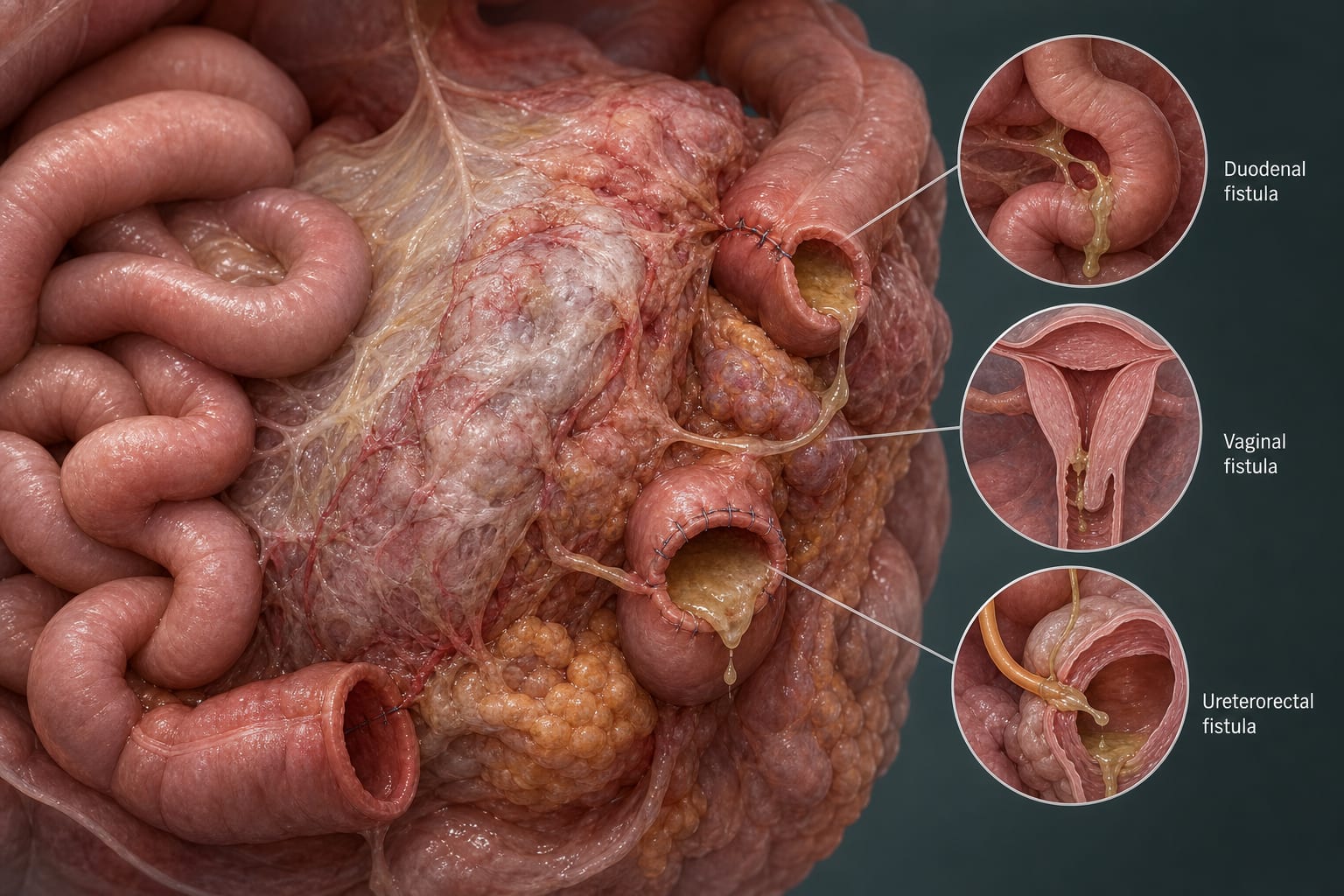
['The patient experienced rapid tumor progression despite targeted therapy.', 'Postoperative complications included duodenal, vaginal, and ureterorectal fistulas.', 'A multidisciplinary team approach was essential for managing complex complications.', 'Stepwise nutritional support was implemented, transitioning from total parenteral nutrition to enteral nutrition.', 'Close imaging surveillance is recommended for early detection of complications.']

Clinical Implications

The case highlights the management of giant mesenteric fibromatosis, particularly when traditional therapies fail.

Conclusion

This case underscores the complexities involved in managing giant mesenteric fibromatosis and the necessity of a tailored, multidisciplinary approach to improve patient outcomes.
Related Resources & Content

  1. Management Approaches for 135 Patients with Enterocutaneous Fistulas, International Journal of Colorectal Disease, 2007 -- Management Approaches for 135 Patients with Enterocutaneous Fistulas
  2. Robotic En Bloc Resection for Transverse Colon Carcinoma Complicated by a Malignant Colojejunal Fistula: A Case Study, International Journal of Colorectal Disease, 2026 -- Robotic En Bloc Resection for Transverse Colon Carcinoma Complicated by a Malignant Colojejunal Fistula
  3. Systematic Review of Gastrocolic Fistula Incidence Linked to Staple Line Leakage After Metabolic Bariatric Surgery, Obesity Surgery, 2025 -- Systematic Review of Gastrocolic Fistula Incidence Linked to Staple Line Leakage After Metabolic Bariatric Surgery
  4. Prospective Analysis of Laparoscopic Fistula Excision and Omentoplasty in 40 Patients with High Rectovaginal Fistulas
  5. Current Management of Desmoid Tumors
  6. Efficacy and Safety of Long-Term Continuous Nirogacestat Treatment in Adults With Desmoid Tumors: Results From the DeFi Trial | Journal of Clinical Oncology
  7. Real-word experience of pazopanib and sorafenib in patients with desmoid tumors: A CanSaRCC multi-center study
  8. Efficacy and safety of systemic treatment for progressive and refractory desmoid tumor: a systematic review and Bayesian network meta-analysis - PMC
  9. FDA approves nirogacestat for desmoid tumors | FDA
  10. IDSA 2024 Guideline Update on the Risk Assessment, Diagnostic Imaging, and Microbiological Evaluation of Complicated Intra-abdominal Infections in Adults, Children, and Pregnant People
  11. The Surgical Infection Society Guidelines on the Management of Intra-Abdominal Infection: 2024 Update - PubMed
  12. Clinical Nutrition 42 (2023) 1940e2021
  13. Entero-Cutaneous and Entero-Atmospheric Fistulas: Insights into Management Using Negative Pressure Wound Therapy
  14. Enterocutaneous Fistula Workup: Laboratory Studies, Imaging Studies, Other Tests

Original Source(s)

Related Content