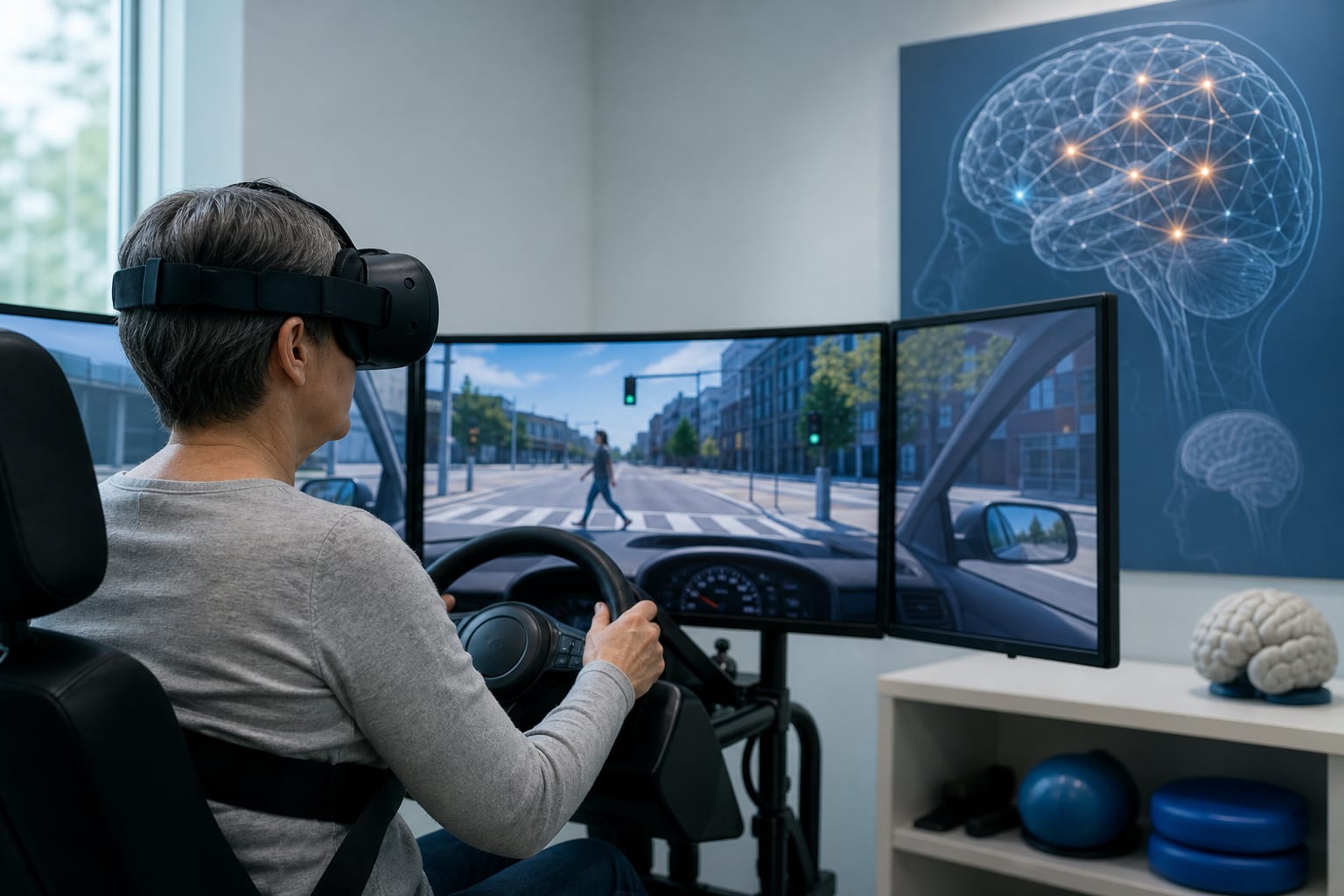
On the Road Again: Virtual Reality for Poststroke Rehabilitation
-
By
-
Jenna Congdon
-
July 13, 2026
Clinical Report: The Role of Virtual Reality in Rehabilitation After Stroke
Overview
Virtual reality (VR) driving simulators are beneficial for stroke survivors, aiding in the recovery of cognitive, visual, and motor skills necessary for driving. However, access to VR rehabilitation is limited due to various barriers including cost and insurance coverage.
Background
Stroke is a leading cause of disability, significantly impacting motor function and independence. Rehabilitation is crucial for recovery, and innovative approaches like VR are being explored to enhance traditional methods.
Data Highlights
No numerical data or trial data provided in the source material.
Key Findings
- VR driving simulators assist stroke survivors in regaining driving skills.
- VR rehabilitation promotes neuroplasticity through tailored, repeated practice.
- Barriers to VR rehabilitation include cost, availability, and insurance coverage.
- Driving requires complex cognitive and motor skills, which can be affected by stroke.
Clinical Implications
Healthcare professionals should consider the barriers that limit access to VR rehabilitation.
Conclusion
Continued research and improved access to VR technologies are essential.
Related Resources & Content
- VA DoD CPG for Management of Stroke Rehabilitation, 2024 -- Clinical Practice Guidelines
- Recommendations | Canadian Stroke Best Practices, 2025 -- Stroke Rehabilitation Guidelines
- 2026 Guideline for the Early Management of Patients With Acute Ischemic Stroke, AHA/ASA -- Stroke Management Guidelines
- Frontiers in Neurology — The effect of non-immersive virtual reality on upper limb motor function and activities of daily living in stroke patients: a systematic review and meta-analysis
- Frontiers in Neurology — Advancing rehabilitation in Parkinson’s disease through virtual reality: a narrative review
- DIGITAL HEALTH — Exploring person-centredness in technology-based gait rehabilitation after stroke: A scoping review framework analysis
- DIGITAL HEALTH — Psychometric assessment of a driving simulation task performed using an immersive virtual reality in cardiovascular rehabilitation: A randomized controlled trial
- The effect of non-immersive virtual reality on upper limb motor function and activities of daily living in stroke patients: a systematic review and meta-analysis
- Advancing rehabilitation in Parkinson’s disease through virtual reality: a narrative review
- Exploring person-centredness in technology-based gait rehabilitation after stroke: A scoping review framework analysis
- VA DoD CPG for Management of Stroke Rehabilitation
- Recommendations | Canadian Stroke Best Practices
- 2026 Guideline for the Early Management of Patients With Acute Ischemic Stroke: A Guideline From the American Heart Association/American Stroke Association
- Virtual reality for stroke rehabilitation | Cochrane
- The effectiveness of virtual reality/motion-sensing games incorporating swing-based elements on upper limb function after stroke: a systematic review and meta-analysis | BMC Neurology | Springer Nature Link
- Journal of Medical Internet Research - Effect of Virtual Reality–Based Therapies on Lower Limb Functional Recovery in Stroke Survivors: Systematic Review and Meta-Analysis
- Guidelines for Adult Stroke Rehabilitation and Recovery | Stroke
This content is an AI-generated, fully rewritten summary based on a published scholarly article. It does not reproduce the original text and is not a substitute for the original publication. Readers are encouraged to consult the source for full context, data, and methodology.