Risk factors for thrombosis in tuberculosis patients admitted to a tuberculosis-dedicated intensive care unit: a retrospective cohort study - Report - MDSpire

Risk factors for thrombosis in tuberculosis patients admitted to a tuberculosis-dedicated intensive care unit: a retrospective cohort study

  • By

  • Aifeng Liu

  • Yuewen Qiu

  • Hongmei Chen

  • Xiaohua Ma

  • June 30, 2026

  • 0 min

Share

Clinical Report: Identifying Thrombosis Risk Factors in Tuberculosis Patients

Overview

This study identifies independent risk factors for thrombus formation in tuberculosis patients in the ICU, highlighting advanced age and prolonged APTT as significant predictors. It evaluates the role of inflammatory biomarkers in predicting thrombosis risk.

Background

Patients with tuberculosis in the ICU are at an increased risk of thrombosis. Understanding the risk factors for thrombus formation in this population is crucial. This study addresses a gap in knowledge regarding the specific risk factors and the role of inflammatory biomarkers in critically ill tuberculosis patients.

Data Highlights

FactorOdds Ratio (OR)p-value
Age1.0570.001
APTT1.0530.041
Fungal co-infection3.1850.006
Non-TB bacterial co-infection0.3360.038

Key Findings

  • Advanced age is an independent predictor of thrombus formation (OR = 1.057, p = 0.001).
  • Prolonged APTT is also an independent predictor (OR = 1.053, p = 0.041).
  • Fungal co-infection significantly increases thrombotic risk (OR = 3.185, p = 0.006).
  • Non-TB bacterial co-infection shows a paradoxical protective effect (OR = 0.336, p = 0.038).
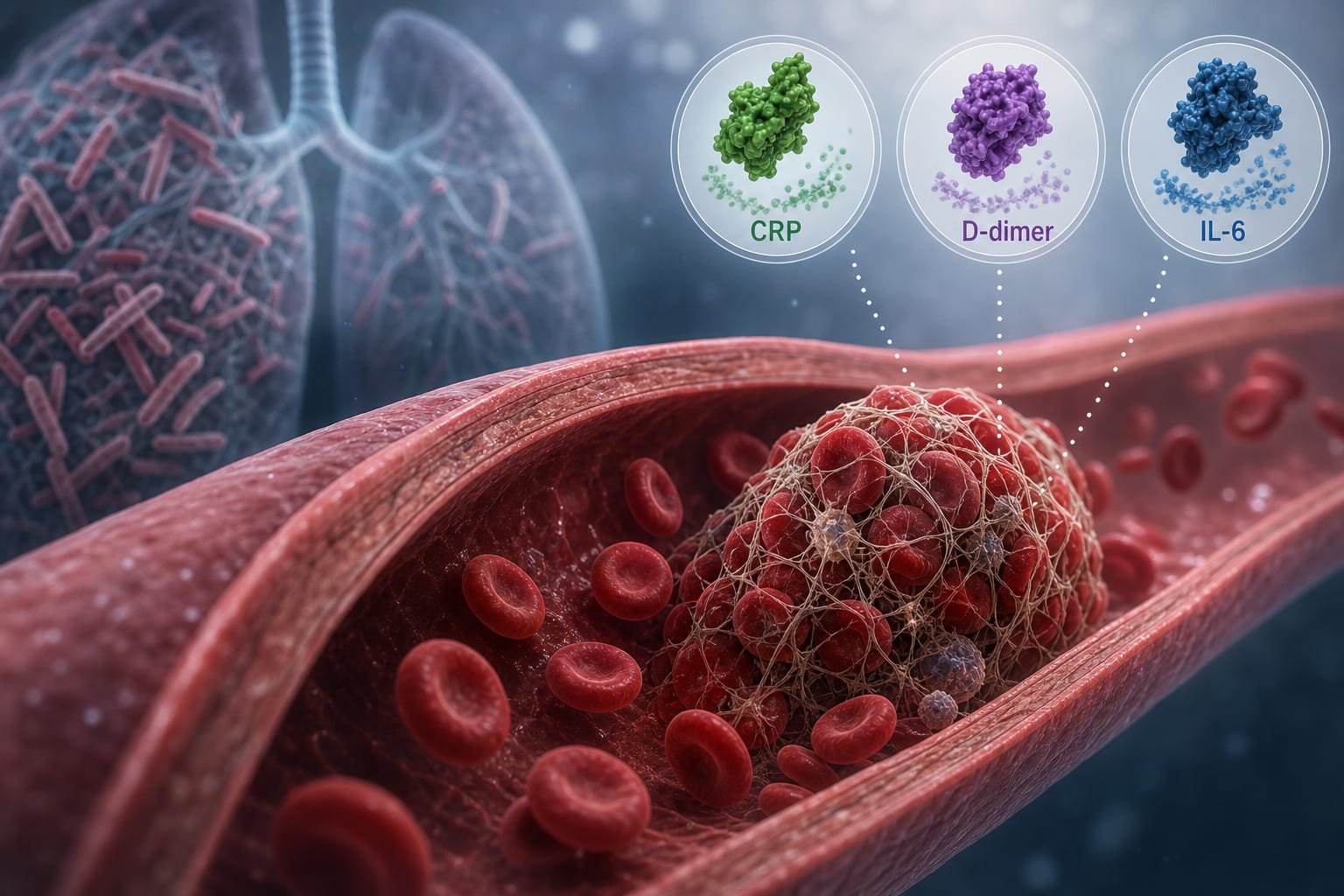
  • The addition of inflammatory biomarkers (CRP, DDR, IL-6) did not significantly improve the predictive model's performance (all p > 0.05).
  • CRP is independently associated with IL-6 levels (β = 0.423, p < 0.001).

Clinical Implications

Clinicians should consider advanced age and prolonged APTT when assessing thrombosis risk in tuberculosis patients in the ICU.

Conclusion

Age and APTT are critical factors in predicting thrombus formation among tuberculosis patients in the ICU.

Related Resources & Content

  1. Open Forum Infectious Diseases, 2023 -- Incidence of Tuberculosis Disease in a Major Integrated Healthcare System in California from 2004 to 2022
  2. Infection, 2020 -- Alterations in T-lymphocyte Populations and Associated Risk Factors in HIV-Negative Individuals with Active Tuberculosis
  3. Infection, 2024 -- Prevalence and Contributing Factors of HIV-Tuberculosis Coinfection in the Cologne–Bonn Area: A Retrospective Cohort Analysis
  4. American Society of Hematology, 2018 -- Guidelines for management of venous thromboembolism: prophylaxis for hospitalized and nonhospitalized medical patients
  5. Hypercoagulability in Tuberculosis: Pathophysiological Mechanisms, Associated Risks, and Advances in Management—A Narrative Review, 2023
  6. Infection — Variability in Clinical Presentation and Treatment Outcomes of Extrapulmonary Tuberculosis in a Low-Incidence Area: Findings from a Prospective Cohort Analysis
  7. American Society of Hematology 2018 guidelines for management of venous thromboembolism: prophylaxis for hospitalized and nonhospitalized medical patients - PMC
  8. Hypercoagulability in Tuberculosis: Pathophysiological Mechanisms, Associated Risks, and Advances in Management—A Narrative Review - PMC

Original Source(s)

Related Content