Interpretable detection of left ventricular hypertrophy using commercial ECG features and machine learning: a study based on the PTB-XL+ dataset - Report - MDSpire
Advertisement
Interpretable detection of left ventricular hypertrophy using commercial ECG features and machine learning: a study based on the PTB-XL+ dataset
Clinical Report: Interpretable Identification of Left Ventricular Hypertrophy Utilizing Commercial ECG Features and Machine Learning
Overview
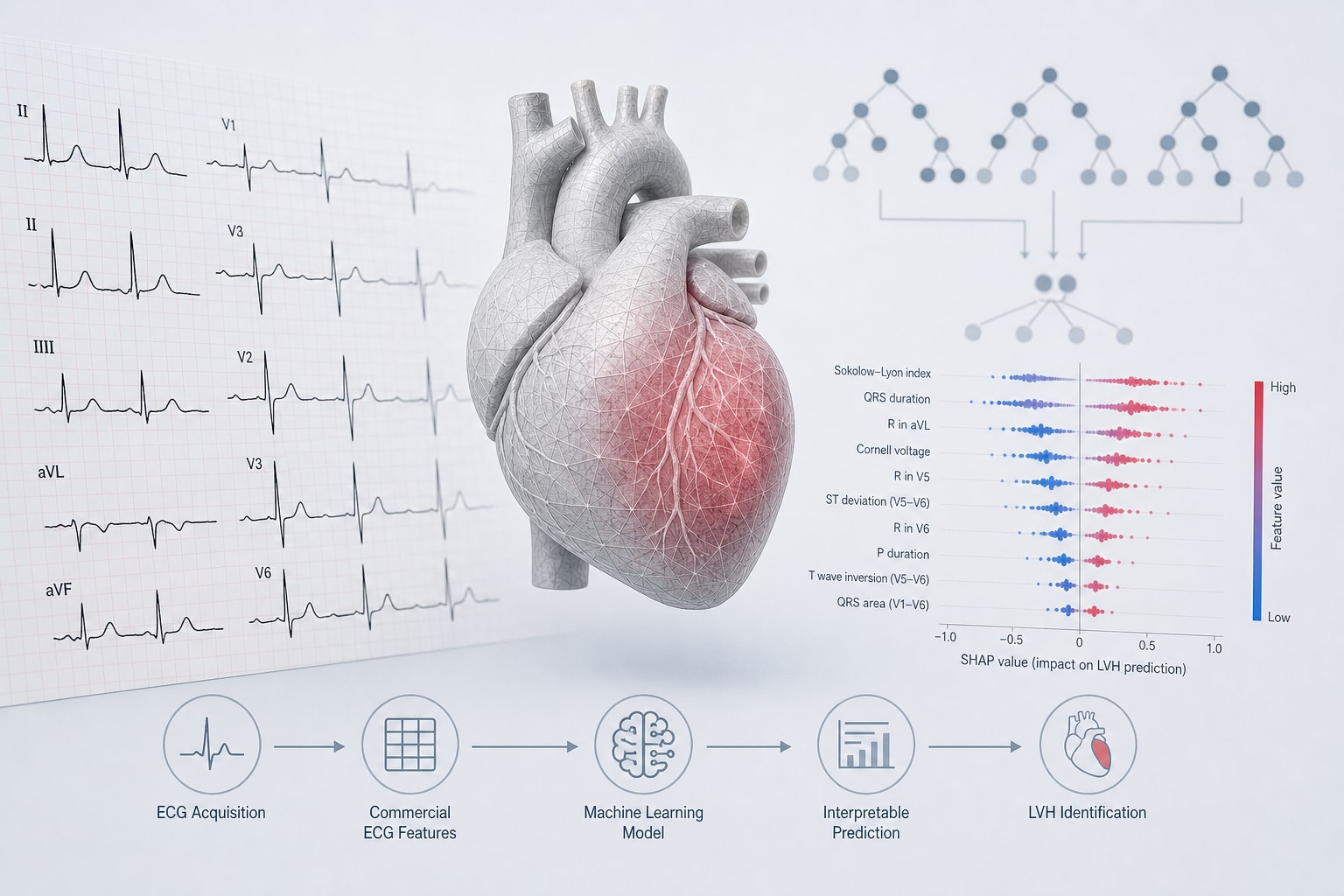
This study evaluates the use of pre-extracted commercial ECG features for interpretable detection of left ventricular hypertrophy (LVH) using machine learning. The XGBoost classifier achieved high performance in LVH detection, with significant interpretability through SHAP analysis.
Background
Left ventricular hypertrophy (LVH) is a critical risk factor for various cardiovascular events, making its early detection essential. Traditional ECG methods for LVH diagnosis have low sensitivity. The PTB-XL+ dataset provides a resource for improving ECG-based LVH detection through interpretable machine learning techniques.
Data Highlights
Classifier
AUC
XGBoost (12SL)
0.9859
XGBoost (UNIG)
0.9853
XGBoost (ECGDeli)
0.9828
Key Findings
XGBoost classifier demonstrated the highest AUC for LVH detection among evaluated classifiers.
Commercial ECG features slightly outperformed open-source ECGDeli features.
Key features identified by SHAP analysis included V5–V6 T-wave changes and precordial R-wave amplitude.
Age was recognized as an important non-ECG predictor of LVH.
Traditional ECG criteria for LVH have low sensitivity.
Clinical Implications
The use of interpretable machine learning with commercial ECG features can enhance the detection of LVH in clinical settings.
Conclusion
Interpretable machine learning approaches utilizing commercial ECG features provide a method for enhancing LVH detection while maintaining clinical interpretability.