Survival prediction in colorectal cancer liver metastases using machine learning with SHAP-based interpretation - Report - MDSpire

Survival prediction in colorectal cancer liver metastases using machine learning with SHAP-based interpretation

  • By

  • Nan Li

  • Baoxin Dong

  • Yu Liang

  • Likun Liu

  • Xixing Wang

  • Ce Zhang

  • Shulan Hao

  • June 10, 2026

  • 0 min

Share

Clinical Report: Predicting Survival Outcomes in Liver Metastases from Colorectal Cancer

Overview

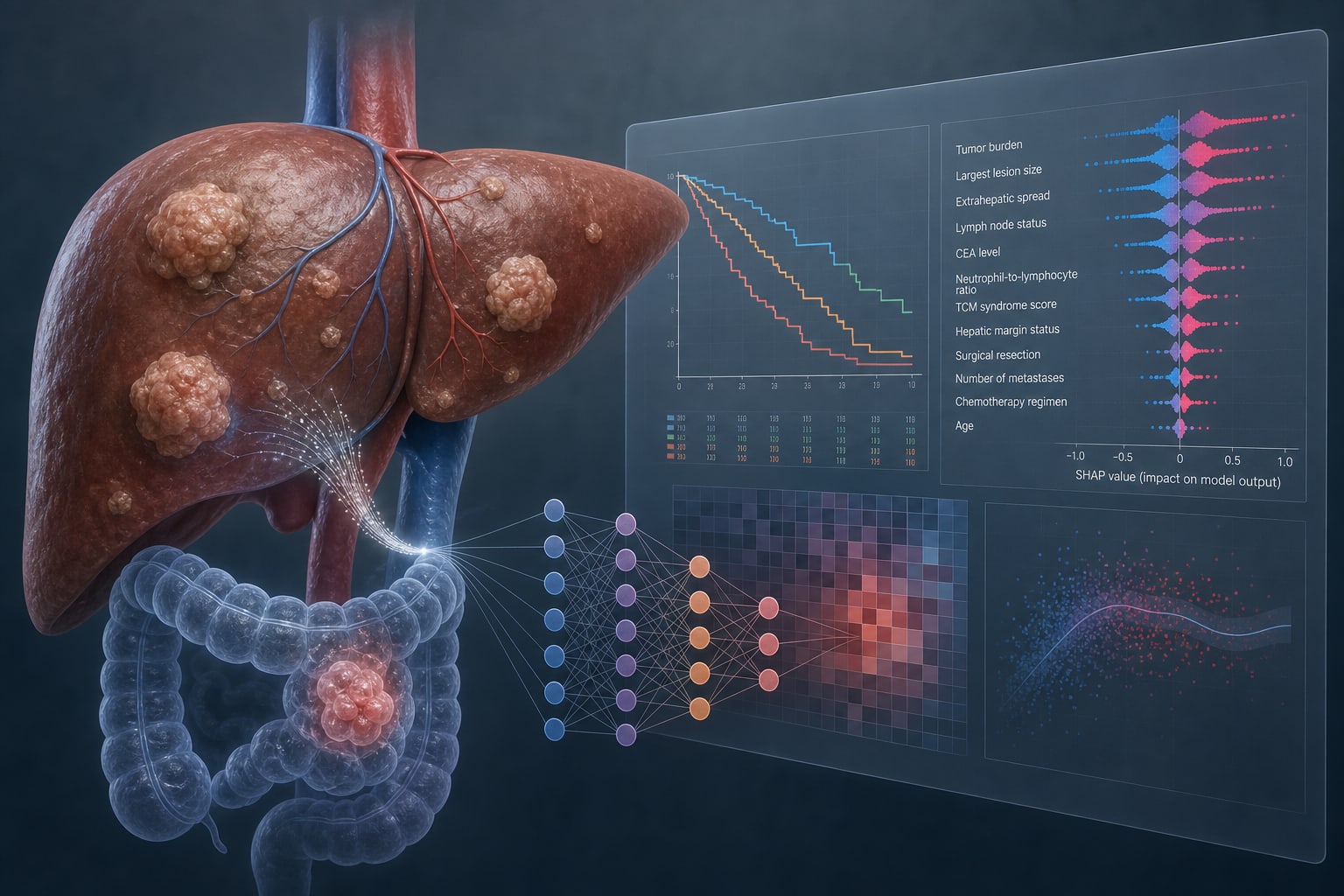
This study developed and validated a machine learning model to predict long-term survival in patients with colorectal cancer liver metastasis (CRLM). The model incorporates Traditional Chinese Medicine (TCM) interventions and demonstrates robust predictive performance, offering a web-based tool for individualized risk assessment.

Background

Colorectal cancer liver metastasis (CRLM) is a significant contributor to cancer-related mortality, with a five-year survival rate of less than 30%. Accurate prognostic tools are essential for tailoring treatment strategies and improving patient outcomes. Traditional models often fail to account for complex interactions among clinical variables and therapeutic interventions.

Data Highlights

ModelAUC (36-month)AUC (60-month)
XGBoost0.891 (training)0.833 (testing)

Key Findings

  • The optimized XGBoost model outperformed other machine learning algorithms in predicting survival.
  • SHAP analysis identified TNM stage, liver metastasis burden, and TCM intervention intensity as key prognostic factors.
  • TCM exposure showed a protective association with survival in a dose-dependent manner.
  • The model was validated with a temporal dataset, confirming its robustness and stability.
  • A web-based tool was developed for clinicians to input patient data and receive real-time risk estimates.

Clinical Implications

The machine learning model provides a novel approach to prognostic assessment in CRLM, integrating TCM interventions that may enhance survival outcomes. Clinicians can utilize this tool for personalized treatment planning and improved patient management.

Conclusion

The study successfully developed an interpretable machine learning model for predicting survival in CRLM patients, highlighting the potential benefits of integrating TCM into clinical practice. This model serves as a practical resource for enhancing individualized patient care.
Related Resources & Content

  1. Frontiers in Surgery, 2026 -- Perioperative machine learning models with SHAP interpretation for predicting adverse outcomes in breast cancer surgery
  2. the asco post, 2026 -- Machine Learning–Enhanced Prognostic Scoring Predicts Survival and Classifies Risk From Spinal Metastases
  3. npj Digital Medicine, 2025 -- Personalized Treatment Approaches Utilizing Artificial Intelligence for Unresectable Hepatocellular Carcinoma: Incorporating HSP90α for Prognostic Evaluation and Survival Forecasting
  4. European Radiology, 2026 -- Radiomics-based outcome prediction for irinotecan-TACE in colorectal liver metastases: advanced analysis from the prospective CIREL trial
  5. Metastatic colorectal cancer: ESMO Clinical Practice Guideline for diagnosis, treatment and follow-up - PubMed
  6. Perioperative FOLFOX4 chemotherapy and surgery versus surgery alone for resectable liver metastases from colorectal cancer (EORTC 40983): long-term results of a randomised, controlled, phase 3 trial - PubMed
  7. Frontiers | Radiofrequency ablation versus surgical resection in colorectal liver metastasis: insight from an umbrella review
  8. Metastatic colorectal cancer: ESMO Clinical Practice Guideline for diagnosis, treatment and follow-up - PubMed
  9. Perioperative FOLFOX4 chemotherapy and surgery versus surgery alone for resectable liver metastases from colorectal cancer (EORTC 40983): long-term results of a randomised, controlled, phase 3 trial - PubMed
  10. Frontiers | Radiofrequency ablation versus surgical resection in colorectal liver metastasis: insight from an umbrella review

Original Source(s)

Related Content