Rapid progression of recurrent intracranial solitary fibrous tumor following a previously reported TERT-wild-type primary tumor: a case report - Report - MDSpire
Coming Soon: Introducing MDSpire News. Learn more
Conexiant’s news site is now MDSpire News. Learn more

Accelerated Recurrence of Intracranial Solitary Fibrous Tumor After TERT-Wild-Type Primary Tumor: A Case Study

  • By

  • Longfei Shao

  • Chao Yang

  • Xukun Teng

  • Jianmin Yang

  • Jinyang Li

  • Yinghao Gu

  • Shuo Sun

  • September 8, 2026

Share

Clinical Report: Accelerated Recurrence of Intracranial Solitary Fibrous Tumor

Overview

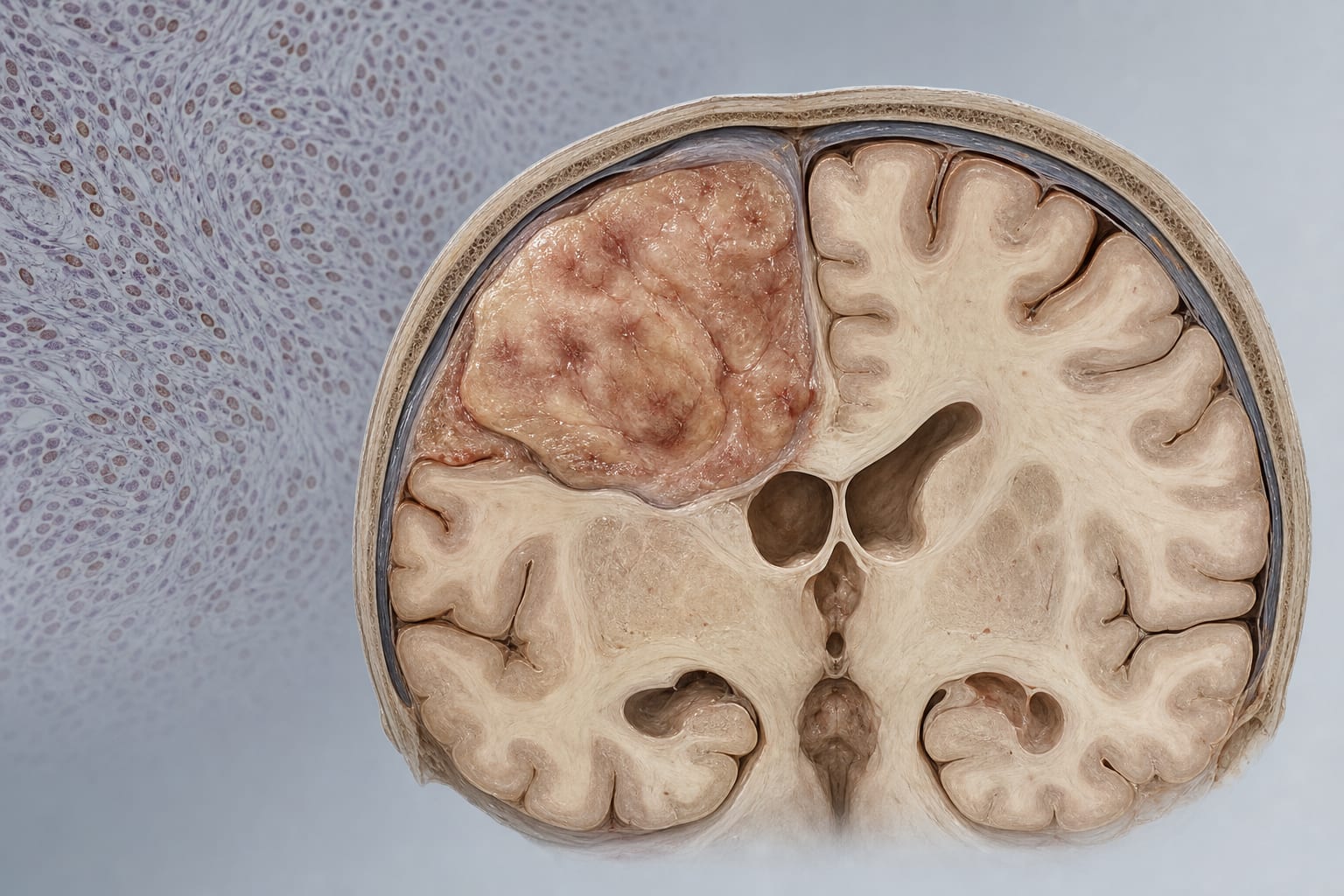
This case study presents a 70-year-old male with rapid recurrence of an intracranial solitary fibrous tumor (SFT) after a TERT-wild-type primary tumor.

Background

Intracranial solitary fibrous tumors are rare mesenchymal neoplasms, constituting approximately 0.09% of intracranial tumors. They are typically associated with TERT promoter mutations, which drive malignant progression.

Data Highlights

No numerical or trial data presented in the article.

Key Findings

  • The patient had a previously classified CNS WHO grade 2 SFT with a Ki-67 index of approximately 15%.
  • Upon recurrence, the tumor exhibited a Ki-67 index of 70% and up to 10 mitotic figures per 10 HPF.
  • Diffuse nuclear STAT6 expression was noted, supporting the diagnosis of recurrent SFT.
  • Imaging prior to surgery was misinterpreted as recurrent meningioma.
  • The original histological slides from the primary tumor were unavailable for review, limiting definitive assessment of progression.

Clinical Implications

Accurate differential diagnosis between SFT and meningioma is essential due to overlapping imaging characteristics.

Conclusion

This case demonstrates the potential for rapid clinical deterioration in intracranial SFTs, particularly those previously classified as TERT-wild-type.

Related Resources & Content

  1. Frontiers in Oncology, 2026 -- Late recurrence and histological progression of a cervical intradural extramedullary solitary fibrous tumor after gross total resection: a case report
  2. Frontiers in Surgery, 2026 -- Case Report: Intramedullary solitary fibrous tumor at the C7-T1 level diagnosed by STAT6 and treated with maximal safe resection
  3. Frontiers in Medicine, 2026 -- Primary orbital solitary fibrous tumor with an 18-year course of five recurrences and extensive sinonasal metastasis following eyeball enucleation: a case report
  4. A Radiologist’s Guide to the 2021 WHO Central Nervous System Tumor Classification: Part 2—Newly Described and Revised Tumor Types | Radiology
  5. A systematic review and meta-analysis on the efficacy of postoperative radiotherapy after gross total resection of intracranial solitary fibrous tumors - PMC
  6. Frontiers in Surgery — Case Report: Giant communicating solitary fibrous tumor of the temporal skull base and infratemporal fossa
  7. A Radiologist’s Guide to the 2021 WHO Central Nervous System Tumor Classification: Part 2—Newly Described and Revised Tumor Types | Radiology
  8. A systematic review and meta-analysis on the efficacy of postoperative radiotherapy after gross total resection of intracranial solitary fibrous tumors - PMC
  9. Systemic Therapy for Solitary Fibrous Tumor - PubMed

Original Source(s)

Related Content