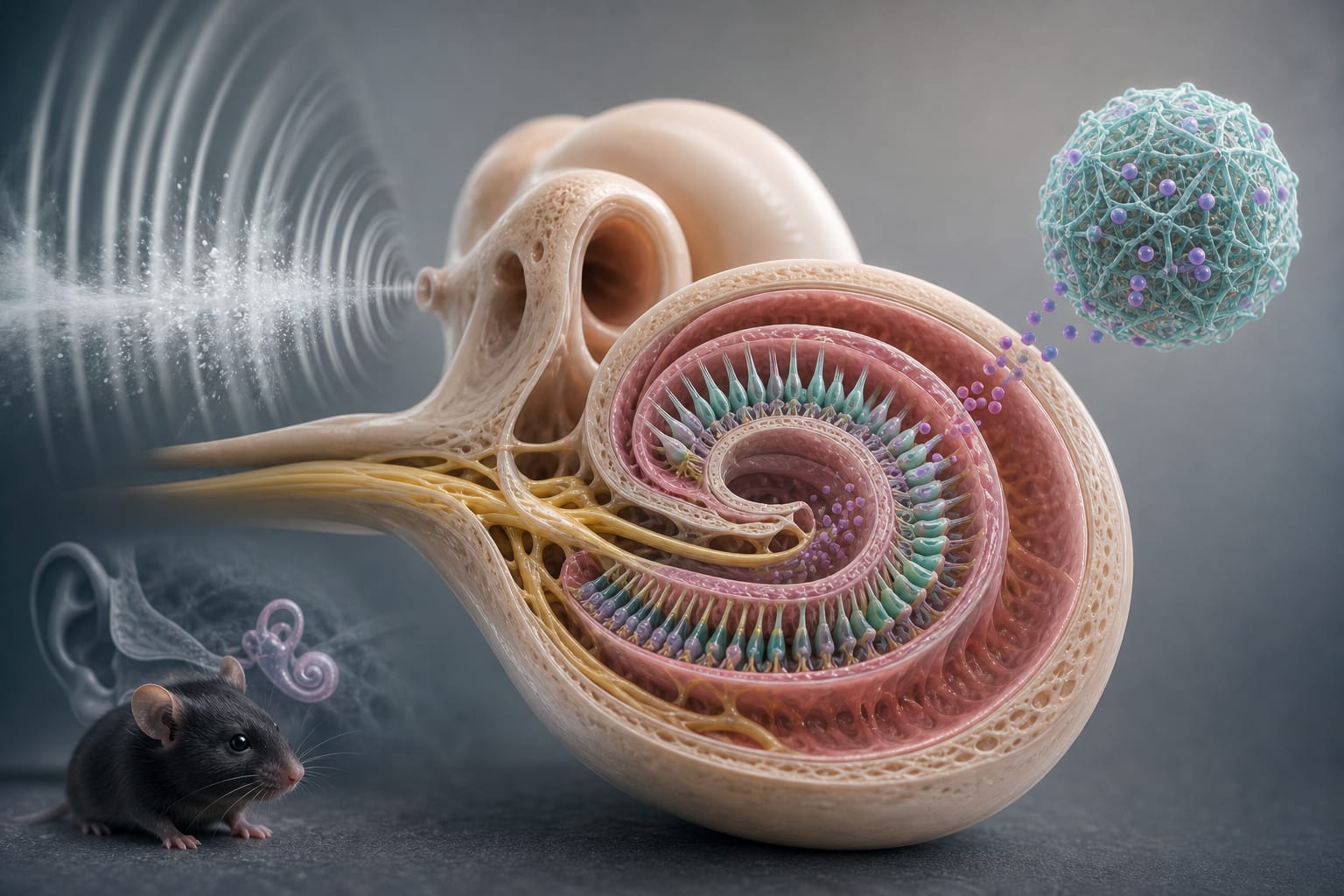
Clinical Report: TrkB Stimulation Alleviates Cochlear Damage from Blast Exposure
Overview
This study demonstrates that localized TrkB activation using 7,8-dihydroxyflavone (7,8-DHF) delivered via nanoparticles significantly improves auditory recovery and preserves cochlear structures in a mouse model of blast-induced hearing loss (BIHL).
Background
Blast-induced hearing loss (BIHL) is a significant concern for military personnel and civilians exposed to high-intensity impulse noise. Current treatment options for BIHL are limited.
Data Highlights
Parameter
Vehicle Treatment
7,8-DHF Treatment
ABR Thresholds at 1 Month
Persistently Impaired
Significantly Improved
Outer Hair Cell Loss
Significant Loss
Attenuated Loss
Inner Hair Cell Ribbon Synapses
Reduced
Partially Preserved
Key Findings
Blast exposure resulted in significant elevations in auditory brainstem response (ABR) thresholds.
Localized delivery of 7,8-DHF via nanoparticles accelerated functional recovery compared to vehicle treatment.
Histological analyses showed preserved inner hair cell density in the 7,8-DHF group.
Outer hair cell loss was significantly attenuated with 7,8-DHF treatment.
The strongest protective effects were observed in the basal cochlear regions.
Clinical Implications
The study supports the feasibility of using nanoparticle-enabled local TrkB activation as a therapeutic strategy for BIHL.
Conclusion
The findings indicate that TrkB stimulation via localized delivery of 7,8-DHF can improve both functional and structural outcomes in a mouse model of BIHL.
Phones in class, a 25-year prescription gone wrong, pickleball's hidden danger, and why your spin class is too loud — four findings hiding in everyday care.