Hemodynamic Forces from Echocardiography in Cardiac Resynchronization Therapy
Overview
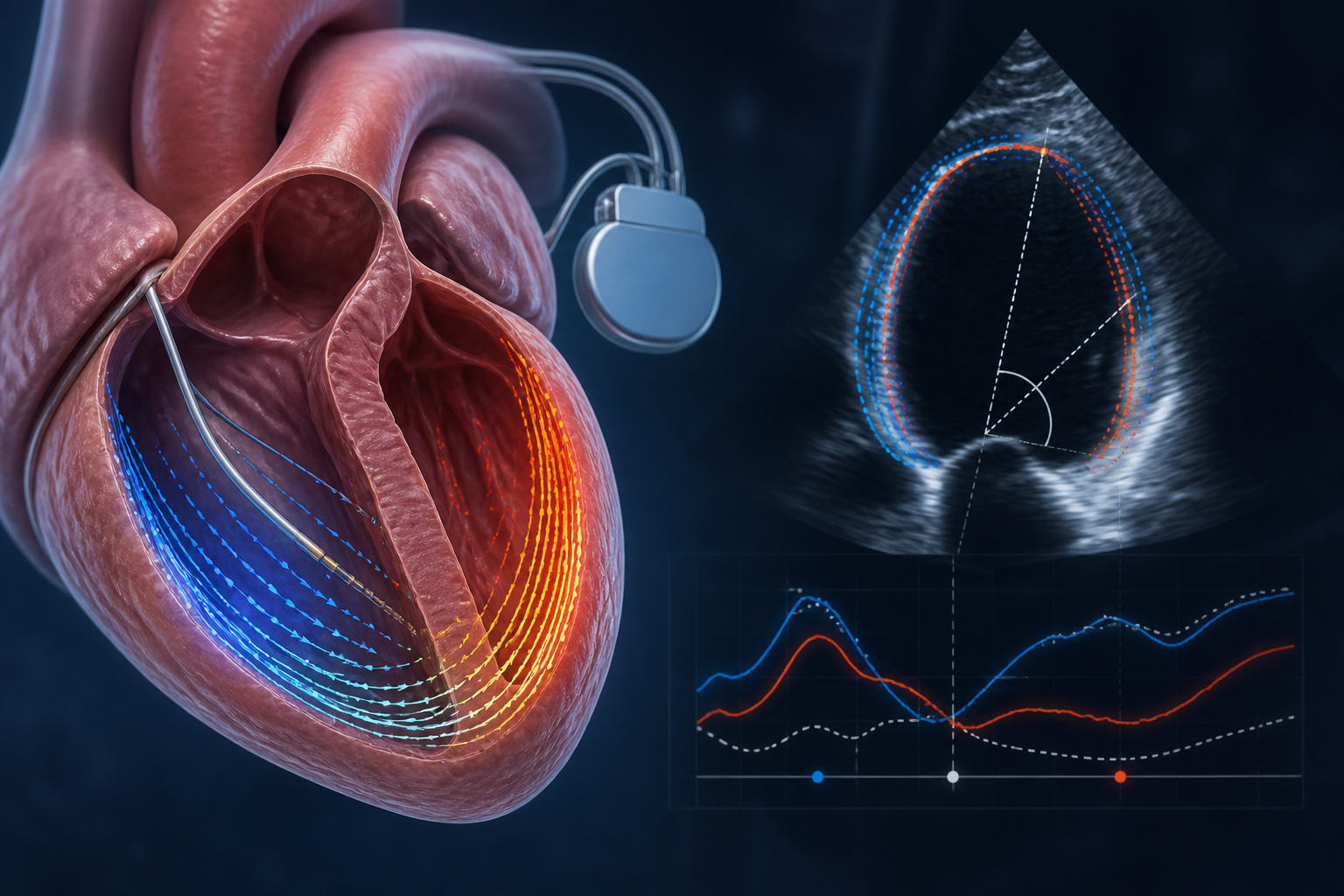
This post hoc analysis of the MARC study evaluates echocardiography-derived hemodynamic force (HDF) parameters in 198 patients undergoing cardiac resynchronization therapy (CRT). It examines associations with reverse remodeling and the composite endpoint of all-cause mortality or cardiovascular hospitalization.
Background
CRT improves outcomes in selected patients with heart failure, reduced ejection fraction, and electromechanical dyssynchrony, but up to 30%–40% do not demonstrate left ventricular reverse remodeling. HDF analysis provides additional insight into ventricular mechanics and may help characterize the mechanical response to CRT.
Data Highlights
Parameter | Findings |
|---|
CRT Response Rate | At 6 months, 120 patients (60.6%) demonstrate a ≥15% reduction in left ventricular end-systolic volume. |
Association with Mortality or Cardiovascular Hospitalization | Baseline systolic angle is independently associated with the composite endpoint; lower values are associated with worse event-free survival. |
Follow-up Duration | Median 9.3 years |
Key Findings
HDF parameters provide complementary information about left ventricular mechanics in patients undergoing CRT.
Adding baseline systolic angle to established clinical, electrocardiographic, and echocardiographic markers significantly improves model fit for CRT response but does not significantly improve discrimination.
CRT responders show significant improvements in HDF parameters at 6 months after implantation; nonresponders show no significant changes.
Baseline systolic angle is independently associated with the composite endpoint of all-cause mortality or cardiovascular hospitalization.
Adding systolic angle improves prognostic model performance but does not significantly improve discrimination.
Clinical Implications
HDF assessment may help describe ventricular mechanics and changes after CRT. However, the findings do not establish its value for selecting CRT candidates or guiding treatment. The exploratory systolic angle threshold requires external validation before clinical implementation.
Limitations
This post hoc analysis is not specifically powered for these outcomes and includes a selected population meeting 2012 CRT guideline criteria. Systolic angle differences are small and approach the technique’s measurement precision. HDF analysis requires high-quality images and careful measurements, and systolic angle has the lowest reproducibility among the evaluated HDF parameters.
Conclusion
Echocardiography-derived HDF parameters provide insight into ventricular mechanics. Baseline systolic angle is associated with CRT response and long-term outcomes, but adding it to established predictors does not significantly improve discrimination. Further prospective research in contemporary populations is needed to establish clinical predictive value.
Related Resources & Content
Laenens D, van der Bijl P, Stassen J, et al. Introduction to hemodynamic forces by echocardiography. Int J Cardiol. 2023;370:442–444.
Vallelonga F, Airale L, Tonti G, et al. Introduction to hemodynamic forces analysis: moving into the new frontier of cardiac deformation analysis. J Am Heart Assoc. 2021;10:e023417.
Laenens D, van der Bijl P, Galloo X, et al. Evolution of echocardiography-derived hemodynamic force parameters after cardiac resynchronization therapy. Am J Cardiol. 2023;209:138–145.
Maass AH, Vernooy K, Wijers SC, et al. Refining success of cardiac resynchronization therapy using a simple score predicting the amount of reverse ventricular remodelling: results from the Markers and Response to CRT (MARC) study. Europace. 2018;20:e1–e10.
Laenens D, Van Der Bijl P, Galloo X, et al. Association between echocardiography-derived haemodynamic force parameters and left ventricular reverse remodelling after cardiac resynchronization therapy. Eur Heart J Cardiovasc Imaging. 2024;25:1721–1733.