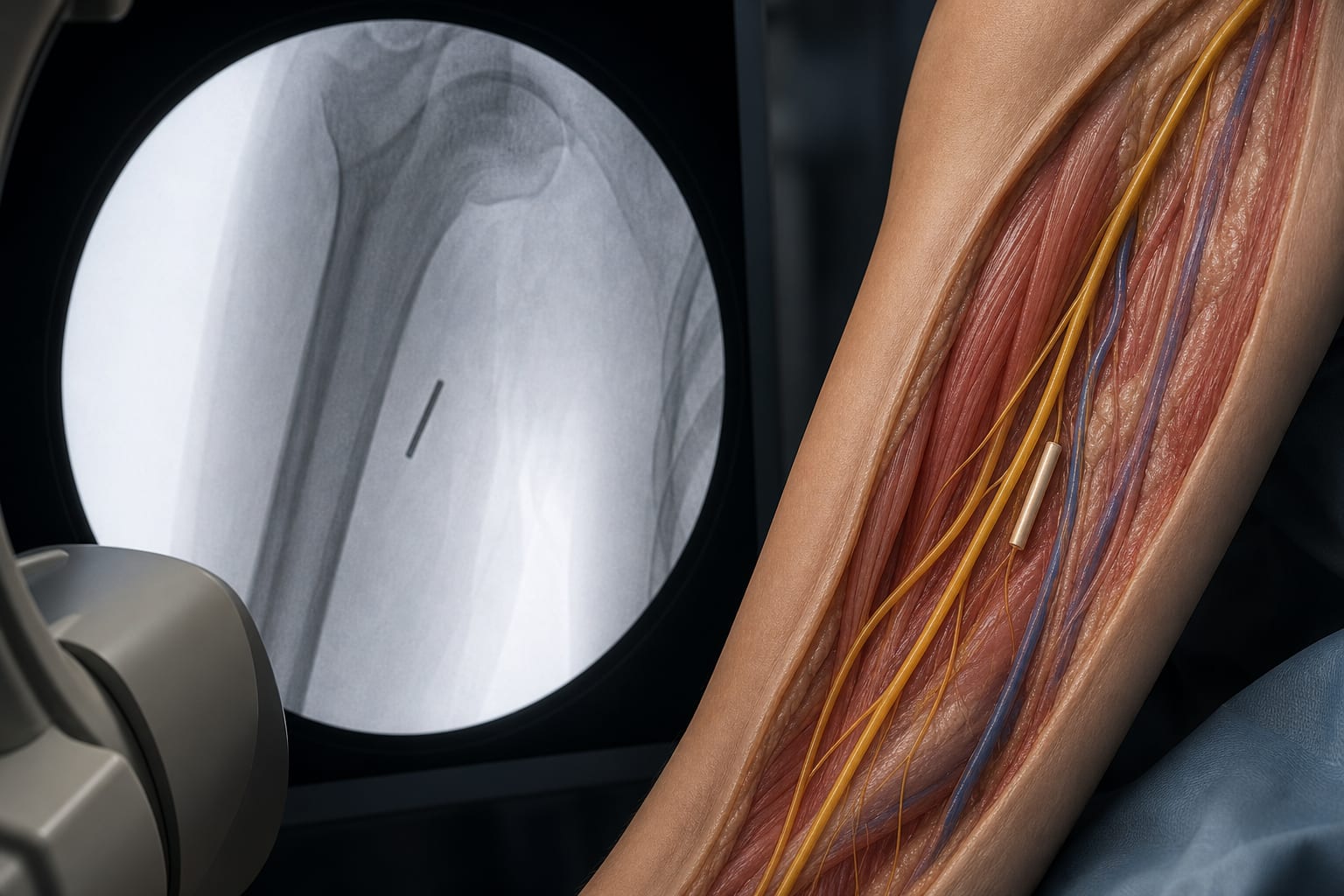
Ultrasound-Assisted Extraction of a Non-Palpable Etonogestrel Implant Adhering to the Ulnar Nerve: A Case Study
-
By
-
Changsung Han
-
Chungwon Lee
-
May 29, 2026
Clinical Report: Ultrasound-Assisted Extraction of a Non-Palpable Etonogestrel Implant
Overview
This report details the successful extraction of a non-palpable etonogestrel implant adhering to the ulnar nerve using fluoroscopy guidance after unsuccessful attempts with ultrasound. The case emphasizes the importance of accurate localization and specialist referral in complex implant removals.
Background
Subdermal etonogestrel implants are effective contraceptives but can lead to complications such as migration and non-palpability, particularly near neurovascular structures. Approximately 3-5% of implants may become non-palpable, necessitating advanced imaging techniques for safe removal. Understanding the challenges associated with these implants is crucial for healthcare providers to prevent potential nerve injuries and ensure patient safety.
Data Highlights
Revise to state: 'No numerical or trial data available; qualitative findings discussed.'Key Findings
- The patient presented with persistent abnormal bleeding three years post-etonogestrel implant placement.
- Previous removal attempts failed due to the implant's deep positioning and migration.
- Ultrasound guidance and hydrodissection were unsuccessful in localizing the implant.
- Fluoroscopy guidance successfully facilitated the extraction of the implant adhering to the ulnar nerve.
- The patient experienced transient tingling during the procedure, which resolved by the two-week follow-up.
- Accurate localization and referral to specialists are critical for safe removal of deeply placed implants.
Clinical Implications
Clinicians should be aware of the potential complications associated with etonogestrel implants, particularly in cases of migration. When faced with non-palpable implants, it is essential to utilize imaging techniques and consider referral to specialists to minimize risks of nerve injury during removal.
Conclusion
This case underscores the effectiveness of fluoroscopy-guided removal of non-palpable etonogestrel implants when conventional methods fail. It highlights the need for careful planning and specialist involvement in complex cases to ensure patient safety.
Related Resources & Content
- Knee Surgery, Sports Traumatology, Arthroscopy, 2018 -- Identifying the Ulnar Nerve in Elbow Arthroscopy via Palpation is Accurate Only Above the Medial Epicondyle
- Knee Surgery, Sports Traumatology, Arthroscopy, 2024 -- Preliminary Insights from Surgical Experience with a Novel Implantable Epicranial Stimulation Device for Chronic Focal Cortex Stimulation in Patients with Drug-Resistant Epilepsy
- Knee Surgery, Sports Traumatology, Arthroscopy, 2021 -- Ultrasound Assessment Reveals Increased Laxity Following Partial Detachment of the Common Extensor Origin, but Not After Additional Injury to the Radial Band of the Lateral Collateral Ligament
- Archives of Orthopaedic and Trauma Surgery, 2026 -- Retrospective Assessment of the Ulna Osteotomy Locking Plate II in Patients Diagnosed with Ulnocarpal Impaction Syndrome
- Organon, 2023 -- Organon Announces US Food and Drug Administration Approval of Supplemental New Drug Application Extending Duration of Use of NEXPLANON® (etonogestrel implant) 68 mg Radiopaque
- ACOG, 2016 -- Clinical Challenges of Long-Acting Reversible Contraceptive Methods
- PubMed, 2023 -- Ultrasound-Guided Hydrodissection with Needle Stabilization: An Innovative Nerve-Sparing Approach to Remove a Contraceptive Implant Causing Ulnar Neuropathy
- FDA Approval of Extended Duration for Nexplanon
- ACOG Guidance on Long-Acting Reversible Contraceptives
- Ultrasound-Guided Hydrodissection with Needle Stabilization: An Innovative Nerve-Sparing Approach to Remove a Contraceptive Implant Causing Ulnar Neuropathy - PubMed
Based on findings from:
Fluoroscopy-guided removal of a migrated non-palpable implanon adherent to the ulnar nerve: a case report
Changsung Han, Chungwon Lee. Frontiers In Medicine, 2026.
https://www.frontiersin.org/journals/medicine/articles/10.3389/fmed.2026.1801202/full
This content is an AI-generated, fully rewritten summary based on a published scholarly article. It does not reproduce the original text and is not a substitute for the original publication. Readers are encouraged to consult the source for full context, data, and methodology.