Complement-secreting CAFs are associated with better prognosis in pancreatic cancer: single-cell multiomics - Report - MDSpire

Complement-secreting CAFs are associated with better prognosis in pancreatic cancer: single-cell multiomics

  • By

  • Kai Chen

  • Yongsu Ma

  • Liling Huang

  • Pengfei Wu

  • Heng-Chung Kung

  • Bohan Yang

  • Jixin Zhang

  • Robert A Anders

  • Jacquelyn W Zimmerman

  • Qingfeng Zhu

  • Xiaodong Tian

  • Jin He

  • Yinmo Yang

  • July 1, 2026

  • 0 min

Share

Clinical Report: Association of Complement-Producing Cancer-Associated Fibroblasts

Overview

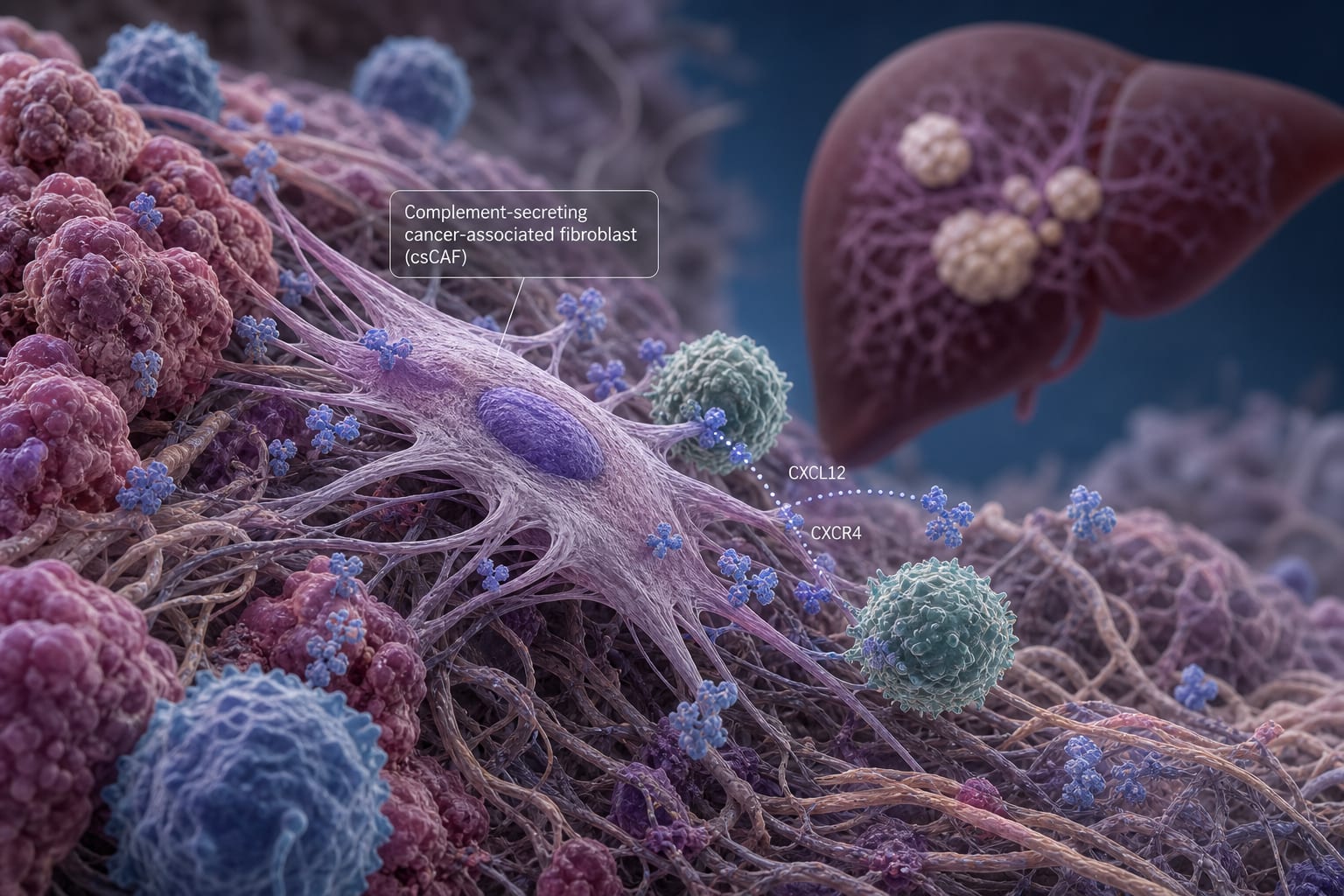
This study identifies a novel subtype of cancer-associated fibroblasts (CAFs) known as complement-secreting CAFs (csCAFs) in pancreatic ductal adenocarcinoma (PDAC).

Background

Pancreatic ductal adenocarcinoma (PDAC) is characterized by a complex tumor microenvironment, including heterogeneous populations of cancer-associated fibroblasts (CAFs). Understanding the roles of different CAF subtypes is crucial, as they can exhibit both tumor-promoting and tumor-restraining properties, impacting patient outcomes and treatment strategies.

Data Highlights

No numerical data provided in the source material.

Key Findings

  • Identification of complement-secreting CAFs (csCAFs) as a subtype.
  • Spatial analysis revealed a CXCL12-CXCR4 interaction between csCAFs and T cells.
  • Liver metastasis showed increased csCAFs compared to primary PDAC, while lung metastasis was enriched with inflammatory CAFs (iCAFs).
  • csCAFs may differentiate into iCAFs during the progression of PDAC.

Clinical Implications

The identification of csCAFs provides insights into potential therapeutic targets for enhancing patient outcomes in PDAC. Understanding the dynamics between different CAF subtypes may inform future strategies for reprogramming tumor-promoting CAFs.

Conclusion

This study enhances the understanding of CAF heterogeneity in PDAC and highlights the potential clinical significance of csCAFs in patient prognosis.

Related Resources & Content

  1. Author(s)/Org, Source, Year -- Title
  2. The ASCO Post — Research Insights From the AACR Special Conference on Pancreatic Cancer
  3. npj Digital Medicine — Unraveling the Immunoregulatory Role of ERS–CAF Through Multimodal AI: Implications for Prognosis and Treatment Across Cancers
  4. Frontiers in Immunology — Integrative multi-omics analysis identifies a CMA-associated heterogeneity risk score and a cDCs-based immune score for robust prognostic stratification in colon cancer with single-center and experimental validation
  5. The ASCO Post — Scientists Are Boosting Immune Responses in Pancreatic Tumors
  6. Research Insights From the AACR Special Conference on Pancreatic Cancer
  7. Unraveling the Immunoregulatory Role of ERS–CAF Through Multimodal AI
  8. Integrative multi-omics analysis identifies a CMA-associated heterogeneity risk score
  9. ESMO Clinical Practice Guideline Express Update on the management of metastatic pancreatic cancer - PMC
  10. NAPOLI 3, a phase 3 study of NALIRIFOX in patients with metastatic pancreatic ductal adenocarcinoma (mPDAC): Final overall survival (OS) analysis and characteristics of the long-term survivors. | Journal of Clinical Oncology
  11. Daraxonrasib in Previously Treated Advanced RAS-Mutated Pancreatic Cancer | New England Journal of Medicine
  12. Macrophages and fibroblasts as regulators of the immune response in pancreatic cancer | Nature Immunology
  13. Complement activation in tumor microenvironment after neoadjuvant therapy and its impact on pancreatic cancer outcomes | npj Precision Oncology
  14. NNMT inhibition in cancer-associated fibroblasts restores antitumour immunity | Nature
  15. www.nature.com/bjc

Original Source(s)

Related Content