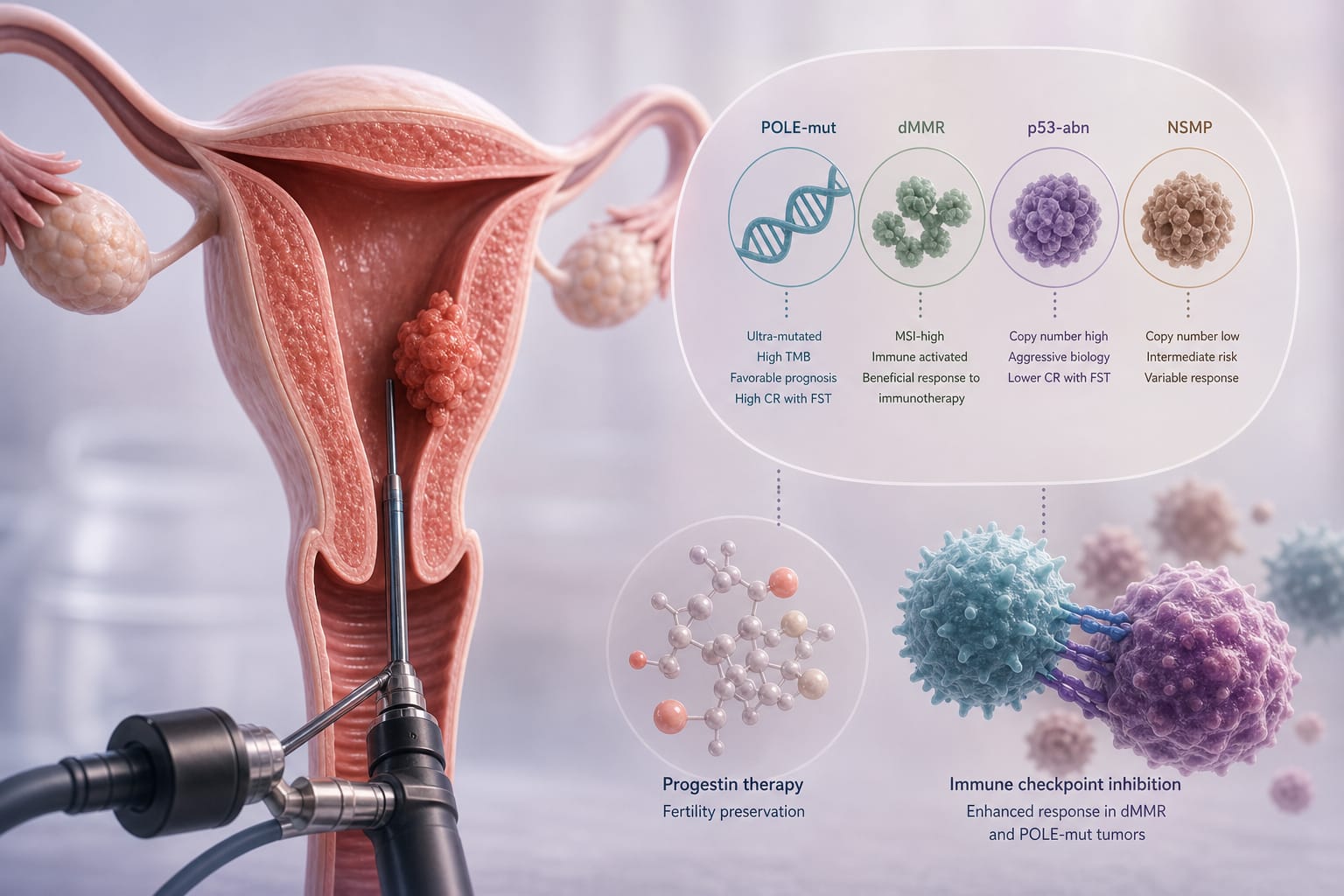
Molecular Subtyping and Immunotherapy in Fertility-Preserving Approaches for Endometrial Cancer: Challenges and Prospects
-
By
-
Jing Li
-
Shixiang Dong
-
Dongdong Hu
-
Wen Feng
-
July 9, 2026
Clinical Report: Molecular Subtyping and Immunotherapy in Endometrial Cancer
Overview
Endometrial cancer (EC) is increasingly prevalent, particularly among young women, necessitating fertility-sparing treatment (FST) options. Molecular subtyping reveals significant prognostic differences, with POLE mutations associated with better outcomes, while dMMR indicates poorer prognosis and higher recurrence rates.
Background
Endometrial cancer is one of the most common malignancies affecting women, with rising incidence rates linked to factors like obesity and delayed childbearing. Standard treatment typically involves hysterectomy, which eliminates fertility, prompting the need for fertility-sparing strategies. Recent advancements in molecular classification have provided insights into the varying prognoses associated with different subtypes of endometrial cancer.
Data Highlights
No numerical data available in the source material.
Key Findings
- Endometrial cancer incidence was approximately 417,000 new cases globally in 2020.
- POLE mutations are associated with a higher complete remission rate in fertility-sparing treatment.
- Patients with dMMR endometrial cancer have a higher recurrence rate post-complete remission.
- Traditional fertility-sparing regimens primarily utilize progestin therapy.
Clinical Implications
Clinicians should consider molecular subtyping when evaluating treatment options for young women with endometrial cancer seeking to preserve fertility.
Conclusion
Molecular classification plays a crucial role in guiding fertility-sparing treatment strategies for endometrial cancer.
Related Resources & Content
- roswell park comprehensive cancer center, Physician Resources, 2023 -- Immunotherapies, Antibody Drug Conjugants Among Advances in Endometrial Cancer Treatment Options
- Archives of Gynecology and Obstetrics, 2023 -- Subtype matters: ovarian endometriosis impairs ovarian reserve and embryo quality—should these patients consider fertility preservation?
- Frontiers in Immunology, 2026 -- Immune heterogeneity and therapeutic resistance in gynecological malignancies
- Policy Review, ESGO Guidelines, 2025 -- ESGO-ESTRO-ESP Guidelines for EC
- Frontiers in Reproductive Health — Immunotherapy does not impair ovarian function in a mouse model of breast cancer
- 2025 ESGO Guidelines for Endometrial Cancer
- THE LANCET OncologySupplementary appendixThis appe
- Pocket Guidelines Management of Patients with E
- A practical guideline on the fertility‐sparing treatment of patients with endometrial carcinoma and atypical endometrial hyperplasia
- Performance of molecular classification in predicting oncologic outcomes of fertility-sparing treatment for atypical endometrial hyperplasia and endometrial cancer - ScienceDirect
- Molecular classification of patients undergoing fertility sparing management of endometrial cancer: a systematic review and meta-analysis - International Journal of Gynecological Cancer
- Pembrolizumab plus Chemotherapy in Advanced Endometrial Cancer | New England Journal of Medicine
- FDA approves pembrolizumab with chemotherapy for primary advanced or recurrent endometrial carcinoma | FDA
- Dostarlimab for Primary Advanced or Recurrent Endometrial Cancer | New England Journal of Medicine
- Significant overall survival benefit with dostarlimab plus chemotherapy in advanced endometrial cancer - Nierengarten - 2024 - Cancer - Wiley Online Library
- FDA expands endometrial cancer indication for dostarlimab-gxly with chemotherapy | FDA
- Lenvatinib plus pembrolizumab in previously treated advanced endometrial cancer: 5-year outcomes from the randomized, phase 3 Study 309/KEYNOTE-775 - PMC
- NCCN Guidelines® Insights: Uterine Neoplasms, Version 3.2025 - PubMed
Based on findings from:
Molecular classification and immunotherapy in fertility-sparing treatment for endometrial cancer: opportunities and challenges
Jing Li, Shixiang Dong, Dongdong Hu, Wen Feng. Frontiers In Oncology, 2026.
https://www.frontiersin.org/journals/oncology/articles/10.3389/fonc.2026.1853596/full
This content is an AI-generated, fully rewritten summary based on a published scholarly article. It does not reproduce the original text and is not a substitute for the original publication. Readers are encouraged to consult the source for full context, data, and methodology.