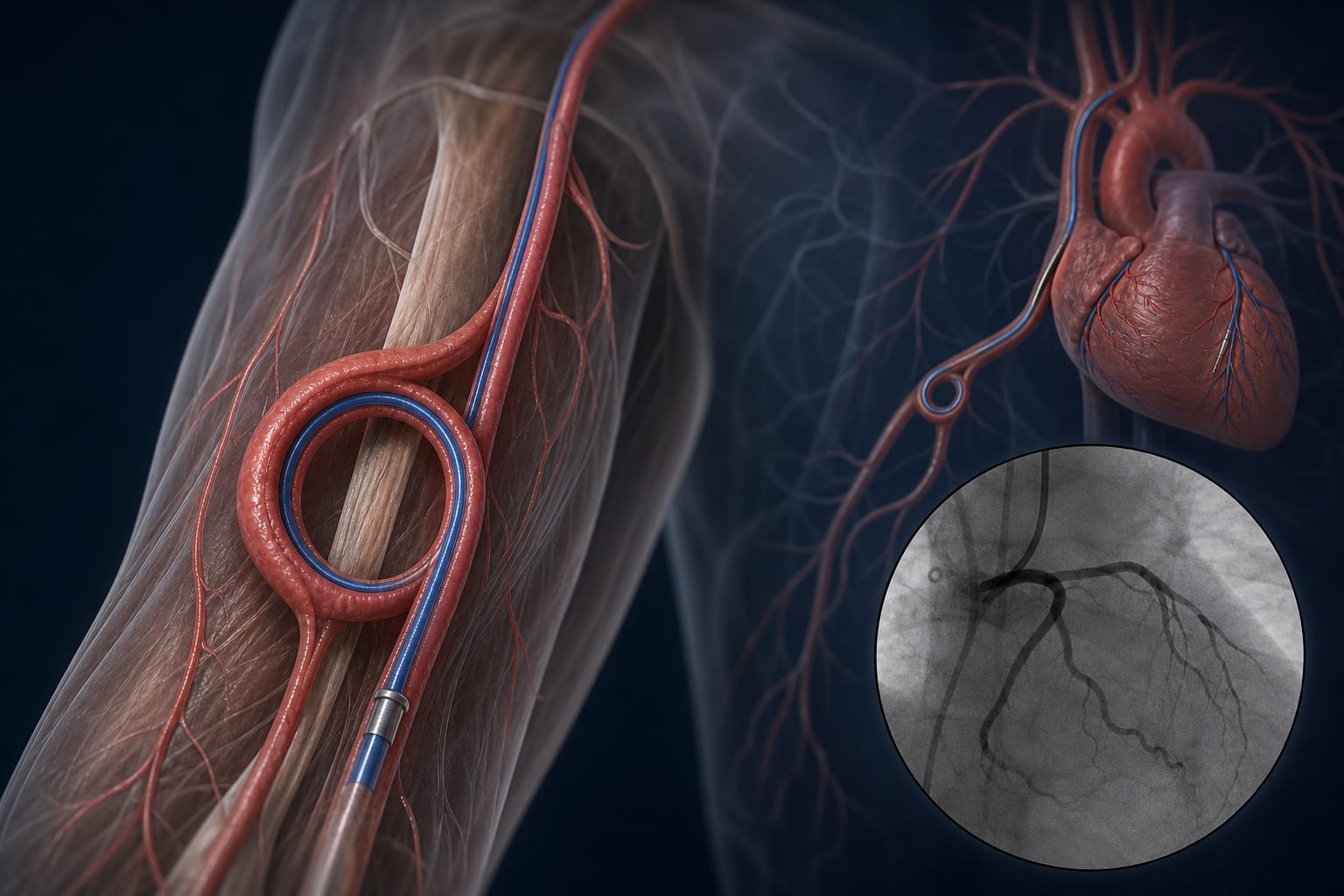
Case Study: Beyond Simple Traversal - Achieving Functional Access in an Extreme Brachial Artery Loop During Primary PCI
-
By
-
Ali Hakan Konuş
-
Recep Polat
-
July 16, 2026
Clinical Report: Achieving Functional Access in an Extreme Brachial Artery Loop
Background
Transradial access is increasingly preferred for coronary interventions due to its association with reduced complications compared to transfemoral access, as supported by existing literature. However, extreme tortuosity in upper-limb arteries can complicate procedures, necessitating effective management strategies. Understanding the difference between traversal success and functional access is crucial for optimizing outcomes in acute coronary syndromes.
Data Highlights
No numerical data or trial data provided in the article.
Key Findings
- Successful guidewire traversal does not guarantee functional access in tortuous arterial anatomy.
- The case involved a 73-year-old woman with acute inferior STEMI and a near-complete circular brachial artery loop.
- Despite successful catheter passage, inadequate catheter support was noted due to persistent loop geometry.
- A structured escalation strategy using progressively higher-support guidewires was necessary to achieve effective loop straightening.
- The primary PCI was completed with a door-to-balloon time of 36 minutes, demonstrating efficiency in a time-sensitive setting.
Clinical Implications
Clinicians should recognize that successful traversal of tortuous anatomy does not equate to functional access. A correctability-focused approach is essential in managing complex vascular configurations.
Conclusion
This case highlights the importance of distinguishing between traversal and functional access in transradial procedures, emphasizing a structured approach to manage extreme arterial tortuosity.
Related Resources & Content
- Author(s)/Org, Source, Year -- Title
- Author(s)/Org, Source, Year -- Title
- Author(s)/Org, Source, Year -- Title
- philips image guided therapy devices academy — Ultra-low contrast PCI case studies in high-risk patients: Techniques and tools to optimize outcomes
- Endovascular Recanalization through the Ascending Cervical Artery for Occlusion of Non-Conical Stump Vertebral Artery: A Case Study
- Pediatric Cardiology — Innovative Applications of the SwiftNinja Steerable Microcatheter in Pediatric Cardiac Procedures
- Frontiers in Cardiovascular Medicine — Learning curve of distal transradial access for coronary intervention: a single-center retrospective study
- Ultra-low contrast PCI case studies in high-risk patients: Techniques and tools to optimize outcomes
- Endovascular Recanalization through the Ascending Cervical Artery for Occlusion of Non-Conical Stump Vertebral Artery: A Case Study
- Innovative Applications of the SwiftNinja Steerable Microcatheter in Pediatric Cardiac Procedures
- 2025 ACC/AHA/ACEP/NAEMSP/SCAI Guideline for the Management of Patients With Acute Coronary Syndromes: A Report of the American College of Cardiology/American Heart Association Joint Committee on Clinical Practice Guidelines | JACC
- 2023 ESC Guidelines for the management of acute coronary syndromes | European Heart Journal. Acute Cardiovascular Care | Oxford Academic
- SCAI Expert Consensus Statement on the Management of Patients With STEMI Referred for Primary PCI - PMC
- Minimizing Adverse Haemorrhagic Events by Transradial Access Site and Systemic Implementation of AngioX: Radial vs. Femoral - American College of Cardiology
- Radial versus femoral randomized investigation in ST-segment elevation acute coronary syndrome: the RIFLE-STEACS (Radial Versus Femoral Randomized Investigation in ST-Elevation Acute Coronary Syndrome) study - PubMed
- RadIal Vs femorAL access for coronary intervention - American College of Cardiology
- SAfety and Efficacy of Femoral Access vs RadIal Access in STEMI - American College of Cardiology
- https://academic.oup.com/eurheartj/article/47/5/625/8186172
- Checking your browser - reCAPTCHA
- https://www.thieme-connect.de/products/ejournals/html/10.1055/s-0044-1782204?device=desktop&innerWidth=412&lang=en&offsetWidth=412&utm_source=openai
- Manual reduction of a radial artery loop under direct fluoroscopic visualization - PMC
- Balloon-assisted tracking for transradial catheterization: beating the curve - PubMed
- Successful Use of an Extra-Long Hydrophilic-Coated Sheath in Enlarged Aorta to Overcome Extreme Tortuosity of Right Subclavian Artery Via Transradial Approach During Coronary Angiography
Based on findings from:
Case Report: When crossing is not enough: restoring functional access in an extreme brachial artery loop during primary PCI
Ali Hakan Konuş, Recep Polat. Frontiers In Cardiovascular Medicine, 2026.
https://www.frontiersin.org/journals/cardiovascular-medicine/articles/10.3389/fcvm.2026.1903487/full
This content is an AI-generated, fully rewritten summary based on a published scholarly article. It does not reproduce the original text and is not a substitute for the original publication. Readers are encouraged to consult the source for full context, data, and methodology.