Clinical Report: Investigation of ARHGAP27's Role in Aortic Dissection Progression
Overview
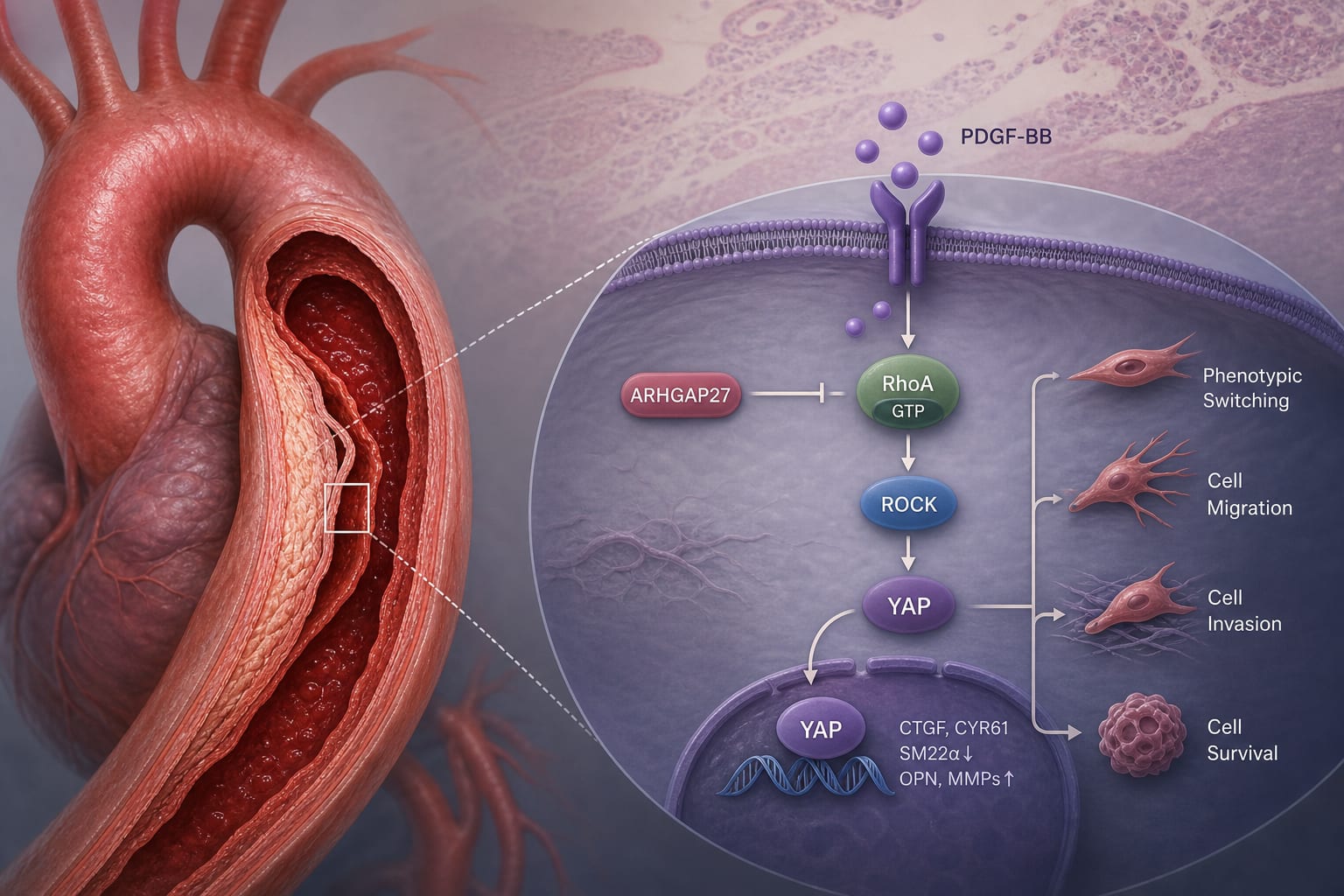
This study investigates the role of ARHGAP27 in aortic dissection (AD) progression through the RhoA/ROCK/YAP signaling pathway. Findings indicate that ARHGAP27 is upregulated in AD and promotes vascular smooth muscle cell (VSMC) survival, migration, and invasion.
Background
Aortic dissection is a critical cardiovascular emergency characterized by a tear in the aorta's intimal layer, leading to potentially fatal complications. Understanding the molecular mechanisms involved in AD, such as the role of ARHGAP27, is essential.
Data Highlights
ARHGAP27 was significantly upregulated in AD tissue and cell models. Overexpression of ARHGAP27 enhanced VSMC survival, migration, and invasion, while knockdown produced opposite effects. PDGF-BB downregulated RhoA and ROCK1/2, while upregulating YAP phosphorylation.
Key Findings
ARHGAP27 is significantly upregulated in aortic dissection tissues.
Overexpression of ARHGAP27 promotes VSMC survival, migration, and invasion.
Knockdown of ARHGAP27 inhibits VSMC survival and migration.
PDGF-BB affects the expression of RhoA, ROCK1/2, and YAP in VSMCs.
LPA treatment reverses the effects of ARHGAP27 overexpression.
Clinical Implications
The findings indicate the role of ARHGAP27 in VSMC behavior.
Conclusion
ARHGAP27 plays a significant role in the progression of aortic dissection by modulating the RhoA/ROCK/YAP signaling pathway.