Clinical Report: An Integrated Ensemble Approach for Early Identification of IUGR
Overview
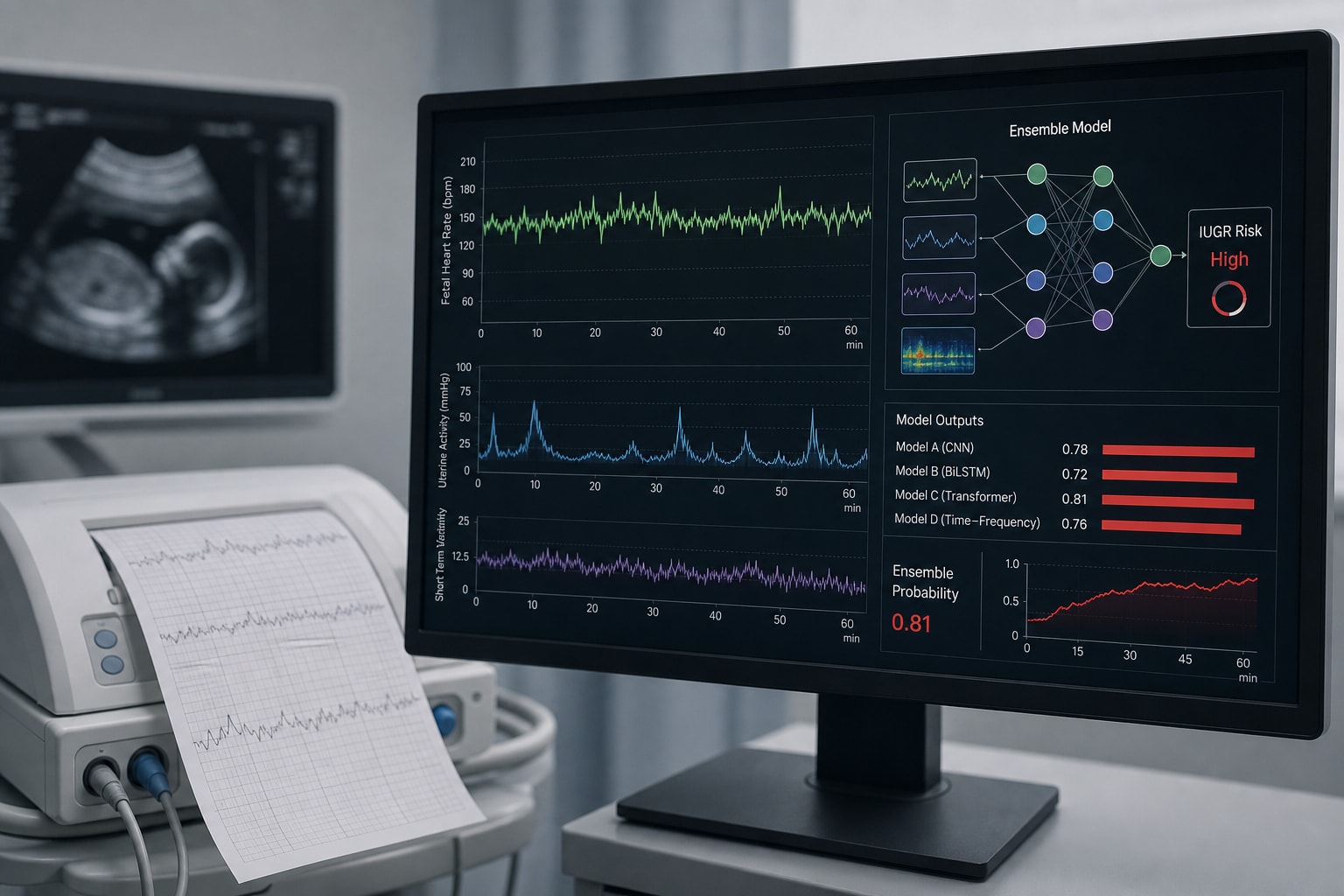
This study presents a multidimensional ensemble pipeline for detecting intrauterine growth restriction (IUGR) using cardiotocography (CTG) recordings. The proposed approach significantly improves detection accuracy, achieving a balanced accuracy of 0.799 and an AUC of 0.868.
Background
Intrauterine growth restriction (IUGR) is a significant contributor to perinatal morbidity and mortality, often linked to placental insufficiency. Effective monitoring during the antepartum period is crucial for identifying fetal compromise and improving outcomes. Cardiotocography (CTG) is a widely used non-invasive technique for fetal surveillance, but its interpretation can be challenging due to variability among clinicians.
Data Highlights
Model
Balanced Accuracy
AUC
Ensemble Approach
0.799
0.868 (95% CI: 0.849–0.885)
ResNet
Comparable
Not specified
CNN + MLP
Comparable
Not specified
Key Findings
The ensemble approach integrates a residual deep learning model and a hybrid CNN–MLP architecture.
The study utilized the NAPAMI database, comprising over 70,000 CTG recordings.
Both base models achieved comparable performance levels before integration.
The ensemble framework enhances the detection of IUGR by combining different representations of fetal heart rate dynamics.
Clinical Implications
The findings suggest that employing an ensemble approach for CTG analysis may enhance the early detection of IUGR, potentially leading to improved clinical decision-making. This method could serve as a valuable tool in prenatal medicine, particularly in settings where traditional CTG interpretation is challenging.
Conclusion
The study demonstrates that an integrated ensemble approach can significantly improve the detection of IUGR from CTG recordings, highlighting the potential of AI-assisted tools in prenatal care.