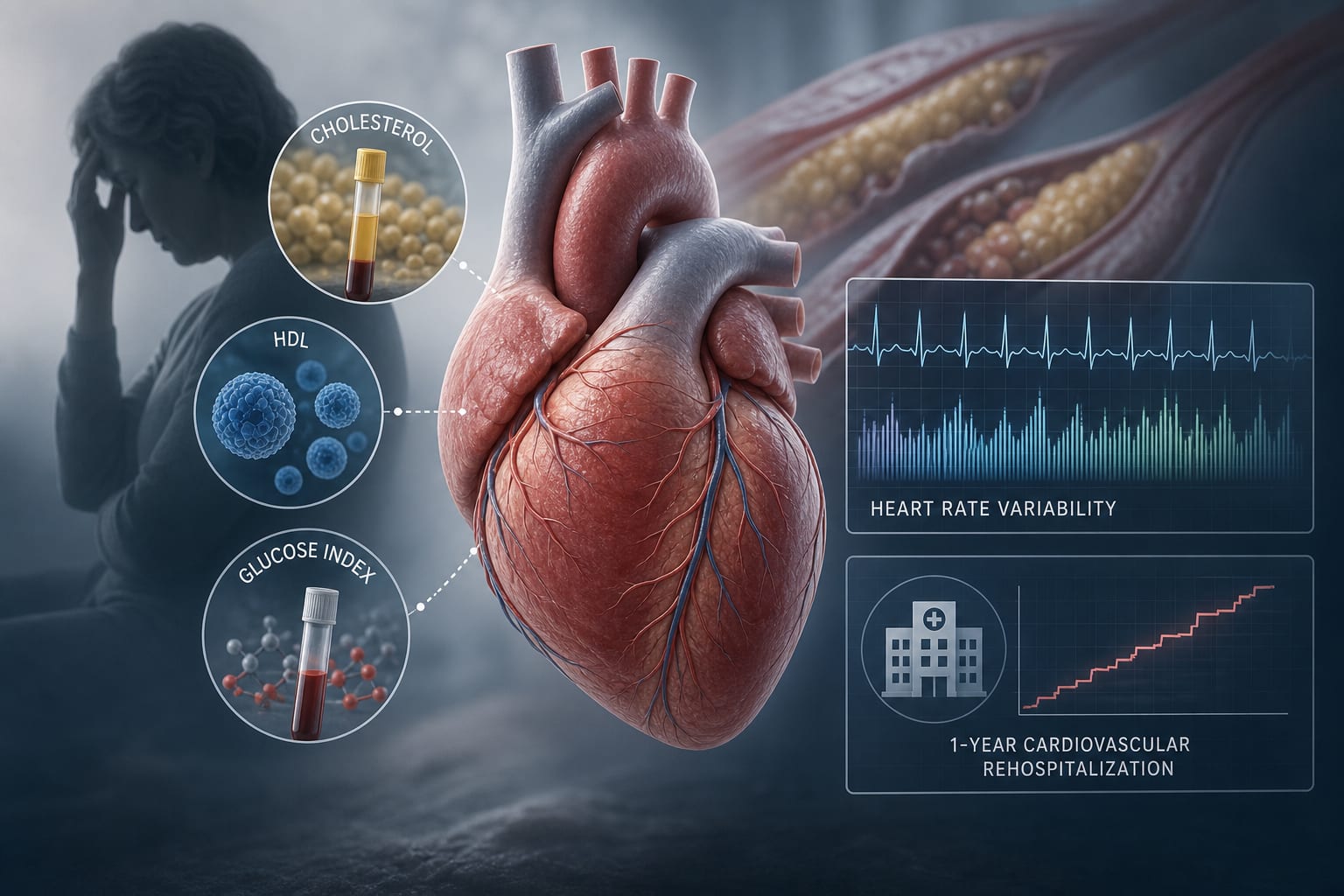
Cholesterol, high-density lipoprotein, and glucose index as a cardiometabolic marker associated with heart rate variability and 1-year cardiovascular rehospitalization in chronic coronary syndromes with comorbid anxiety: a retrospective cohort study - Report - MDSpire
Advertisement
Cholesterol, high-density lipoprotein, and glucose index as a cardiometabolic marker associated with heart rate variability and 1-year cardiovascular rehospitalization in chronic coronary syndromes with comorbid anxiety: a retrospective cohort study
Clinical Report: Association of Cholesterol, HDL, and Glucose Index with HRV
Overview
This study investigates the relationship between the cholesterol, high-density lipoprotein, and glucose (CHG) index and heart rate variability (HRV) in patients with chronic coronary syndromes (CCS) and anxiety. Elevated CHG is associated with increased risk of 1-year cardiovascular rehospitalization, highlighting the importance of metabolic and autonomic factors in this population.
Background
Chronic coronary syndromes (CCS) are a significant cause of morbidity and mortality, often exacerbated by comorbid anxiety. Metabolic dysregulation, particularly involving cholesterol and glucose levels, may contribute to adverse cardiovascular outcomes. Understanding the interplay between metabolic markers and heart rate variability (HRV) can enhance risk stratification and management strategies for patients with CCS and anxiety.
Data Highlights
Measure
Result
P-value
HRV_z (Q4 vs Q1)
-0.529 (95% CI -0.698 to -0.361)
< 0.001
1-year rehospitalization risk (per 1-unit increase in CHG)
OR = 3.253 (95% CI 2.292–4.617)
< 0.001
1-year rehospitalization risk (Q4 vs Q1)
OR = 3.656 (95% CI 2.443–5.472)
< 0.001
Key Findings
Patients in the highest CHG quartile had significantly lower HRV_z compared to those in the lowest quartile.
Each 1-unit increase in CHG was associated with a higher risk of 1-year cardiovascular rehospitalization.
Exploratory analyses indicated that higher HRV_z correlated with a lower risk of rehospitalization.
Nonlinear associations were observed between CHG, HRV_z, and rehospitalization risk.
Complete-case sensitivity analyses supported the main findings, though caution is advised in interpreting HRV-related results.
Clinical Implications
The findings suggest that monitoring the CHG index and HRV_z may provide valuable insights for risk assessment in patients with CCS and anxiety. Clinicians should consider these factors when developing management plans to reduce rehospitalization risk in this vulnerable population.
Conclusion
Elevated CHG is linked to increased cardiovascular rehospitalization risk in patients with CCS and anxiety, emphasizing the need for integrated metabolic and autonomic assessments in clinical practice.
Ahead of ISC2026 in Prague, Jennifer Van Eyk explains how scalable LC-MS workflows and single-cell proteomics are helping reveal the biological differences that could make precision medicine a clinical reality