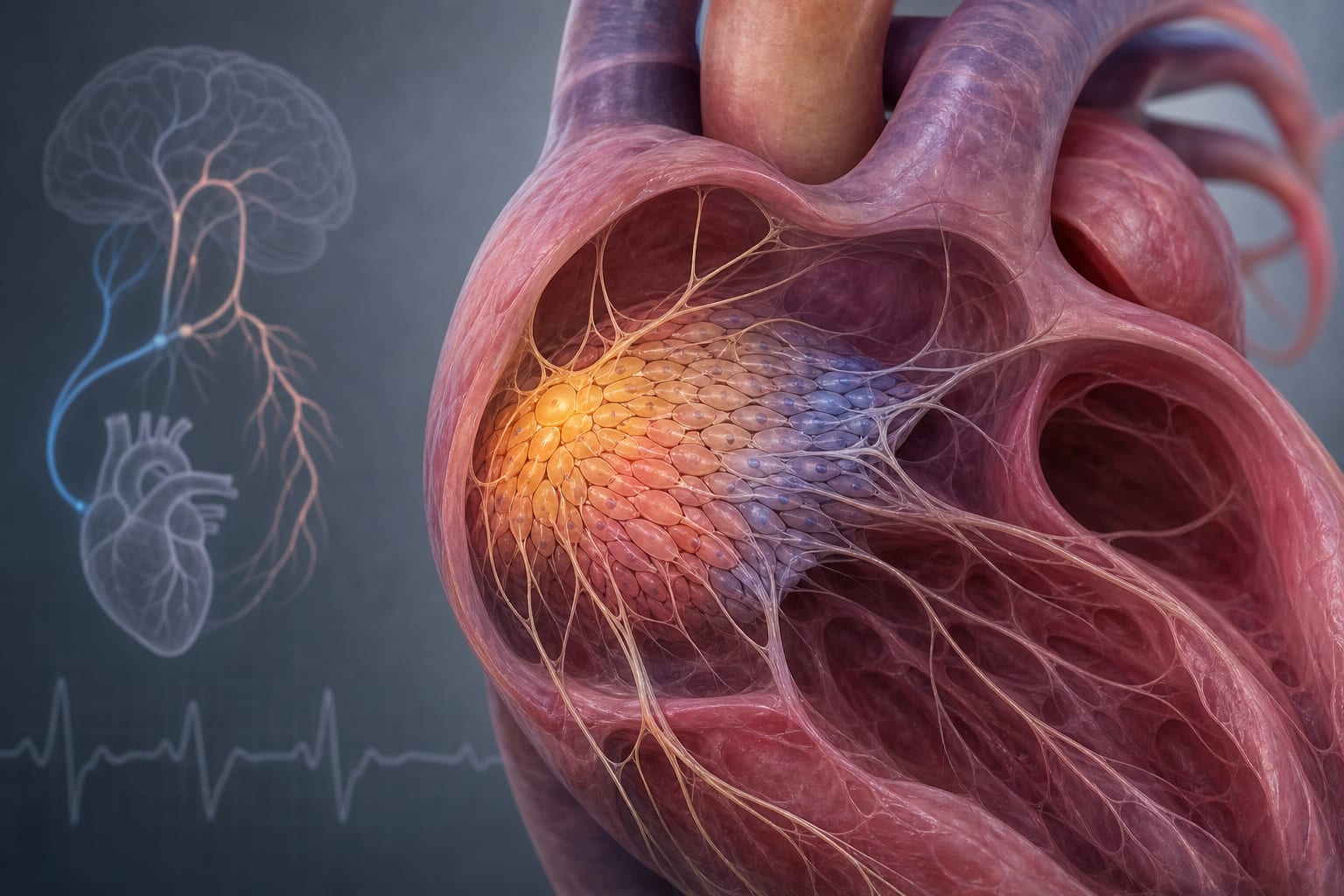
Transforming Atrial Fibrillation Management: The Role of Digital Twins and Artificial Intelligence in Comprehensive Care
-
By
-
Dandan Song
-
Shaning Yang
-
June 22, 2026
Clinical Report: Transforming Atrial Fibrillation Management with AI
Overview
This review discusses the integration of digital twins and artificial intelligence in managing atrial fibrillation (AF).
Background
Atrial fibrillation is a prevalent cardiac arrhythmia that poses a significant risk for thromboembolic events, particularly ischemic stroke. Traditional management approaches are often fragmented, relying on static data and lacking a comprehensive view of the patient's condition. The advent of digital twins and artificial intelligence offers a promising solution to unify data sources and improve clinical decision-making.
Data Highlights
| Metric | Value |
|---|---|
| Anatomical Dice Coefficients | 93% or higher |
| Correlation Coefficient for Activation Time Prediction | Exceeding 0.96 |
| AI-ECG Detection Rate Increase | 2.3-fold |
| Post-ablation Recurrence AUC | 0.72 to 0.85 |
| Intra-operative 3D Reconstruction Time | 65 seconds |
Key Findings
- The integration of digital twins allows for patient-specific modeling and dynamic predictions of cardiac activity.
- AI-ECG technology enhances AF detection rates.
- Models predicting post-ablation recurrence demonstrate AUC values between 0.72 and 0.85.
- The proposed virtual closed-loop framework has been preliminarily validated in various clinical scenarios.
- Current evidence supports AI-assisted personalized AF management, though further validation is necessary.
Clinical Implications
The integration of digital twins and AI in AF management may lead to more personalized treatment strategies.
Conclusion
The use of digital twins and artificial intelligence represents an advancement in the management of atrial fibrillation.
Related Resources & Content
- DIGITAL HEALTH, SAGE Journals, 2021 -- Development of a semi–real-time electrocardiogram monitoring system integrating artificial intelligence and wearable devices for atrial fibrillation screening
- Frontiers in Oncology, 2026 -- Digital Twins as catalysts for Whole Person Health Mind Body Medicine in Integrative Oncology
- ASCO AI in Oncology, 2026 -- Digital Twins in Oncology: From Concept to Implementation
- Clinical Research in Cardiology, 2022 -- Utilizing Machine Learning for Identifying and Managing Atrial Fibrillation
- 2024 ESC Guidelines for the management of atrial fibrillation, European Heart Journal, 2024 -- 2024 ESC Guidelines for the management of atrial fibrillation developed in collaboration with the European Association for Cardio-Thoracic Surgery (EACTS)
- Early Treatment of Atrial Fibrillation for Stroke Prevention Trial - American College of Cardiology, 2020 -- EAST-AFNET 4
- Nature Reviews Bioengineering, 2026 -- Digital twins and digital models of the human circulatory system
- 2024 ESC Guidelines for the management of atrial fibrillation developed in collaboration with the European Association for Cardio-Thoracic Surgery (EACTS) | European Heart Journal | Oxford Academic
- Early Treatment of Atrial Fibrillation for Stroke Prevention Trial - American College of Cardiology
- Digital twins and digital models of the human circulatory system | Nature Reviews Bioengineering
Based on findings from:
A paradigm shift toward full-cycle management of atrial fibrillation: integrating digital twins and artificial intelligence
Dandan Song, Shaning Yang. Frontiers In Cardiovascular Medicine, 2026.
https://www.frontiersin.org/journals/cardiovascular-medicine/articles/10.3389/fcvm.2026.1872233/full
This content is an AI-generated, fully rewritten summary based on a published scholarly article. It does not reproduce the original text and is not a substitute for the original publication. Readers are encouraged to consult the source for full context, data, and methodology.