Preoperative gut microbiota depletion and metabolomic signatures predict postoperative pneumonia in patients with intracranial space-occupying lesions: a multi-omics prospective cohort study - Report - MDSpire

Preoperative gut microbiota depletion and metabolomic signatures predict postoperative pneumonia in patients with intracranial space-occupying lesions: a multi-omics prospective cohort study

  • By

  • Juan Chen

  • Zhiyu Li

  • Yewen Zhan

  • Qianqian Tan

  • Jin Li

  • Hong Pu

  • June 16, 2026

  • 0 min

Share

Clinical Report: Preoperative Depletion of Gut Microbiota and Metabolomic Profiles

Overview

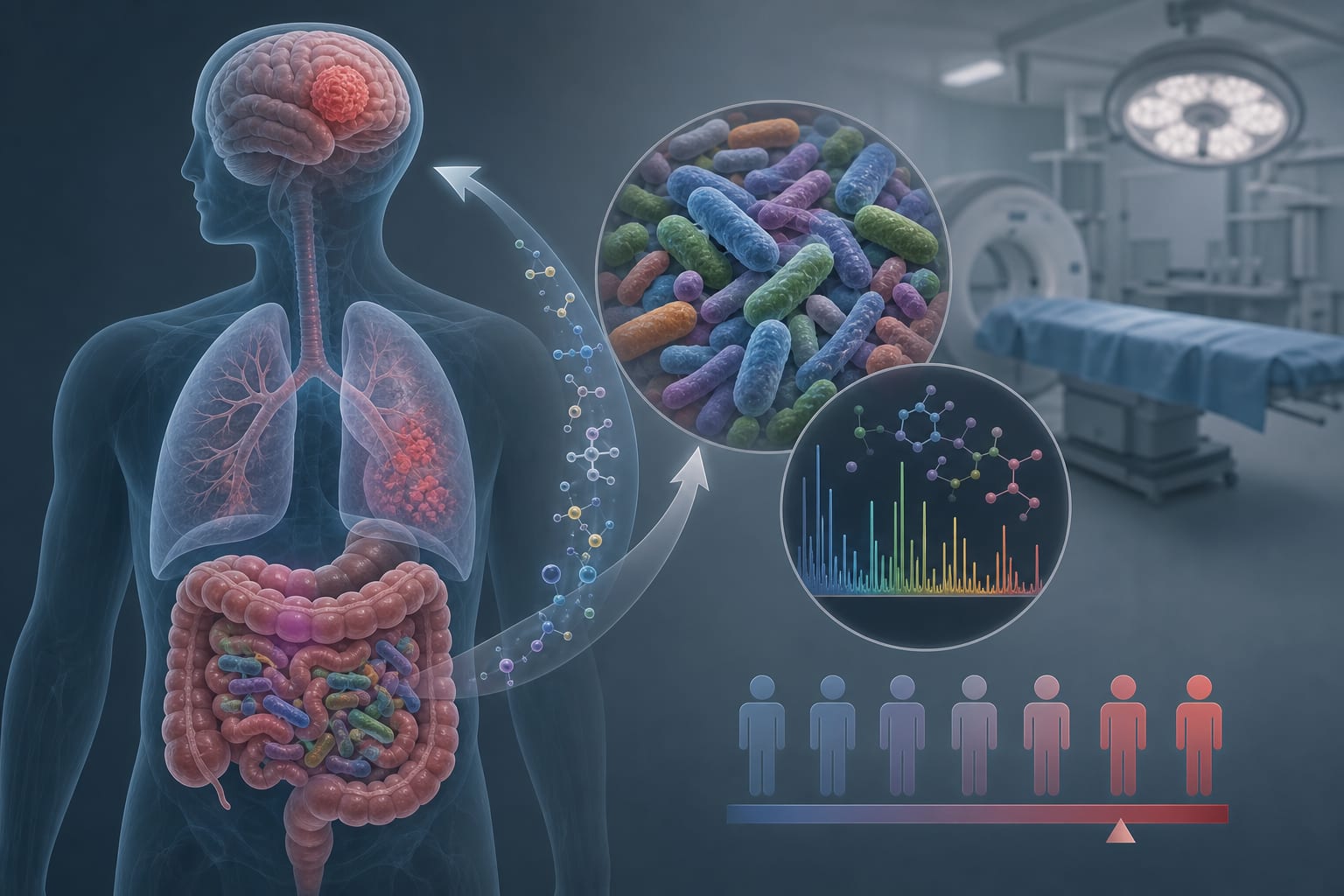
This study identifies preoperative gut microbiota depletion and specific metabolomic profiles as significant predictors of postoperative pneumonia (POP) in patients undergoing surgery for intracranial lesions. The findings suggest that monitoring these factors could enhance risk stratification and intervention strategies.

Background

Postoperative pneumonia (POP) is a critical complication in neurosurgery, significantly impacting recovery and mortality rates. Understanding the role of gut microbiota and metabolic profiles in predicting POP could lead to improved preoperative assessments and targeted interventions. The gut-lung axis theory provides a framework for exploring these relationships, emphasizing the need for innovative predictive models in surgical care.

Data Highlights

FindingDetails
Patient Enrollment50 patients with intracranial lesions
Microbial DiversityReduced across all groups post-surgery
Roseburia DepletionSignificant preoperative depletion in POP patients
Metabolic DeficiencyImpaired fructose and mannose metabolism in POP group
Predictive Model AUC1.0 for top 10 preoperative metabolites

Key Findings

  • Preoperative depletion of Roseburia is significantly associated with POP.
  • Patients who developed POP exhibited a preoperative metabolic deficiency state.
  • Microbial diversity decreased post-surgery across all patient groups.
  • 1-methylnicotinamide levels positively correlated with Roseburia abundance.
  • A metabolic signature of the top 10 metabolites can predict POP with high accuracy.

Clinical Implications

Monitoring preoperative gut microbiota and metabolic profiles may allow for early identification of patients at high risk for postoperative pneumonia. This approach could facilitate targeted interventions to improve surgical outcomes and reduce morbidity associated with POP.

Conclusion

The study underscores the importance of gut microbiota and metabolic health in predicting postoperative pneumonia, suggesting that integrating these factors into preoperative assessments could enhance patient care in neurosurgery.

Related Resources & Content

  1. BJS (British Journal of Surgery), 2024 -- Exploring Microbiome Alterations During Rectal Cancer Surgery: Insights from the NIHR IntAct Trial
  2. Open Forum Infectious Diseases, 2024 -- Preoperative Intestinal Microbiota Profiles as Predictors of Surgical Site Infections Following Abdominal Procedures
  3. Frontiers in Surgery, 2026 -- Meta-analysis of efficacy of probiotics in reducing postoperative infections and improving outcomes in gastrointestinal surgery
  4. Healthcare-Associated Pneumonia Prevention Guideline | Infection Control | CDC, 2024
  5. Altered gut microbiota and metabolite profiles in community-acquired pneumonia: a metagenomic and metabolomic study, 2025
  6. Tailored Risk Assessment for Extended Ileus Following Minimally Invasive Surgery for Colorectal Cancer: Comprehensive Analysis of Contributing Factors and Model Creation
  7. Healthcare-Associated Pneumonia Prevention Guideline | Infection Control | CDC
  8. Altered gut microbiota and metabolite profiles in community-acquired pneumonia: a metagenomic and metabolomic study - PubMed

Original Source(s)

Related Content