The clinical efficacy analysis of ultrasound-assisted minimally invasive treatment for Jakob Type II humeral lateral condyle fractures in children - Report - MDSpire

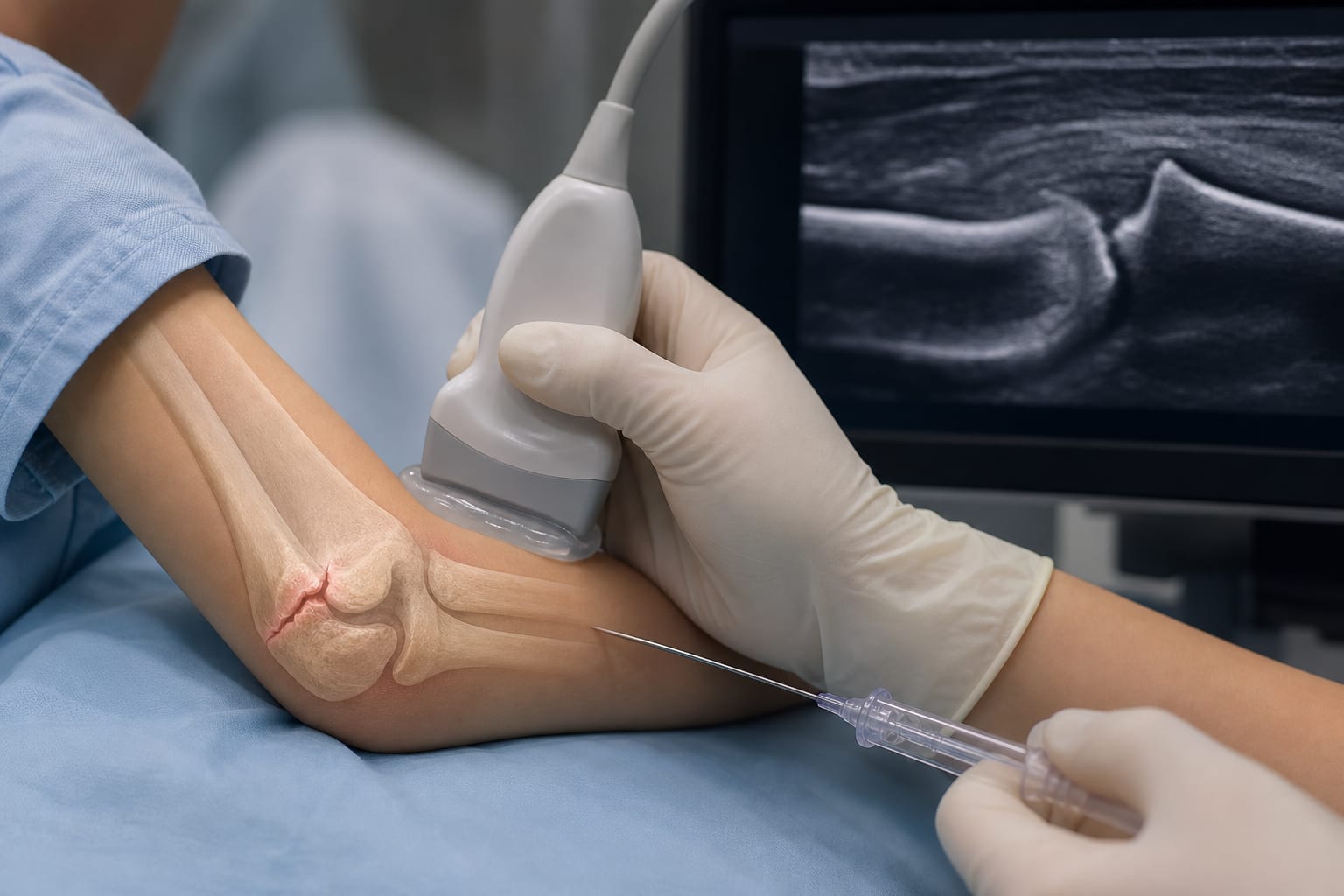
The clinical efficacy analysis of ultrasound-assisted minimally invasive treatment for Jakob Type II humeral lateral condyle fractures in children

  • By

  • Yunlong Liu

  • Sheng Ding

  • June 8, 2026

  • 0 min

Share

Clinical Report: Evaluating the Clinical Effectiveness of Ultrasound-Guided Techniques

Overview

This study assesses the clinical efficacy of ultrasound-assisted minimally invasive treatment for Jakob Type II humeral lateral condyle fractures in children. The findings indicate that this technique results in shorter surgical times and hospital stays compared to traditional open reduction methods, with similar functional outcomes and lower complication rates.

Background

Humeral lateral condyle fractures are common in pediatric patients, accounting for 12%-20% of distal humeral fractures. Jakob Type II fractures, characterized by articular surface disruption and fragment displacement, present treatment challenges due to the risk of complications affecting limb function. Accurate assessment and effective treatment are crucial to prevent long-term consequences such as elbow deformities and traumatic arthritis.

Data Highlights

GroupSurgical TimeHospital StayRadiological Union Time
UA-CRPPShorterShorterShorter
ORPPLongerLongerLonger

Key Findings

  • No significant differences in demographics or complications between UA-CRPP and ORPP groups (P > 0.05).
  • No cases of nonunion, refracture, or nerve injury were observed in either group.
  • The UA-CRPP group had shorter surgical times compared to the ORPP group (P < 0.05).
  • The radiological union time was shorter in the UA-CRPP group (P < 0.05).
  • Both techniques yielded similar functional outcomes.

Clinical Implications

Ultrasound-assisted closed reduction and internal fixation may offer a less invasive alternative to open reduction for treating Jakob Type II humeral lateral condyle fractures in children. The reduced surgical time and lower complication rates could enhance patient recovery and outcomes.

Conclusion

Ultrasound-assisted techniques for treating Jakob Type II humeral lateral condyle fractures in children demonstrate clinical effectiveness with advantages in surgical efficiency and complication rates compared to traditional methods.

Related Resources & Content

  1. Frontiers, Frontiers in Pediatrics, 2026 -- The clinical efficacy analysis of ultrasound-assisted minimally invasive treatment for Jakob Type II humeral lateral condyle fractures in children
  2. Lateral Condyle Fractures | Pediatric Orthopaedic Society of North America (POSNA)
  3. Safety and Efficacy of Open Plate Fixation for Displaced Proximal Humerus Fractures in Children: Achieving Excellent Functional Results
  4. Management and Outcomes of 100 Consecutive Cases of Proximal Radius Fractures in Pediatric Patients
  5. Comparative Analysis of Mid-term Clinical and Ultrasound Results in Minimally Invasive Reconstruction of the Acromioclavicular Joint: Mini-open Technique Versus Arthroscopic Assistance
  6. Non-displaced to minimally displaced intraoperative periprosthetic humeral shaft fractures during reverse total shoulder arthroplasty do not impact short-term clinical and radiographic outcomes.
  7. Lateral Condyle Fractures | Pediatric Orthopaedic Society of North America (POSNA)
  8. Surgical versus conservative management of minimally displaced (≤ 2 mm) pediatric lateral humeral condyle fractures: systematic review and meta-analysis | BMC Musculoskeletal Disorders | Springer Nature Link
  9. Frontiers | The clinical efficacy analysis of ultrasound-assisted minimally invasive treatment for Jakob Type II humeral lateral condyle fractures in children

Original Source(s)

Related Content