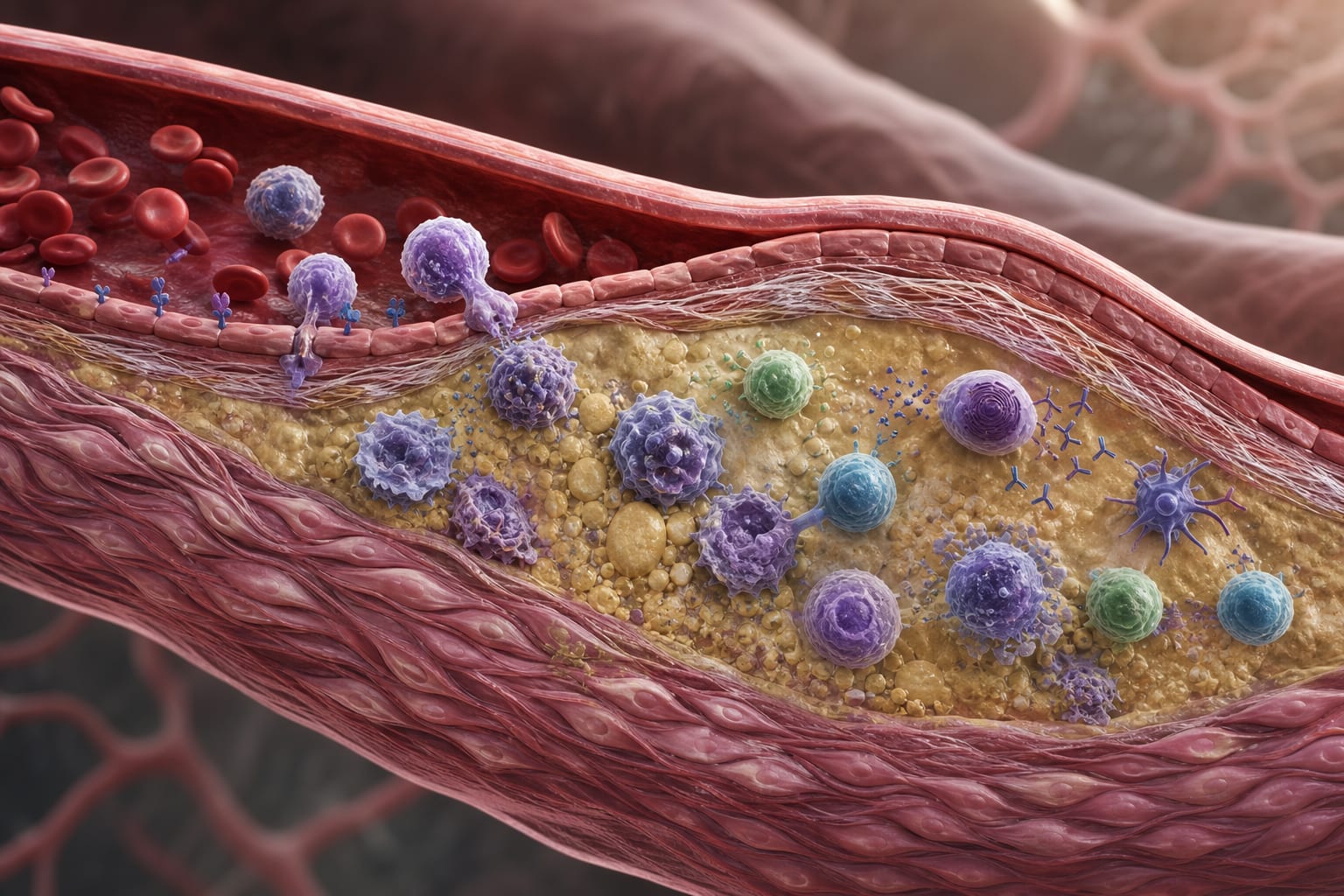
Integration of Various Biophysical Stimuli in Vascular Endothelial Cells
-
By
-
Louison Blivet-Bailly
-
Claire Leclech
-
Abdul I. Barakat
-
June 17, 2026
Clinical Report: Integration of Various Biophysical Stimuli in Vascular Endothelial Cells
Overview
This report discusses the complex interplay of biophysical stimuli affecting vascular endothelial cells (ECs) and their implications for vascular health. Understanding how ECs integrate these stimuli is crucial for elucidating their role in cardiovascular diseases.
Background
Vascular endothelial cells are essential for maintaining vascular homeostasis and respond dynamically to various mechanical stimuli. Disruption in the balance of these stimuli can lead to pathological conditions such as atherosclerosis and diabetes. Therefore, understanding the integration of multiple biophysical cues is vital for advancing vascular health and disease management.
Data Highlights
No numerical data presented in the article.
Key Findings
- Vascular ECs are subjected to a dynamic combination of mechanical stimuli including shear stress, pressure, and stretch forces.
- Most studies have focused on single mechanical cues, neglecting the simultaneous effects of multiple stimuli.
- The mechanical environment of ECs varies significantly in space and time, influencing their behavior and function.
- Understanding EC responses to combined stimuli is essential for elucidating mechanisms of vascular health and disease.
- ECs must translate multiple biophysical cues into a common language to integrate and respond appropriately.
Clinical Implications
Clinicians should consider the complex mechanical environment when assessing endothelial function and its role in cardiovascular diseases. Targeted interventions that address these biophysical stimuli may improve vascular health outcomes.
Conclusion
The integration of various biophysical stimuli is crucial for understanding endothelial mechanobiology. Further research in this area may lead to improved strategies for managing vascular health and disease.
Related Resources & Content
- Frontiers in Immunology, 2026 -- The immune-endothelial axis in neurovascular pathophysiology: a framework for targeted interventions
- Retinal Physician, 2011 -- Ocular Angiogenesis: The Science Behind the Symptoms
- Basic Research in Cardiology, 2022 -- The Importance of Endothelial Resilience in Sustaining Cardiac Health
- Basic Research in Cardiology, 2023 -- LINC00607: An Endothelial-Enriched lncRNA Involved in Angiogenesis
- Biophysical and Biochemical Roles of Shear Stress on Endothelium: A Revisit and New Insights - PMC
- European Journal of Preventive Cardiology -- Effect of exercise modality and intensity on endothelial function in patients with cardiovascular disease: a systematic review and network meta-analysis
- PubMed -- A randomized prospective study investigating the relationship between post-PCI wall shear stress and 12-month neointimal healing: The SHEAR-STENT study
- Biophysical and Biochemical Roles of Shear Stress on Endothelium: A Revisit and New Insights - PMC
- Effect of exercise modality and intensity on endothelial function in patients with cardiovascular disease: a systematic review and network meta-analysis | European Journal of Preventive Cardiology | Oxford Academic
- A randomized prospective study investigating the relationship between post-PCI wall shear stress and 12-month neointimal healing: The SHEAR-STENT study - PubMed
Based on findings from:
Vascular endothelial integration of multiple biophysical stimuli
Louison Blivet-Bailly, Claire Leclech, Abdul I. Barakat. Frontiers In Cardiovascular Medicine, 2026.
https://www.frontiersin.org/journals/cardiovascular-medicine/articles/10.3389/fcvm.2026.1866905/full
This content is an AI-generated, fully rewritten summary based on a published scholarly article. It does not reproduce the original text and is not a substitute for the original publication. Readers are encouraged to consult the source for full context, data, and methodology.