Mechanistic remodeling and immunoregulatory functions of the B cell–humoral immunity axis in inflammatory bowel disease - Report - MDSpire

Mechanistic remodeling and immunoregulatory functions of the B cell–humoral immunity axis in inflammatory bowel disease

  • By

  • Tao Zhang

  • Zhetan Ren

  • Hongkun Zhang

  • Zhengchao Pan

  • Meng Chen

  • Siyuan Bu

  • Xiaozhen Cheng

  • Jirun Peng

  • Yongduo Yu

  • July 9, 2026

  • 0 min

Share

Clinical Report: Revisiting the Role of B Cells in Inflammatory Bowel Disease

Background

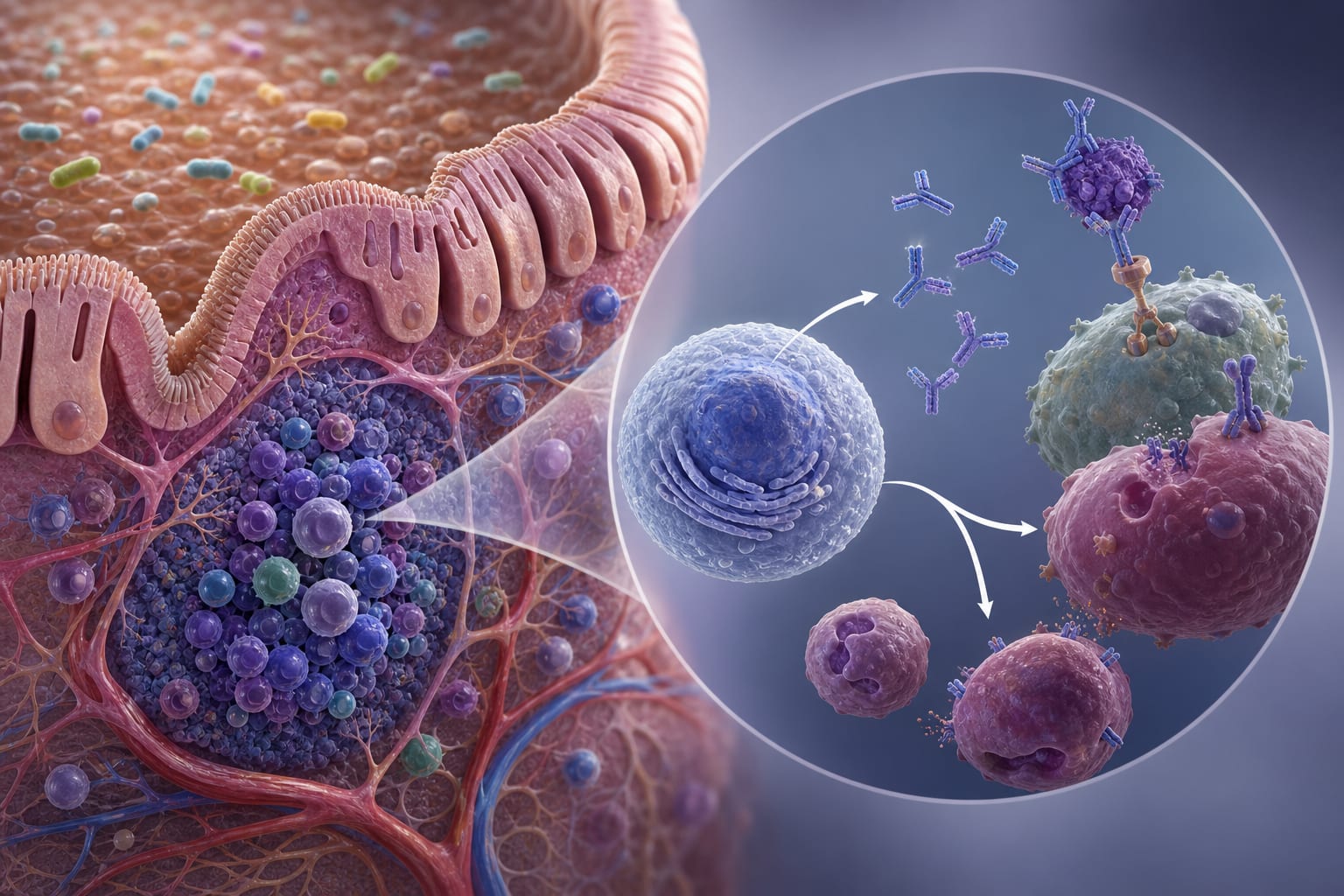
Inflammatory bowel disease (IBD) is characterized by chronic intestinal inflammation and involves complex immune dysregulation. While T cells have traditionally been the focus of research, recent studies indicate that B cells play a significant role in IBD pathogenesis through mechanisms such as antibody production and immune modulation.

Data Highlights

No numerical data or trial data presented in the article.

Key Findings

  • B cells are involved in mucosal immune regulation through differentiation and antibody production.
  • Antibodies can modulate inflammatory cell activation and tissue injury via Fc receptor signaling and immune complex responses.
  • Intestinal barrier integrity influences B cell activation and antibody output.
  • Therapeutic strategies targeting B cell functions are emerging, including B cell-directed therapies and modulation of antibody pathways.
  • Current therapies may not fully address the heterogeneity of IBD.

Clinical Implications

The findings suggest that therapies targeting B cells and humoral immunity may offer new avenues for managing IBD. Clinicians should consider the role of B cells in the immune response when evaluating treatment options for patients with IBD.

Conclusion

The integration of B cell and humoral immunity insights into IBD pathogenesis may enhance the understanding of disease mechanisms and inform the development of targeted therapies.
Related Resources & Content

  1. Journal of Gastroenterology, A Historical and Future Perspective on Inflammatory Bowel Disease, 2006 -- https://link.springer.com/article/10.1007/s00535-006-1995-7
  2. Journal of Gastroenterology, Modifying Gut Microbiota to Improve Immune Regulation in the Treatment of Inflammatory Bowel Diseases, 2019 -- https://link.springer.com/article/10.1007/s00535-019-01618-1
  3. Basic Research in Cardiology, B-cell Immune Response Mediated by Chemokine Receptors in Cardiovascular Disorders, 2025 -- https://link.springer.com/article/10.1007/s00395-025-01140-x
  4. Journal of Gastroenterology, Key Genetic Contributors to Inflammatory Bowel Diseases and Their Impact on Intestinal Barrier Function: Role in Gut Inflammation, 2025 -- https://link.springer.com/article/10.1007/s00535-025-02289-x
  5. Living guideline for pharmacological management of moderate-to-severe ulcerative colitis – American Gastroenterological Association -- https://gastro.org/clinical-guidance/living-guideline-for-moderate-to-severe-ulcerative-colitis/?utm_source=openai
  6. Gut-associated lymphoid tissue attrition associates with response to anti-α4β7 therapy in ulcerative colitis - PMC -- https://pmc.ncbi.nlm.nih.gov/articles/PMC11140591/?utm_source=openai
  7. ECCO-ESGAR-ESP-IBUS Guideline on Diagnostics and Monitoring of Patients with Inflammatory Bowel Disease: Part 2 | Journal of Crohn's and Colitis -- https://academic.oup.com/ecco-jcc/article/19/7/jjaf107/8220327?utm_source=openai
  8. Living guideline for pharmacological management of moderate-to-severe ulcerative colitis – American Gastroenterological Association
  9. Gut-associated lymphoid tissue attrition associates with response to anti-α4β7 therapy in ulcerative colitis - PMC
  10. ECCO-ESGAR-ESP-IBUS Guideline on Diagnostics and Monitoring of Patients with Inflammatory Bowel Disease: Part 2 | Journal of Crohn's and Colitis | Oxford Academic

Original Source(s)

Related Content