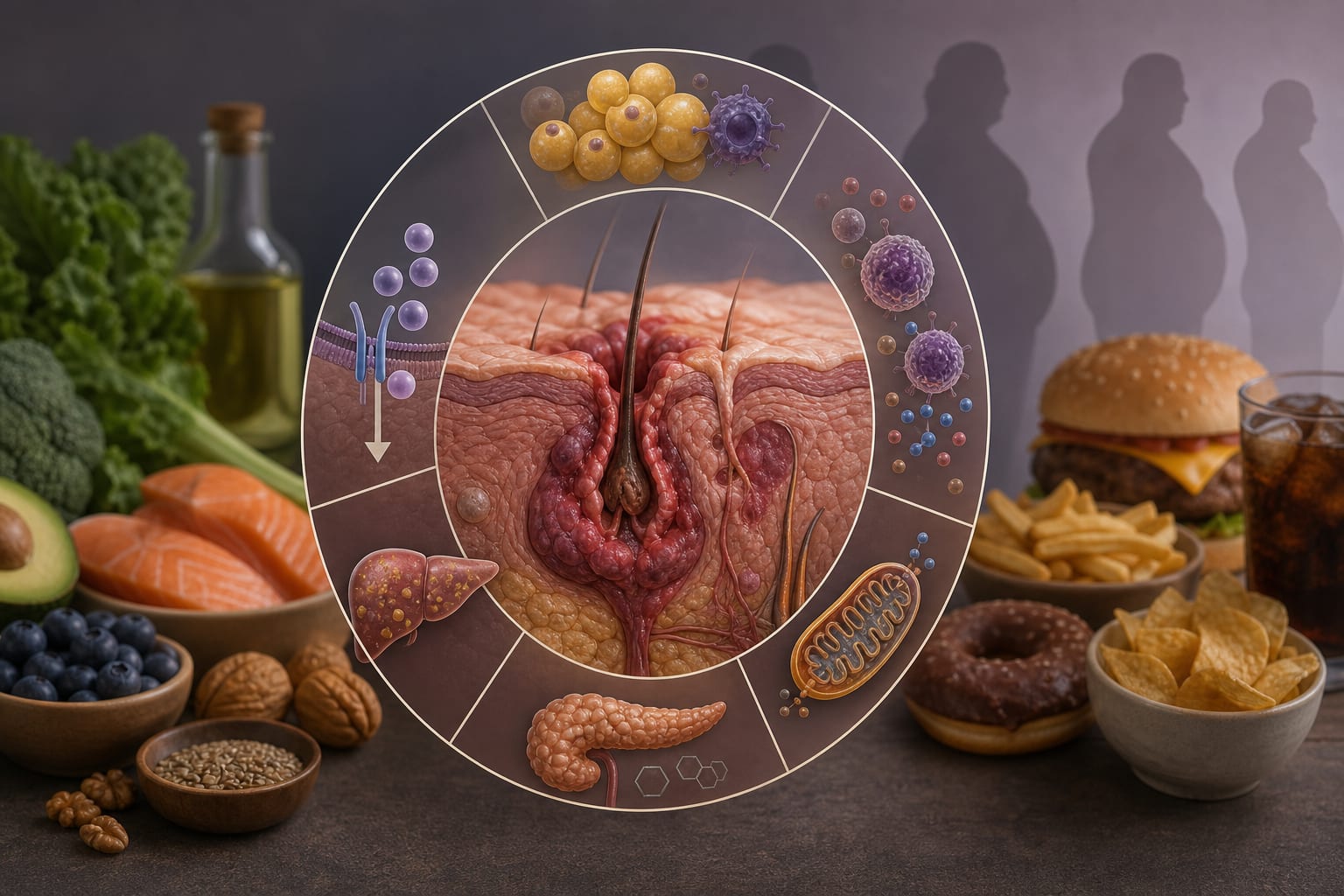
Nutritional Habits, Metabolic Mechanisms, and Chronic Inflammation in Hidradenitis Suppurativa: A Comprehensive Review
-
By
-
Ezgi Celik
-
Falk G. Bechara
-
Eggert Stockfleth
-
Lennart Ocker-Serger
-
Nessr Abu Rached
-
May 18, 2026
Clinical Report: Nutritional Habits and Chronic Inflammation in Hidradenitis Suppurativa
Overview
This comprehensive review evaluates the impact of dietary patterns on hidradenitis suppurativa (HS), highlighting associations between dietary habits and disease severity. Evidence suggests that nutritional status may influence HS through metabolic and inflammatory pathways, although the data remains limited and heterogeneous, necessitating cautious interpretation.
Background
Hidradenitis suppurativa (HS) is a chronic inflammatory skin disease affecting 1-4% of the population, often leading to significant morbidity. It is increasingly recognized as a systemic immunometabolic disorder, with strong associations to obesity and metabolic syndrome, which complicate management strategies. Understanding the role of dietary factors in HS is crucial for developing effective management strategies.
Data Highlights
Eleven studies were included in the review, indicating a correlation between dietary patterns and HS severity. Key findings include lower adherence to Mediterranean diets and higher glycaemic diets linked to increased disease severity. The studies included observational cohorts and pilot interventions.
Key Findings
- Lower adherence to Mediterranean dietary patterns is associated with greater HS disease severity.
- Higher glycaemic dietary patterns correlate with increased HS activity.
- Micronutrient deficiencies, particularly in vitamin D and zinc, are linked to worse HS outcomes.
- A pilot study suggests clinical improvement with a very low-calorie ketogenic diet, though evidence is limited.
- Yeast-exclusion diets may improve symptoms in small patient cohorts, but further research is needed.
- Bariatric surgery may worsen HS in patients with persistent micronutrient deficiencies.
Clinical Implications
Healthcare providers should consider dietary habits and nutritional status when managing patients with HS. Promoting anti-inflammatory dietary patterns, such as the Mediterranean diet, and addressing micronutrient deficiencies may enhance treatment outcomes alongside standard therapies.
Conclusion
Dietary habits appear to influence the pathogenesis and severity of hidradenitis suppurativa through various metabolic and inflammatory mechanisms. Further research, particularly controlled studies, is needed to establish definitive causal relationships.
Related Resources & Content
- Author(s)/Org, Source, Year -- Title
- conexiant, Conexiant, 2023 -- HS Linked to Higher Self-Harm, Suicide Risk
- conexiant, Conexiant, 2023 -- HS Linked to Higher Cancer Risk
- European S2k guidelines for hidradenitis suppurativa/acne inversa part 2: Treatment - PubMed, 2024
- North American clinical practice guidelines for the medical management of hidradenitis suppurativa in special patient populations - PubMed, 2024
- Contact Lens Spectrum — ONLINE PHOTO DIAGNOSIS
- Dermatology and Therapy — Understanding Social Drivers of Health, Burden, and Impact of Hidradenitis Suppurativa among Different Racial and Ethnic Groups in the USA
- FDA approves Novartis Cosentyx® as the first new biologic treatment option for hidradenitis suppurativa patients in nearly a decade
- Effects of GLP-1 Agonists on Patients with Hidradenitis Suppurativa: A Systematic Review
- European S2k guidelines for hidradenitis suppurativa/acne inversa part 2: Treatment - PubMed
- North American clinical practice guidelines for the medical management of hidradenitis suppurativa in special patient populations - PubMed
- 3 Evidence | Adalimumab for treating moderate to severe hidradenitis suppurativa | Guidance | NICE
- Metformin in conjunction with doxycycline is not superior to doxycycline monotherapy for hidradenitis suppurativa; results of a phase III double-blinded randomized placebo- controlled trial - PubMed
- JCI - Hidradenitis suppurativa: key insights into treatment success and failure
- Impact of bariatric surgery on hidradenitis suppurativa: A comprehensive review of outcomes - ScienceDirect
- Very low-calorie ketogenic diet (VLCKD) in the management of hidradenitis suppurativa (Acne Inversa): an effective and safe tool for improvement of the clinical severity of disease. Results of a pilot study | Journal of Translational Medicine | Springer Nature Link
Based on findings from:
Dietary patterns, metabolic pathways and metainflammation in hidradenitis suppurativa: a systematic review
Ezgi Celik, Falk G. Bechara, Eggert Stockfleth, Lennart Ocker-Serger, Nessr Abu Rached. Frontiers In Immunology, 2026.
https://www.frontiersin.org/journals/immunology/articles/10.3389/fimmu.2026.1830618/full
This content is an AI-generated, fully rewritten summary based on a published scholarly article. It does not reproduce the original text and is not a substitute for the original publication. Readers are encouraged to consult the source for full context, data, and methodology.