Clinical Report: Evaluation of COVID-19 Mitigation Strategies in South Korea
Overview
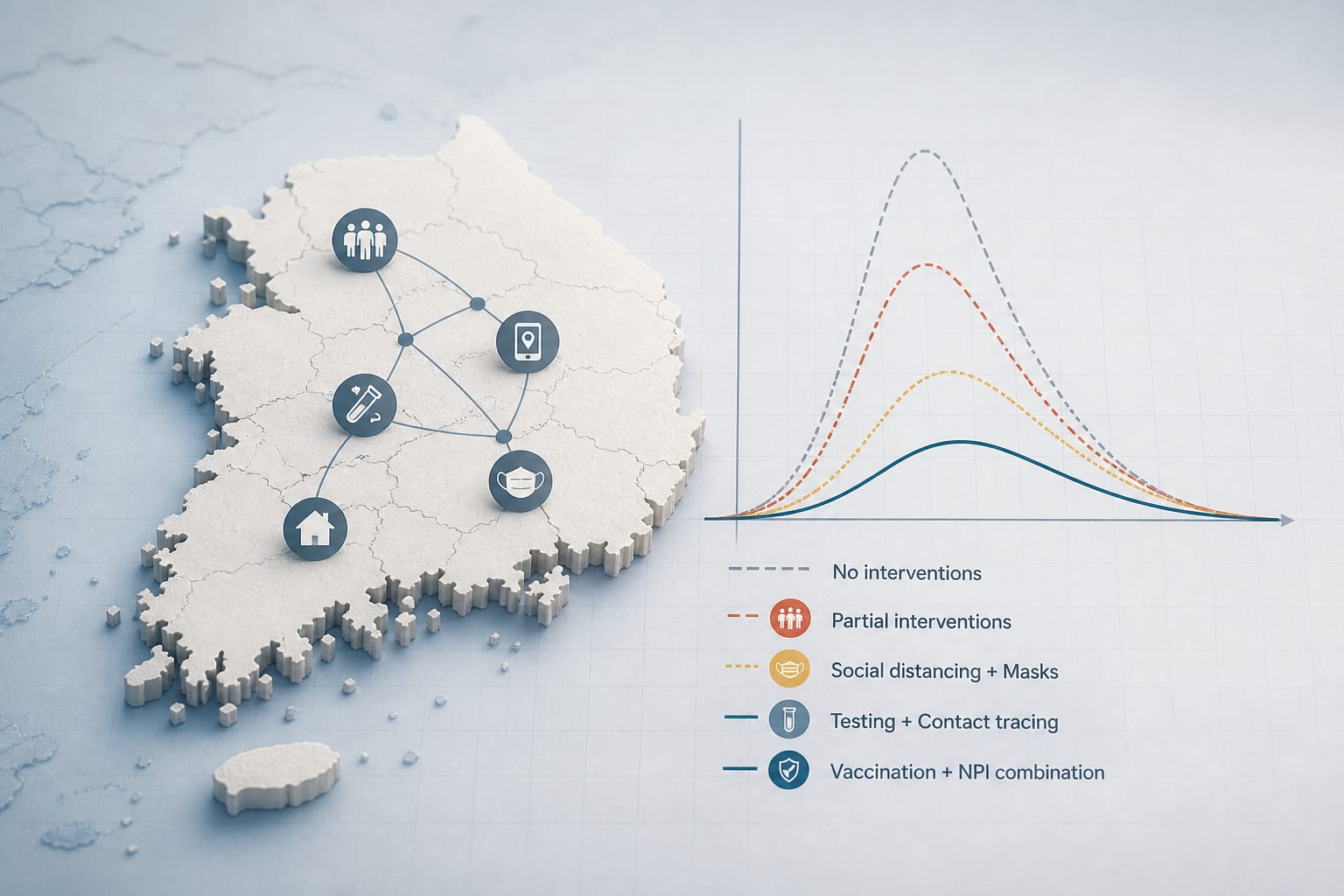
This study used an age-specific, deterministic V-SEIQR model to retrospectively evaluate how vaccination, testing, contact tracing, and social distancing influenced COVID-19 transmission in South Korea. Counterfactual scenarios compared alternative intervention timings and intensities during the pre-Delta and Delta-dominant periods.
Background
Nonpharmaceutical interventions—including testing, contact tracing, isolation, quarantine, and social distancing—were central to South Korea’s COVID-19 response. Drawing on experience from the 2015 MERS outbreak, the country rapidly established testing, epidemiological investigation, real-time surveillance, and quarantine systems without nationwide lockdowns.
Data Highlights
Data covered November 1, 2020, through December 31, 2021.
Advancing vaccination by 2 months reduced cumulative confirmed cases by 48% in the pre-Delta simulation.
Accelerating vaccination 2.5-fold from October 15 to December 1 reduced Delta-period cumulative confirmed cases by approximately 20%.
In a Delta-period scenario with testing capacity reduced to 90% of the reference level, cumulative confirmed cases increased 4.7-fold.
Key Findings
Earlier vaccine deployment had greater modeled impact than accelerating rollout after vaccination began.
Reduced testing capacity and weaker contact tracing increased modeled case burdens.
Delaying the Gradual Recovery to a New Normal policy or maintaining stricter distancing longer mitigated Delta-period resurgence.
Intervention effects varied by timing, intensity, and epidemiological period.
The findings are counterfactual model estimates rather than observed causal effects.
Clinical Implications
The findings suggest the importance of early vaccine deployment, sustained testing and contact tracing capacity, and timely adjustment of social distancing. Because this was a population-level modeling study, its implications primarily concern pandemic preparedness and public health policy rather than individual patient care.
Conclusion
South Korea’s epidemic trajectory could have differed meaningfully under alternative policy scenarios. The model suggests that earlier vaccination, sustained detection and contact tracing, and timely social-distancing adjustments could support epidemic control through distinct pathways.
Related Resources & Content
Counterfactual evaluation of COVID-19 control policies in South Korea: A scenario-based modeling study
Supplementary materials accompanying the study
Korea Disease Control and Prevention Agency surveillance data