Case Report: Supraorbital keyhole resection of IDH-mutant grade 3 astrocytoma of the medial orbitofrontal region - Report - MDSpire

Case Report: Supraorbital keyhole resection of IDH-mutant grade 3 astrocytoma of the medial orbitofrontal region

  • By

  • Nurali Ashirov

  • David Pochivalov

  • Daniyar Zhamoldin

  • Viktor Aleinikov

  • Berik Zhetpisbayev

  • Aisa Nurpeisov

  • Vladimir Kenzhebayev

  • Serik Akshulakov

  • July 10, 2026

  • 0 min

Share

Clinical Report: Supraorbital Keyhole Approach for Resection of IDH-Mutant Grade 3 Astrocytoma

Background

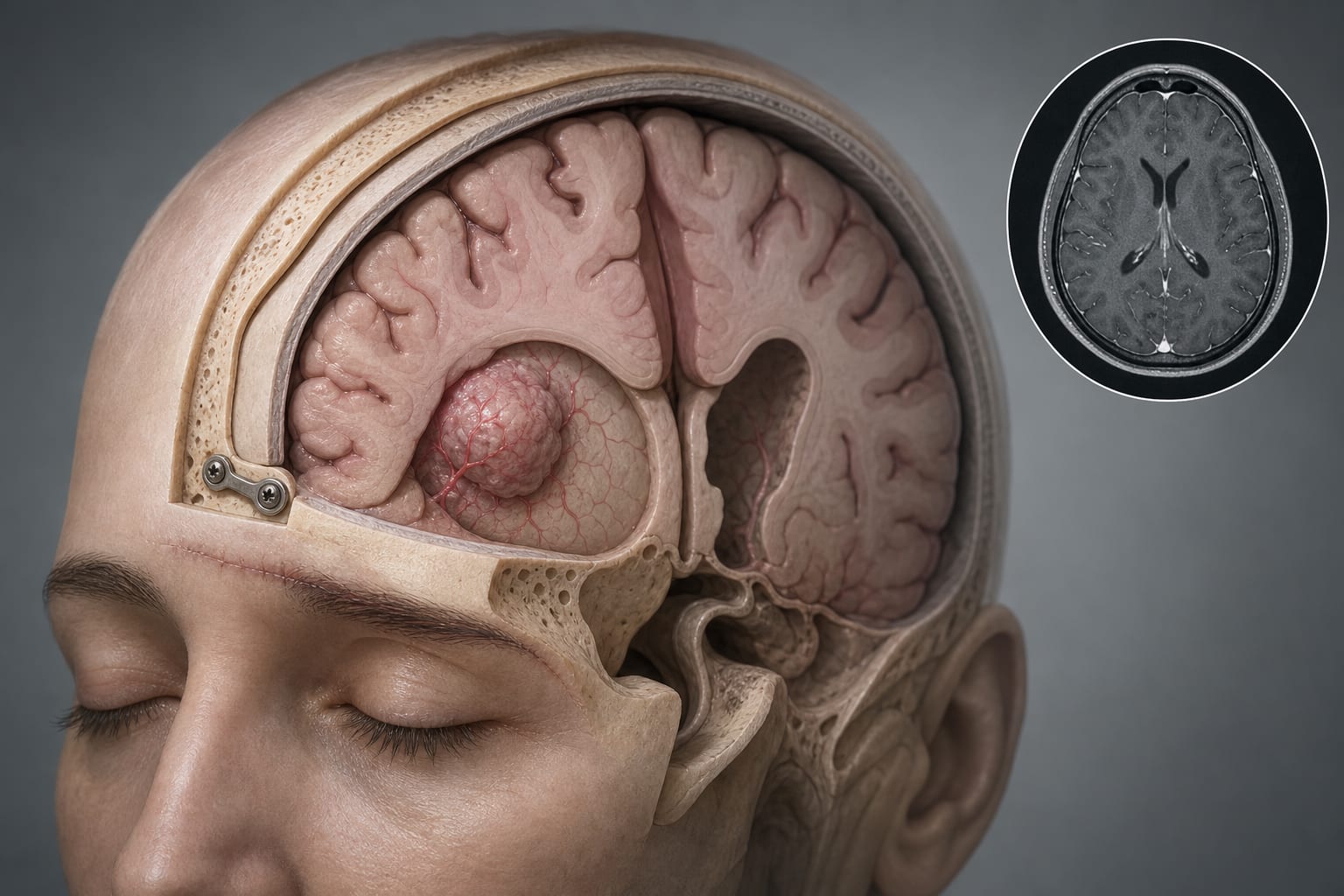
High-grade gliomas, particularly those located in the medial orbitofrontal region, pose significant surgical challenges due to their deep location and proximity to critical structures. The supraorbital trans-eyebrow approach offers a minimally invasive option.

Data Highlights

No numerical data or trial data presented in the article.

Key Findings

  • A 47-year-old female with an IDH-mutant Grade 3 astrocytoma underwent gross total resection via a supraorbital keyhole approach.
  • Postoperative MRI confirmed gross total resection without residual tumor.
  • Histopathological examination showed microvascular proliferation consistent with Grade 3 astrocytoma.
  • The patient received standard adjuvant radiochemotherapy with temozolomide following surgery.
  • Follow-up indicated preserved neurological function and high cosmetic satisfaction.

Clinical Implications

The case demonstrates the feasibility of the supraorbital keyhole approach for resecting high-grade gliomas in challenging locations.

Conclusion

The successful application of the supraorbital keyhole approach in this case highlights its application for medial orbitofrontal IDH-mutant high-grade gliomas.

Related Resources & Content

  1. EANO guidelines on the diagnosis and treatment of diffuse gliomas of adulthood - PMC
  2. EANS-EANO guidelines on the extent of resection in gliomas | Neuro-Oncology | Oxford Academic
  3. Techniques for a Paramedian Transparietal Approach to Access the Lateral Ventricle in the Dominant Hemisphere
  4. Utilizing a Combined Exoscopic and Endoscopic Oblique Technique for Accessing Parafalx Lesions via the Interhemispheric Fissure While Preserving Surrounding Structures: A Step-by-Step Guide
  5. Techniques for Endoscopic Transorbital Resection of Sphenoid Osseous Meningioma Using the Lateral Orbital 'Sliding Coach Door' Method
  6. Techniques for Endoscopic Endonasal Resection of Tuberculum Sellae Meningiomas
  7. EANO guidelines on the diagnosis and treatment of diffuse gliomas of adulthood - PMC
  8. EANS-EANO guidelines on the extent of resection in gliomas | Neuro-Oncology | Oxford Academic

Original Source(s)

Related Content