Prompt-Sensitive Decision Behavior of Large Language Models in Intensive Care Unit Mortality Prediction for Spontaneous Intracerebral Hemorrhage: Comparative Benchmarking Study - Report - MDSpire

Prompt-Sensitive Decision Behavior of Large Language Models in Intensive Care Unit Mortality Prediction for Spontaneous Intracerebral Hemorrhage: Comparative Benchmarking Study

  • By

  • Jinn-Rung Kuo

  • Guan-Yu Chen

  • Xiao-Han Vivian Yap

  • Chao-Chien Li

  • Yung-De Kuo

  • Chung-Feng Liu

  • July 8, 2026

  • 0 min

Share

Clinical Report: Evaluating the Impact of Prompting on Decision-Making by LLMs

Overview

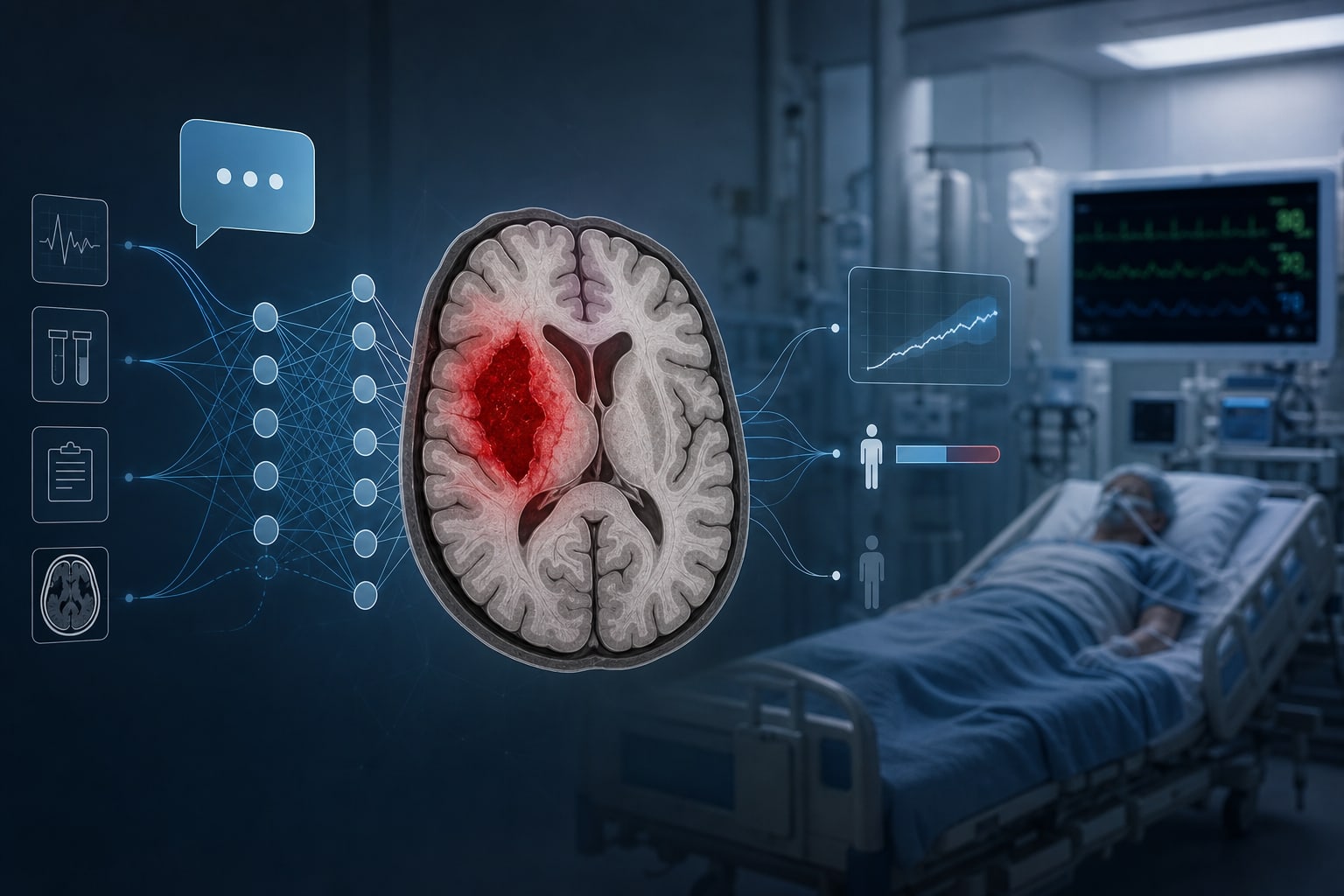
This study evaluates the performance of inference-only large language models (LLMs) in predicting mortality for ICU patients with spontaneous intracerebral hemorrhage (SICH). It compares these models to traditional outcome-trained machine learning models, focusing on predictive discrimination and decision behavior.

Background

Spontaneous intracerebral hemorrhage (SICH) is a severe form of stroke associated with high mortality and disability. Accurate mortality risk estimation in ICU patients with SICH is crucial for clinical decision-making. Traditional prognostic methods have limitations, prompting the exploration of machine learning and large language models for improved predictive capabilities.

Data Highlights

No specific numerical data or trial results were provided in the source material.

Key Findings

  • Inference-only LLMs generate probability-like outputs through language-mediated reasoning.
  • Traditional machine learning models are optimized using outcome-labeled data for predictive accuracy.
  • Concerns exist regarding the interpretability and reliability of LLM outputs in clinical settings.
  • Threshold-dependent decision behavior of LLMs has not been extensively studied.
  • Explainability frameworks like SHAP differ significantly from LLM-generated explanations.

Clinical Implications

Understanding the differences between LLMs and traditional machine learning models is essential for clinicians when interpreting mortality predictions.

Conclusion

The study emphasizes the need for careful evaluation of LLMs in clinical prediction tasks.
Related Resources & Content

  1. Author(s)/Org, Source, Year -- Title
  2. European Stroke Organisation (ESO) and European Association of Neurosurgical Societies (EANS) guideline on stroke due to spontaneous intracerebral haemorrhage | European Stroke Journal | Oxford Academic
  3. npj Digital Medicine — Collaboration Between Humans and Large Language Models in Clinical Practice: A Systematic Review and Meta-Analysis
  4. Intensive Care Medicine — Utilizing Behavioral AI Technology for Triage Decisions in COVID-19 Intensive Care: Clarifying Implicit Judgments
  5. npj Digital Medicine — Comparative Analysis of Diagnostic and Triage Efficacy Between Large Language Models and Healthcare Professionals, Including Collaborative Outcomes
  6. npj Digital Medicine — Improving Privacy-Respecting Deployable Large Language Models for Detecting Perioperative Complications: A Focused Approach Using LoRA Fine-Tuning
  7. 2022 Guideline for the Management of Patients With Spontaneous Intracerebral Hemorrhage: A Guideline From the American Heart Association/American Stroke Association
  8. European Stroke Organisation (ESO) and European Association of Neurosurgical Societies (EANS) guideline on stroke due to spontaneous intracerebral haemorrhage | European Stroke Journal | Oxford Academic
  9. The third Intensive Care Bundle with Blood Pressure Reduction in Acute Cerebral Haemorrhage Trial (INTERACT3): an international, stepped wedge cluster randomised controlled trial
  10. Rapid Blood-Pressure Lowering in Patients with Acute Intracerebral Hemorrhage | New England Journal of Medicine
  11. The ICH score: a simple, reliable grading scale for intracerebral hemorrhage - PubMed
  12. Do-not-resuscitate orders and predictive models after intracerebral hemorrhage[image] - PMC
  13. Multicenter Validation of the max-ICH Score in Intracerebral Hemorrhage - PubMed
  14. Minimally invasive surgery with thrombolysis in intracerebral haemorrhage evacuation (MISTIE III): a randomised, controlled, open-label phase 3 trial with blinded endpoint - PMC
  15. Thrombolytic removal of intraventricular haemorrhage in treatment of severe stroke: results of the randomised, multicentre, multiregion, placebo-controlled CLEAR III trial - PMC
  16. Minimally invasive trans-sulcal parafascicular surgery for the early evacuation of spontaneous intracerebral hemorrhage: the ENRICH trial - PMC
  17. European Stroke Organisation (ESO) and European Association of Neurosurgical Societies (EANS) guideline on stroke due to spontaneous intracerebral haemorrhage - PMC
  18. After Spontaneous ICH, Does Earlier rFVIIa Improve Outcomes? | NEJM Clinician
  19. Tranexamic acid for hyperacute primary IntraCerebral Haemorrhage (TICH-2): an international randomised, placebo-controlled, phase 3 superiority trial - PMC

Original Source(s)

Related Content