Prognostic impact of iliofemoral access-site calcification volume on outcomes after transcatheter aortic valve implantation - Report - MDSpire

Prognostic impact of iliofemoral access-site calcification volume on outcomes after transcatheter aortic valve implantation

  • By

  • Vivian Vij

  • Katja Schauwienold

  • Jasmin Shamekhi

  • Samuel Muli

  • Mustafa Basha

  • Eleftherios Markidis

  • Andreas Zietzer

  • Philip Düsing

  • Muntadher Al Zaidi

  • Marcel Weber

  • Lara Al-Kassou

  • Tobias Zeus

  • Victor Mauri

  • Matti Adam

  • Jörg Schröder

  • Stephan Baldus

  • Malte Kelm

  • Nikolaus Marx

  • Farhad Bakhtiary

  • Enzo Lüsebrink

  • Sebastian Zimmer

  • Georg Nickenig

  • Alexander Sedaghat

  • Baravan Al-Kassou

  • June 11, 2026

  • 0 min

Share

Clinical Report: Influence of Iliofemoral Access-Site Calcification Volume on Outcomes Following TAVI

Overview

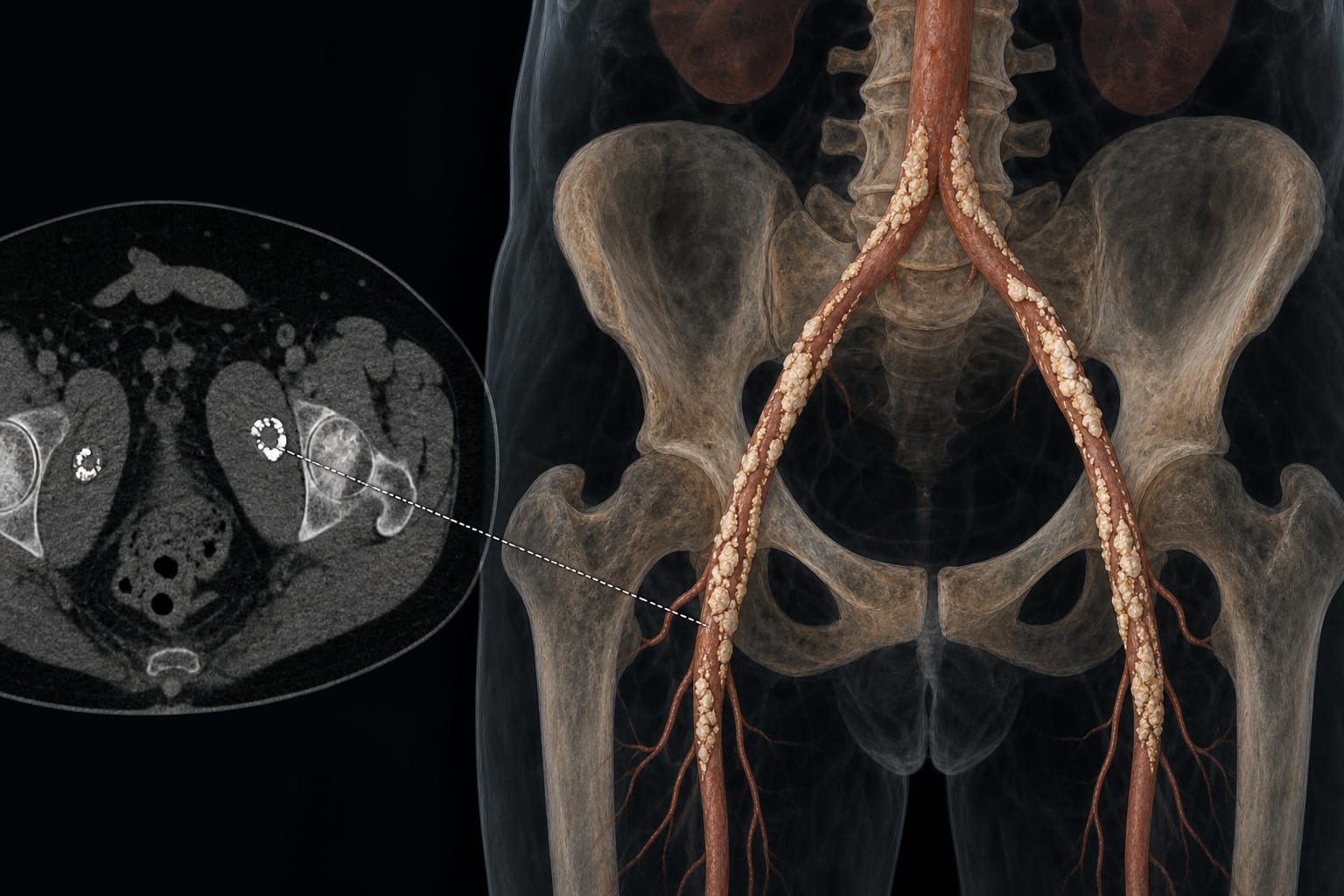
This study investigates the prognostic significance of iliofemoral access-site calcification (IASC) volume in patients undergoing transcatheter aortic valve implantation (TAVI).

Background

Transcatheter aortic valve implantation (TAVI) is a critical intervention for patients with severe symptomatic aortic stenosis. Accurate pre-procedural assessment of vascular anatomy and calcification is essential.

Data Highlights

The study analyzed 1067 patients who underwent TAVI, focusing on the relationship between IASC volume and clinical outcomes.

Key Findings

  • Higher IASC volume is independently associated with increased mid- and long-term all-cause mortality.
  • No significant association was found between IASC volume and peri-procedural major vascular or bleeding complications at 30 days.
  • CT-derived volumetric assessment provides a more objective measure of vascular calcification compared to qualitative estimates.
  • The study utilized a dedicated three-dimensional software for accurate quantification of IASC volume.
  • Follow-up data were collected through routine outpatient visits and standardized telephone interviews.

Clinical Implications

Clinicians should consider the volume of iliofemoral calcification when evaluating patients for TAVI, as it may serve as a prognostic marker for long-term outcomes. Enhanced pre-procedural imaging and assessment can aid in better patient selection and management.

Conclusion

Quantifying iliofemoral calcification volume in TAVI patients is linked to long-term mortality outcomes.

Related Resources & Content

  1. Clinical Research in Cardiology, 2023 -- Prognostic impact of iliofemoral access-site calcification volume on outcomes after transcatheter aortic valve implantation
  2. Clinical Research in Cardiology, 2023 -- Intravascular Lithotripsy Facilitates Safe and Effective Transfemoral Approach for Aortic Valve Replacement
  3. Clinical Research in Cardiology, 2023 -- Prognostic Significance and Diagnostic Utility of Invasively Obtained Hemodynamic Metrics in Severe Aortic Stenosis Patients Undergoing Transcatheter Aortic Valve Implantation
  4. Clinical Research in Cardiology, 2020 -- Factors Influencing Low TAVI-Prosthesis Position Evaluated Through Fusion Imaging of Pre- and Post-Procedure CT Angiography
  5. 2025 ESC/EACTS Guidelines for the Management of Valvular Heart Disease
  6. Clinical Research in Cardiology — Calcification Patterns and Clinical Outcomes Following TAVI in Patients with End-Stage Renal Disease
  7. https://inavalverhd.inaheart.org/wp-content/uploads/2025/09/2025-ESC-EACTS-Guidelines-for-the-Management-of-Valvular-Heart-Disease.pdf
  8. Prognostic impact of iliofemoral access-site calcification volume on outcomes after transcatheter aortic valve implantation | Clinical Research in Cardiology | Springer Nature Link
  9. Transcaval access for transcatheter aortic valve implantation: A meta-analysis and systematic review - PubMed

Original Source(s)

Related Content