Impact of metastatic pattern and histologic subtype on PD-(L)1 inhibitor efficacy in HER2-negative advanced gastric and gastroesophageal cancer: a meta-analysis - Report - MDSpire

Impact of metastatic pattern and histologic subtype on PD-(L)1 inhibitor efficacy in HER2-negative advanced gastric and gastroesophageal cancer: a meta-analysis

  • By

  • Derek Tai

  • Kyung-il Kim

  • Pranati Shah

  • Daniel Park

  • Lucas Kim

  • Jianan Li

  • Claire Jung

  • Sofia Guzman

  • Gagandeep Brar

  • Shengyang Wu

  • Dani Castillo

  • June 29, 2026

  • 0 min

Share

Clinical Report: Influence of Metastatic Sites and Histological Subtypes on PD-(L)1

Overview

This meta-analysis evaluates the impact of metastatic sites and histological subtypes on survival outcomes in HER2-negative advanced gastric and gastroesophageal cancer treated with PD-(L)1 inhibitors. The findings are based on the analysis of overall survival outcomes in various patient subgroups.

Background

Gastric cancer is a leading cause of cancer-related deaths globally, with advanced stages often resulting in poor prognosis. The introduction of PD-(L)1 inhibitors has been evaluated for their role in treatment outcomes, with responses varying based on tumor biology and metastatic patterns.

Data Highlights

OutcomeHR (95% CI)p-value
Overall Survival (IO + CT vs CT)0.79 (0.75-0.84)<0.001
Overall Survival (LM)0.75-
Overall Survival (PM)0.93-
Overall Survival (Intestinal vs Diffuse)0.78 vs 0.87-
PD-L1 CPS ≥50.70-

Key Findings

  • Overall survival improved significantly with PD-(L)1 inhibitor plus chemotherapy compared to chemotherapy alone (HR 0.79).
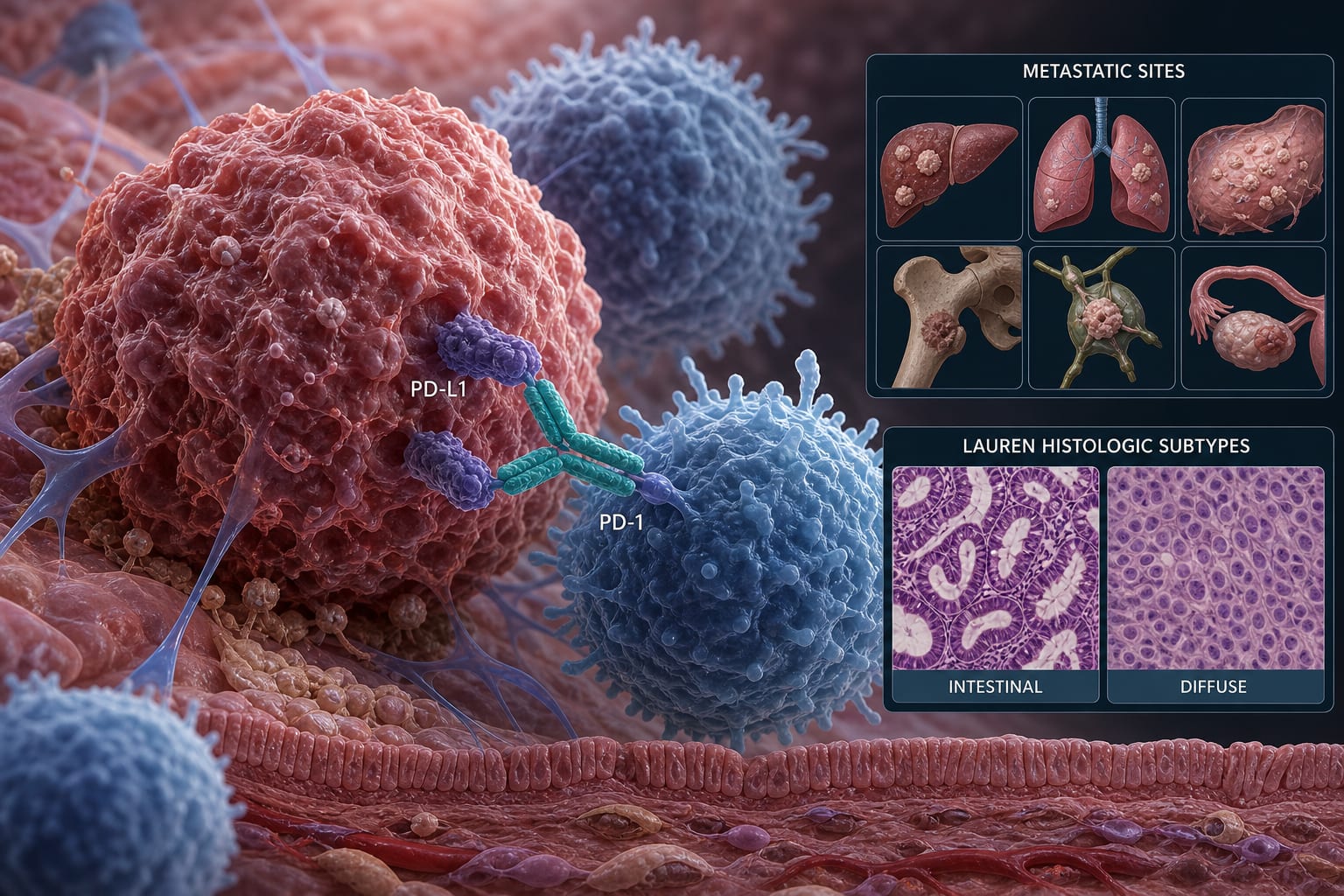
  • Patients with liver metastases showed better survival outcomes (HR 0.75) compared to those with peritoneal metastases (HR 0.93).
  • Intestinal-type tumors had a greater overall survival benefit than diffuse-type tumors (HR 0.78 vs 0.87).
  • PD-L1 CPS ≥5 was associated with superior overall survival benefit (HR 0.70).
  • Grade ≥3 adverse events were infrequent and primarily hematologic.

Clinical Implications

The findings suggest that treatment strategies for HER2-negative advanced gastric and gastroesophageal cancer should consider both the metastatic site and histological subtype. Specifically, patients with intestinal-type tumors and those without peritoneal metastases may derive greater benefit from PD-(L)1 inhibitor-based therapies.

Conclusion

First-line chemoimmunotherapy has been shown to prolong survival in HER2-negative gastric and gastroesophageal junction cancers.

Related Resources & Content

  1. Gastric Cancer — Variability in Predictive Biomarker Expression in Gastric and Esophagogastric Junction Carcinomas Associated with Peritoneal Metastasis
  2. Journal of Gastroenterology — The Role of Intratumoral HER2 Variability in Influencing Trastuzumab Effectiveness for Patients with HER2-Positive Gastric Cancer
  3. Gastric Cancer — Significance of PD-1 Expressing CD8 T-Cells in the Context of Gastric Cancer
  4. Gastric Cancer — Enhanced Scoring of PD-L1 in Gastric Carcinoma
  5. Immunotherapy and Targeted Therapy for Advanced Gastroesophageal Cancer: ASCO Guideline Update | Journal of Clinical Oncology
  6. First-Line Nivolumab Plus Chemotherapy for Advanced Gastric, Gastroesophageal Junction, and Esophageal Adenocarcinoma: 3-Year Follow-Up of the Phase III CheckMate 649 Trial | Journal of Clinical Oncology
  7. PD-L1 CPS in gastroesophageal cancer: differences in routine care versus Checkmate 649 and implications for biopsy-site choice and assay standardisation | British Journal of Cancer
  8. Immunotherapy and Targeted Therapy for Advanced Gastroesophageal Cancer: ASCO Guideline Update | Journal of Clinical Oncology
  9. First-Line Nivolumab Plus Chemotherapy for Advanced Gastric, Gastroesophageal Junction, and Esophageal Adenocarcinoma: 3-Year Follow-Up of the Phase III CheckMate 649 Trial | Journal of Clinical Oncology
  10. PD-L1 CPS in gastroesophageal cancer: differences in routine care versus Checkmate 649 and implications for biopsy-site choice and assay standardisation | British Journal of Cancer

Original Source(s)

Related Content