Rethinking the 2-Hour Rule: Equilibrium and Saturation in Polymyxin B Hemoadsorption
-
By
-
Chizuru Yamashita
-
Yu Kato
-
Takahiro Kawaji
-
Mariko Nagata
-
Osamu Nishida
-
Tomoyuki Nakamura
-
October 8, 2026
Clinical Report: Rethinking the 2-Hour Rule in Polymyxin B Hemoadsorption
Overview
This letter challenges the claim that a PMX-20R cartridge approaches endotoxin saturation after a 2-hour treatment. The authors interpret earlier closed-loop experiments as showing adsorption–desorption equilibrium, and cite continuous-loading and clinical observations of endotoxin removal during longer treatments. These findings address cartridge kinetics and do not establish clinical efficacy of prolonged PMX treatment.
Background
Polymyxin B hemoadsorption (PMX) has been evaluated in septic shock, with trial results varying across studies. The Tigris trial used a Bayesian design informed by EUPHRATES evidence and studied patients with endotoxin activity (EA) values of 0.60–0.89. A commentary on Tigris described a PMX-20R adsorption capacity of approximately 10–20 µg and suggested near-saturation during a 2-hour session. The letter examines the experimental basis for that interpretation and discusses evidence from longer-duration models and clinical use.
Data Highlights
| Evidence | Reported data | Interpretation in the letter |
|---|---|---|
| Closed-loop experiments | A single 15-µg LPS spike; concentration reduction plateaued at approximately 2 hours. | The plateau is interpreted as dynamic adsorption–desorption equilibrium, not demonstrated saturation. |
| Human whole-blood experiment | After a 100-µg LPS load, approximately 20 µg was recovered bound to the cartridge at 2 hours. | A single 2-hour endpoint did not establish saturation. |
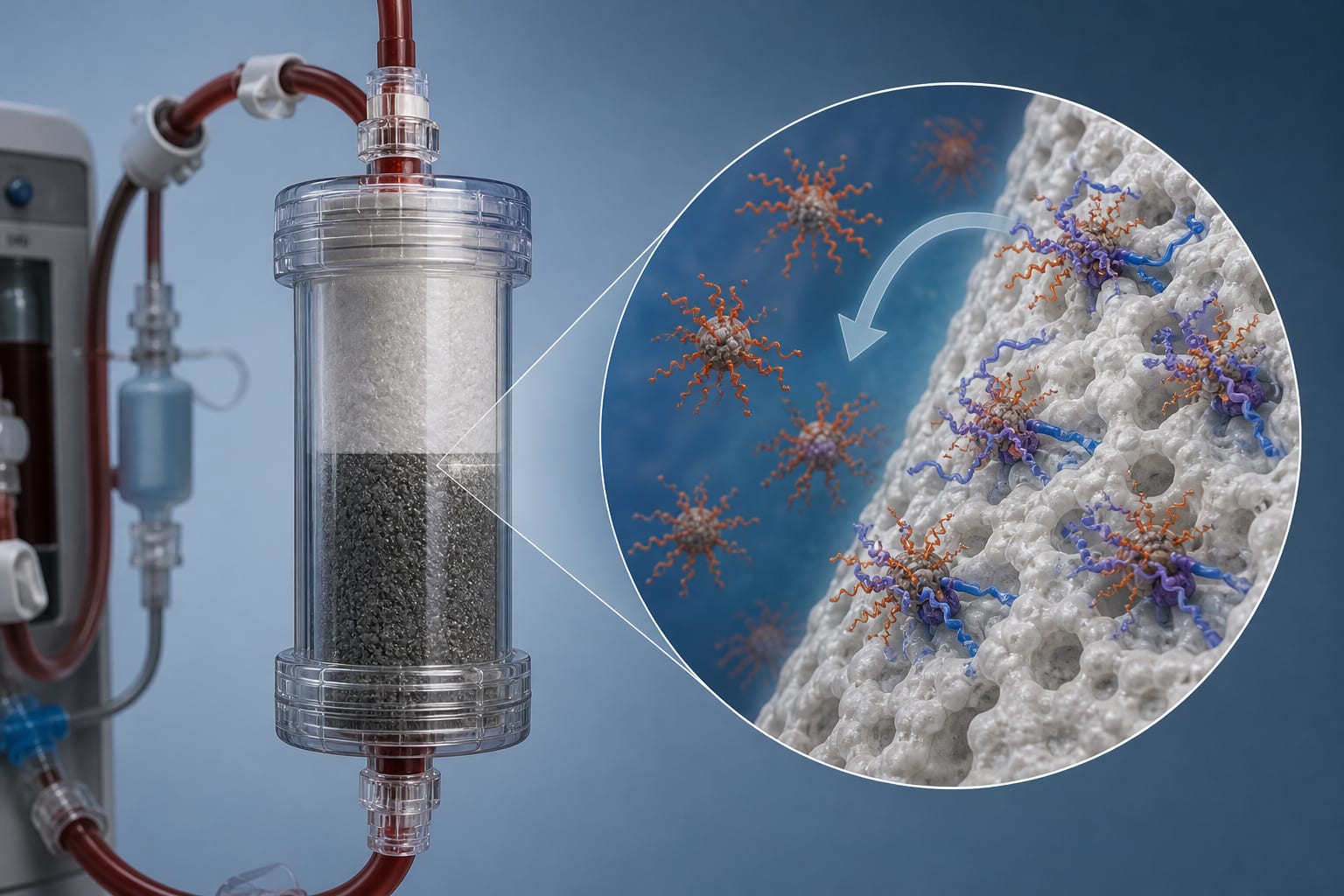
| Cartridge composition | PMX-20R contains approximately 300 mg immobilized polymyxin B. | The authors’ 1:1 molar-binding calculation yields a theoretical capacity more than 1,000-fold above the proposed 10–20-µg threshold. |
| Continuous-loading model | PMX-01R received LPS at 0.5 µg/h for 24 hours; cumulative adsorption reached 4.73 µg without saturation. Fiber-mass scaling gives 66.2 µg for PMX-20R. | Adsorption efficiency decreased after 2 hours, while the adsorption ratio thereafter remained approximately 40%. |
| Clinical PMX-20R treatment | In septic shock, median endotoxin removal was 74.4% after 24 hours among patients with pre-cartridge concentrations above the assay detection limit. | Reported clinical observation of endotoxin removal during extended treatment. |
| Japanese labeling | For acute exacerbation of idiopathic pulmonary fibrosis, treatment is 6–24 hours per cartridge. | The letter notes this approved treatment duration and reports national insurance coverage since November 2024. |
Key Findings
- The approximately 2-hour plateau in closed-circuit experiments followed a single 15-µg LPS spike; the authors attribute it to adsorption–desorption equilibrium rather than proven cartridge saturation.
- Recovery of approximately 20 µg of cartridge-bound LPS after a 100-µg whole-blood load was measured only at the 2-hour endpoint, so the experiment did not establish when or whether saturation occurred.
- The PMX-20R contains approximately 300 mg of immobilized polymyxin B; the letter’s theoretical 1:1 molar-binding calculation exceeds the proposed 10–20-µg limit by more than 1,000-fold.
- In a 24-hour continuous-loading experiment using the neonatal PMX-01R, cumulative adsorption reached 4.73 µg without saturation; scaling by fiber mass, the authors estimate 66.2 µg for PMX-20R.
- In the continuous-loading model, adsorption efficiency declined after the first 2 hours, but the endotoxin adsorption ratio remained approximately 40% thereafter.
- The letter reports 24-hour clinical PMX-20R endotoxin removal in septic shock, including a median removal rate of 74.4% among patients whose baseline endotoxin exceeded the assay detection limit; it also notes Japanese labeling of 6–24 hours per cartridge for acute exacerbation of idiopathic pulmonary fibrosis.
Clinical Implications
The authors state that the available experimental evidence does not support assuming PMX-20R saturation at 2 hours and caution that this assumption could discourage consideration of prolonged treatment. They propose that longer perfusion with one cartridge may enhance endotoxin removal, while the evidence presented here does not establish a clinical outcome benefit from that strategy.
Conclusion
The letter argues that a 2-hour concentration plateau should not be equated with PMX cartridge saturation. Continuous-loading and clinical observations support endotoxin removal beyond 2 hours, but do not by themselves demonstrate improved patient outcomes with prolonged treatment.
Related Resources & Content
- Legrand et al., Critical Care, 2026 — Polymyxin B hemoadsorption in endotoxic septic shock: ten questions on the Tigris trial
- Foster and Kellum, review cited in the letter — Source for the proposed 10–20-µg adsorption capacity
- Romaschin et al., experimental studies cited in the letter — LPS adsorption experiments
- Kodama et al., PMX cartridge development study cited in the letter — Cartridge composition and experimental data
- Mitaka et al., 2014 — Clinical endotoxin removal during 24-hour PMX-20R treatment
- Surviving Sepsis Campaign, SCCM, 2026 — Adult Guidelines
- Payen et al., JAMA, 2009 — Early Use of Polymyxin B Hemoperfusion in Abdominal Septic Shock: The EUPHAS Randomized Controlled Trial
- Intensive Care Medicine, 2022 — Extracorporeal Hemoperfusion in Critical Care Settings
- Intensive Care Medicine — No Significant Reduction of Meropenem Levels by the Cytokine Adsorber CytoSorb® in Critically Ill Patients Experiencing Sepsis or Septic Shock
- Infection — Optimized Dosing Strategies for Meropenem in Critically Ill Patients Undergoing SLEDD: Insights from an Observational Study
- Intensive Care Medicine — Optimizing Dosing Strategies for Meropenem and Piperacillin/Tazobactam in Critically Ill Patients Undergoing Renal Replacement Therapy
- Surviving Sepsis Campaign Adult Guidelines | SCCM
- Early Use of Polymyxin B Hemoperfusion in Abdominal Septic Shock: The EUPHAS Randomized Controlled Trial
- Polymyxin B hemoadsorption in endotoxic septic shock: ten questions on the Tigris trial
- Extracorporeal Hemoperfusion in Critical Care Settings
- Early Use of Polymyxin B Hemoperfusion in Abdominal Septic Shock: The EUPHAS Randomized Controlled Trial | Critical Care Medicine | JAMA | JAMA Network
Based on findings from:
Beyond the 2-hour dogma: adsorption equilibrium versus saturation in polymyxin B hemoadsorption
Chizuru Yamashita, Yu Kato, Takahiro Kawaji, Mariko Nagata, Osamu Nishida, Tomoyuki Nakamura. Critical Care, 2026.
https://link.springer.com/article/10.1186/s13054-026-06383-1
This content is an AI-generated, fully rewritten summary based on a published scholarly article. It does not reproduce the original text and is not a substitute for the original publication. Readers are encouraged to consult the source for full context, data, and methodology.