Longitudinal changes in the ALPS index and its clinical correlates in patients with basal ganglia hemorrhage - Report - MDSpire

Longitudinal changes in the ALPS index and its clinical correlates in patients with basal ganglia hemorrhage

  • By

  • Zhaofeng Su

  • Jiajia Chen

  • Peng Wu

  • Rongjun Zhang

  • Xiaochi Yang

  • Nan Dong

  • Zhihui Fu

  • July 9, 2026

  • 0 min

Share

Clinical Report: Temporal Variations in the ALPS Index and Its Clinical Associations

Overview

This study evaluates the DTI-ALPS index's robustness and its correlation with clinical characteristics in patients post-basal ganglia hemorrhage. Findings indicate significant differences in the ALPS index among patient groups.

Background

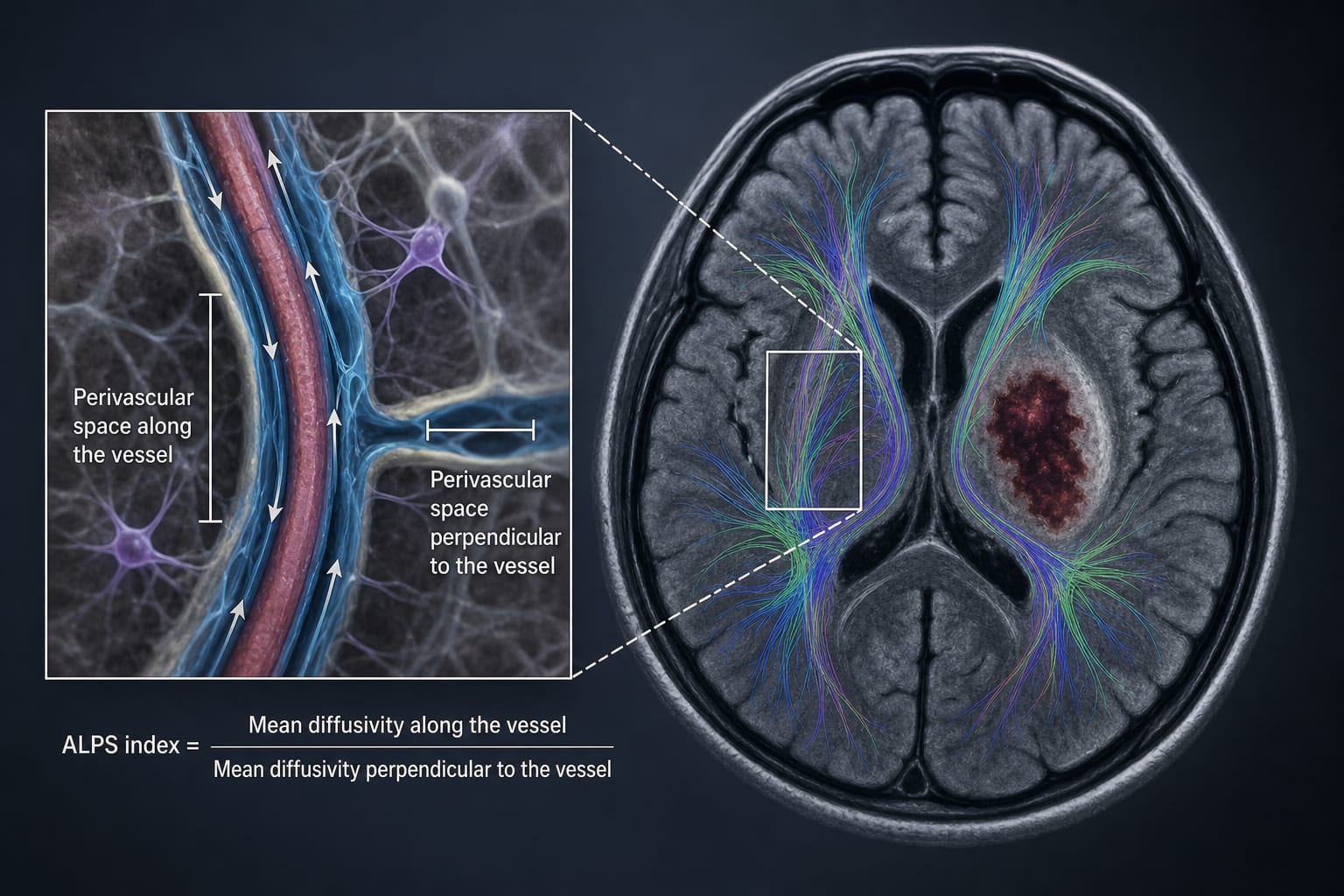
Spontaneous intracerebral hemorrhage (ICH) is a critical condition that can lead to severe neurological deficits. Understanding the microstructural changes in the brain following such events is essential. The ALPS index serves as a potential imaging biomarker to assess glymphatic function.

Data Highlights

GroupALPS Indexn
Group A (≤ 14 days)1.24 ± 0.0334
Group B (3 months)1.14 ± 0.0412
Group C (1 year)1.18 ± 0.0410

Key Findings

  • ALPS index showed significant differences among patient groups (p < 0.05).
  • All patient groups had significantly lower ALPS indices compared to healthy controls (p < 0.001).
  • No significant correlation was found between ALPS index and Brunnstrom recovery stage for the hand (r = 0.219, p > 0.05).
  • A significant negative correlation was observed between ALPS index and hematoma volume in the ≤ 10 mL subgroup (r = −0.529, p < 0.05).
  • The consistency of ALPS index measurements between 15-direction and 32-direction DTI data was excellent (ICC = 0.959–0.981, p < 0.05).

Clinical Implications

The ALPS index may serve as a useful imaging biomarker for assessing glymphatic function in patients following basal ganglia hemorrhage.

Conclusion

The study highlights the ALPS index in understanding the impact of basal ganglia hemorrhage on glymphatic function.

Related Resources & Content

  1. Frontiers in Surgery, 2026 -- Retrospective clinical study of endoscopic transfrontal approach vs. transSylvian-transinsular craniotomy for hypertensive intracerebral hemorrhage in basal ganglia: efficacy comparison and value of anatomical cognition of Sylvian fissure
  2. Dynamics of Alpha 2-Plasmin Inhibitor and Plasmin-Alpha 2-Plasmin Inhibitor Complex Levels in Traumatic Brain Injury Patients
  3. Temporal Progression of Neurological Impairments Following Surgery for Primary Brain Tumors
  4. European Stroke Organisation (ESO) and European Association of Neurosurgical Societies (EANS) guideline on stroke due to spontaneous intracerebral haemorrhage - PMC
  5. 2022 Guideline for the Management of Patients With Spontaneous Intracerebral Hemorrhage: A Guideline From the American Heart Association/American Stroke Association
  6. Frontiers in Neurology — Morphological and electroencephalographic correlates in patients with disorders of consciousness following primary brainstem hemorrhage: a retrospective analysis
  7. Evaluation of the Glymphatic System Using the DTI-ALPS Index in Patients with Spontaneous Intracerebral Haemorrhage
  8. Diffusion Tensor Image Analysis ALong the Perivascular Space (DTI-ALPS): Revisiting the Meaning and Significance of the Method
  9. European Stroke Organisation (ESO) and European Association of Neurosurgical Societies (EANS) guideline on stroke due to spontaneous intracerebral haemorrhage - PMC
  10. 2022 Guideline for the Management of Patients With Spontaneous Intracerebral Hemorrhage: A Guideline From the American Heart Association/American Stroke Association
  11. The third Intensive Care Bundle with Blood Pressure Reduction in Acute Cerebral Haemorrhage Trial (INTERACT3): an international, stepped wedge cluster randomised controlled trial - PMC
  12. Trial of Early Minimally Invasive Removal of Intracerebral Hemorrhage | New England Journal of Medicine
  13. Minimally Invasive Surgery for Spontaneous Intracerebral Hemorrhage: Meta‐Analysis of High‐Quality Randomized Clinical Trials - Alkhiri - 2025 - Annals of Neurology - Wiley Online Library
  14. Checking your browser - reCAPTCHA
  15. MRI-Based ALPS Index as a Biomarker of Glymphatic Dysfunction and Prognosis After Aneurysmal Subarachnoid Hemorrhage - PubMed
  16. Improving detection of cerebral small vessel disease aetiology in patients with isolated lobar intracerebral haemorrhage | Stroke and Vascular Neurology
  17. Glymphatic dysfunction correlates with severity of small vessel disease and cognitive impairment in cerebral amyloid angiopathy - Xu - 2022 - European Journal of Neurology - Wiley Online Library

Original Source(s)

Related Content