CD3+ T-cell count prediction for anti-thymocyte globulin treatment monitorization in kidney transplant recipients: a machine learning model - Report - MDSpire

CD3+ T-cell count prediction for anti-thymocyte globulin treatment monitorization in kidney transplant recipients: a machine learning model

  • By

  • Ahmet B. Ak

  • Hayri K. Goren

  • Nuri B. Hasbal

  • Nur I. Genc

  • Sidar Copur

  • Lasin Ozbek

  • Burak Kocak

  • Adrian Covic

  • Mehmet Kanbay

  • June 18, 2026

  • 0 min

Share

Clinical Report: Predicting CD3+ T-cell Levels for Monitoring ATG Therapy

Overview

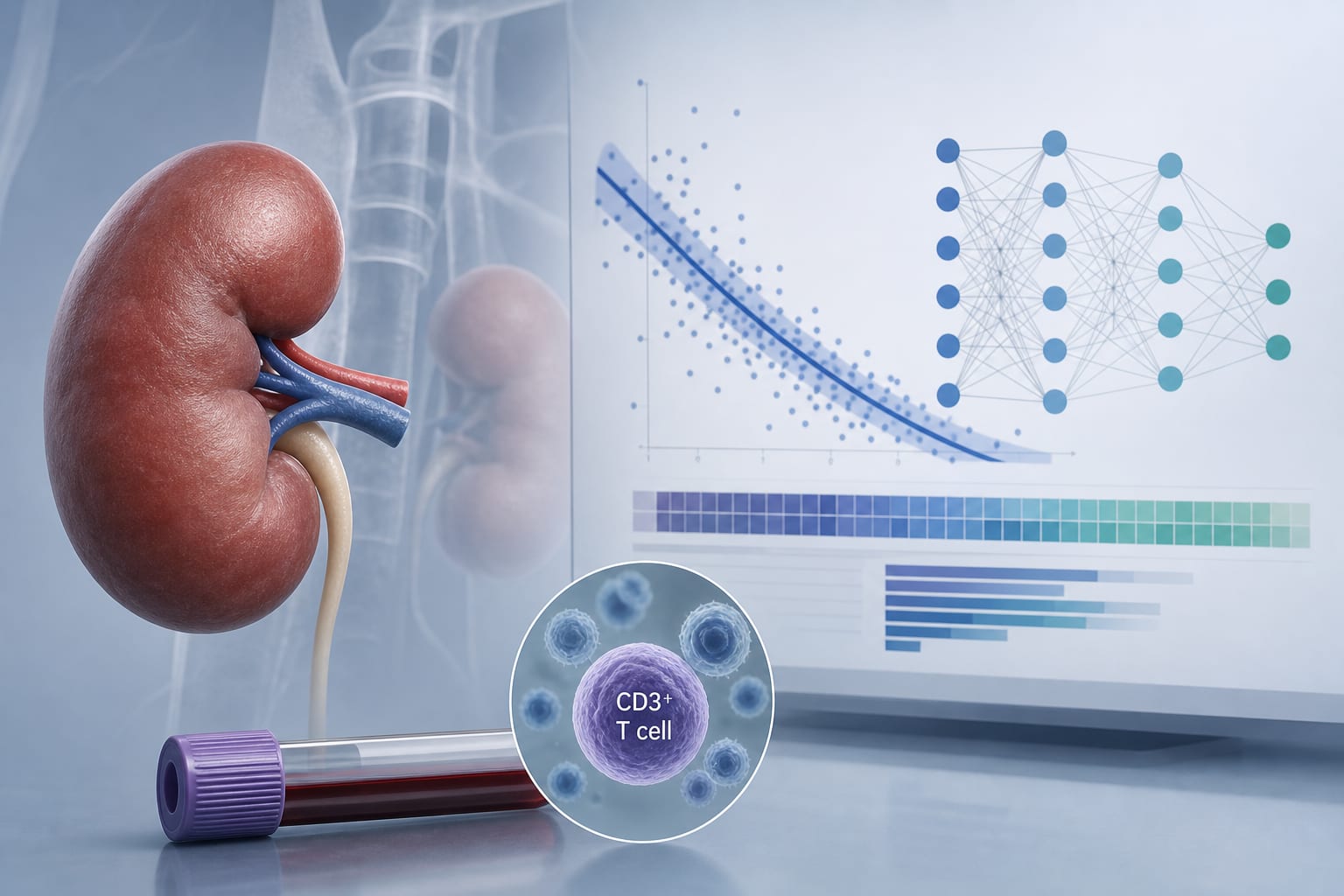
This study developed a machine learning model to predict CD3+ T-cell depletion in kidney transplant patients undergoing antithymocyte globulin (ATG) therapy.

Background

Monitoring ATG therapy is crucial in kidney transplantation to prevent acute rejection and manage the risks associated with over or undertreatment. Conventional methods rely on CD3+ T-cell quantification, which may not be available in all clinical settings. This study explores alternative predictive approaches using machine learning.

Data Highlights

DayThreshold% AchievedROC-AUC
1CD3+ T-cell < 50 cell/μl57.2%0.75 (test), 0.80 (validation)
2CD3+ T-cell < 30 cell/μl57.5%0.70 (test), 0.66 (validation)

Key Findings

  • 57.2% of patients achieved the day-1 CD3+ T-cell < 50 cell/μl threshold.
  • 57.5% of patients reached the day-2 CD3+ T-cell < 30 cell/μl threshold.
  • The machine learning model outperformed logistic regression in predicting CD3+ T-cell counts.
  • ROC-AUC values for day-1 predictions were 0.75 and 0.80 for test and validation sets, respectively.
  • Day-2 predictions yielded ROC-AUC scores of 0.70 and 0.66.

Clinical Implications

Machine learning models can predict CD3+ T-cell levels.

Conclusion

The study presents a machine learning framework for predicting CD3+ T-cell depletion in kidney transplant patients.

Related Resources & Content

  1. npj Digital Medicine, 2025 -- Enhancing post-kidney transplant prognostication: an interpretable machine learning approach for longitudinal outcome prediction
  2. Frontiers in Immunology, 2026 -- From thresholds to trajectories: a perspective on reframing alloimmune risk for computational modeling in solid organ transplantation
  3. the asco post, 2025 -- Machine Learning Program May Enhance Transplantation Risk Assessment in Patients With Myelofibrosis
  4. Transplant Recipient – KDIGO -- KDIGO Guidelines
  5. Interruption of anti-thymocyte globuline treatment in solid organ transplantation is effectively monitored through a low total lymphocyte count - PMC
  6. Prediction of peripheral blood lymphocyte subpopulations after renal transplantation - PMC
  7. The ASCO Post — Machine Learning Program May Enhance Transplantation Risk Assessment in Patients With Myelofibrosis
  8. Transplant Recipient – KDIGO
  9. Interruption of anti-thymocyte globuline treatment in solid organ transplantation is effectively monitored through a low total lymphocyte count - PMC
  10. Prediction of peripheral blood lymphocyte subpopulations after renal transplantation - PMC

Original Source(s)

Related Content