The hypoxia-epigenetics-ncRNA axis in endometriosis: from molecular cascades to self-sustaining pathogenic circuits - Report - MDSpire

The hypoxia-epigenetics-ncRNA axis in endometriosis: from molecular cascades to self-sustaining pathogenic circuits

  • By

  • Yangyi Zhang

  • Yating Zhan

  • Hao Wu

  • Weifeng Huang

  • Juan Du

  • June 26, 2026

  • 0 min

Share

Clinical Report: The Role of Hypoxia, Epigenetics, and Non-Coding RNA in Endometriosis

Overview

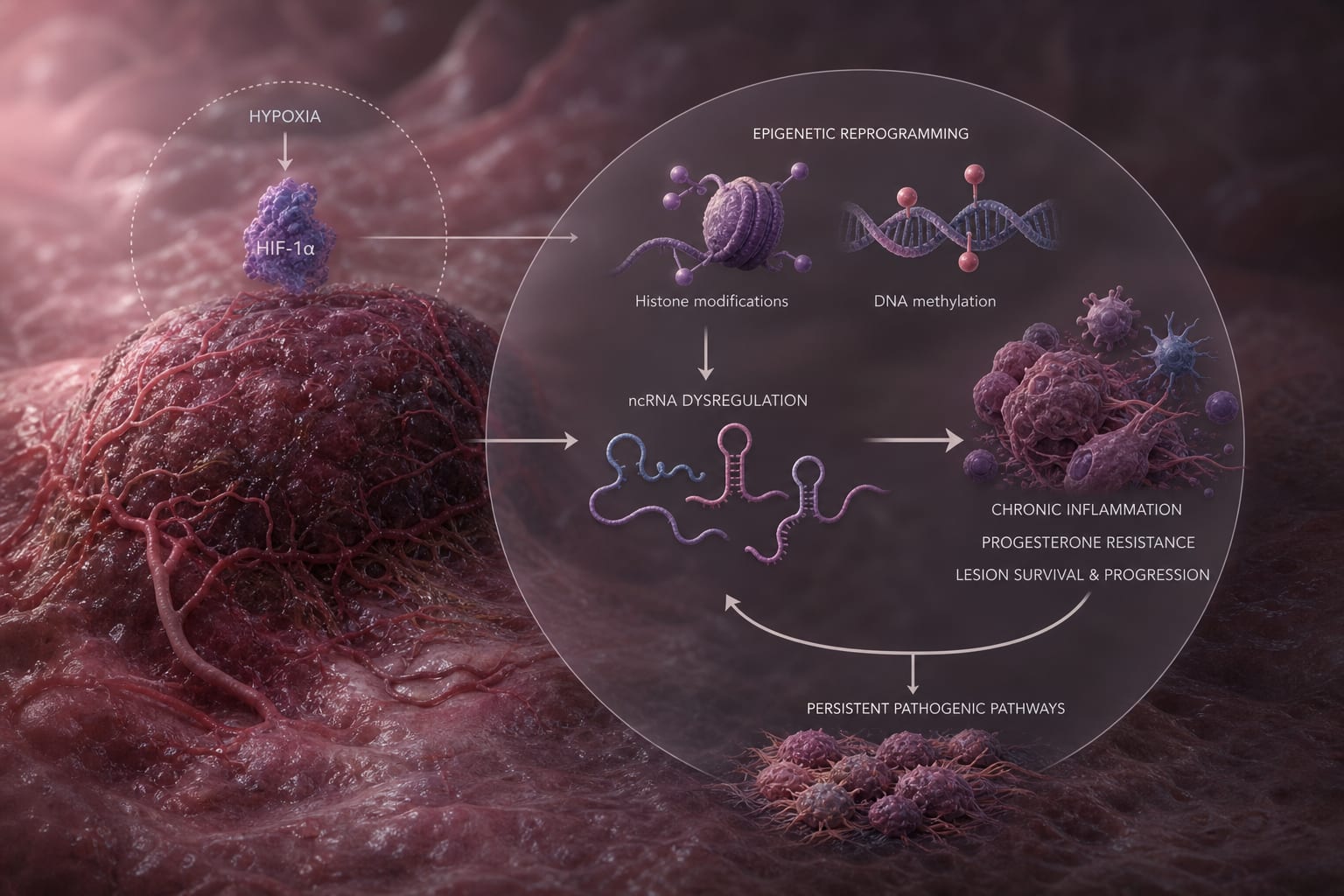
This review elucidates the hypoxia-epigenetics-non-coding RNA axis in endometriosis pathogenesis. It highlights the molecular reprogramming driven by hypoxia, leading to aberrant DNA methylation and ncRNA dysregulation, which contribute to the disease's clinical manifestations.

Background

Endometriosis is a chronic inflammatory disorder affecting approximately 10% of women of reproductive age, leading to significant morbidity. Understanding the molecular mechanisms underlying endometriosis is crucial for developing effective diagnostic and therapeutic strategies. The interplay between hypoxia, epigenetics, and non-coding RNAs is an area of ongoing research.

Data Highlights

No numerical or trial data provided in the source material.

Key Findings

  • Hypoxia stabilizes HIF-1α, initiating a cascade of epigenetic modifications in endometriosis.
  • Aberrant DNA methylation and histone modifications are fundamental to the pathogenesis of endometriosis.
  • Non-coding RNAs are dysregulated in endometriosis, contributing to disease progression.
  • The review proposes a four-stage dynamic progression model for endometriosis development.
  • Targeting the hypoxia-epigenetics-ncRNA axis may lead to new therapeutic and diagnostic approaches.

Clinical Implications

Understanding the hypoxia-epigenetics-non-coding RNA axis may inform the development of therapies and diagnostic biomarkers for endometriosis.

Conclusion

The integration of molecular insights into the pathogenesis of endometriosis may facilitate clinical applications.

Related Resources & Content

  1. Frontiers in Immunology, 2026 -- Deciphering immune-inflammatory dysregulation in the endometriotic microenvironment: insights from single-cell omics and artificial intelligence
  2. Frontiers in Reproductive Health, 2026 -- Endometrial dysfunction in embryo implantation: from molecular mechanisms to clinical management
  3. Basic Research in Cardiology, 2012 -- Epigenetic Changes Associated with Cardiovascular Disorders
  4. Diagnosis of Endometriosis | ACOG
  5. Overview | Endometriosis: diagnosis and management | Guidance | NICE
  6. ESHRE guideline: endometriosis‡ | Human Reproduction Open
  7. Frontiers in Immunology — From gut-reproductive microbiota to ferroptosis: a comprehensive insight into the molecular-pathogenicity of endometriosis
  8. Diagnosis and Therapy of Endometriosis. Guideline of the DGGG, OEGGG and SGGG (S2k-Level, AWMF Registry No. 015/045, April 2025)
  9. Once daily oral relugolix combination therapy versus placebo in patients with endometriosis-associated pain: two replicate phase 3, randomised, double-blind, studies (SPIRIT 1 and 2)
  10. Diagnosis of Endometriosis | ACOG
  11. Overview | Endometriosis: diagnosis and management | Guidance | NICE
  12. ESHRE guideline: endometriosis‡ | Human Reproduction Open | Oxford Academic
  13. MYFEMBREE Highlights of Prescribing Information
  14. Oral Gonadotropin-Releasing Hormone Antagonists for the Treatment of Endometriosis-Associated Pain: A Systematic Review and Meta-Analysis - PubMed
  15. The short- and mid-term efficacy and safety of elagolix in the management of pain associated with endometriosis: A systematic review and meta-analysis - ScienceDirect
  16. www.eshre.eu/guidelines
  17. Diagnostic accuracy of non-coding RNA for detecting endometriosis: A systematic review and meta-analysis - ScienceDirect

Original Source(s)

Related Content