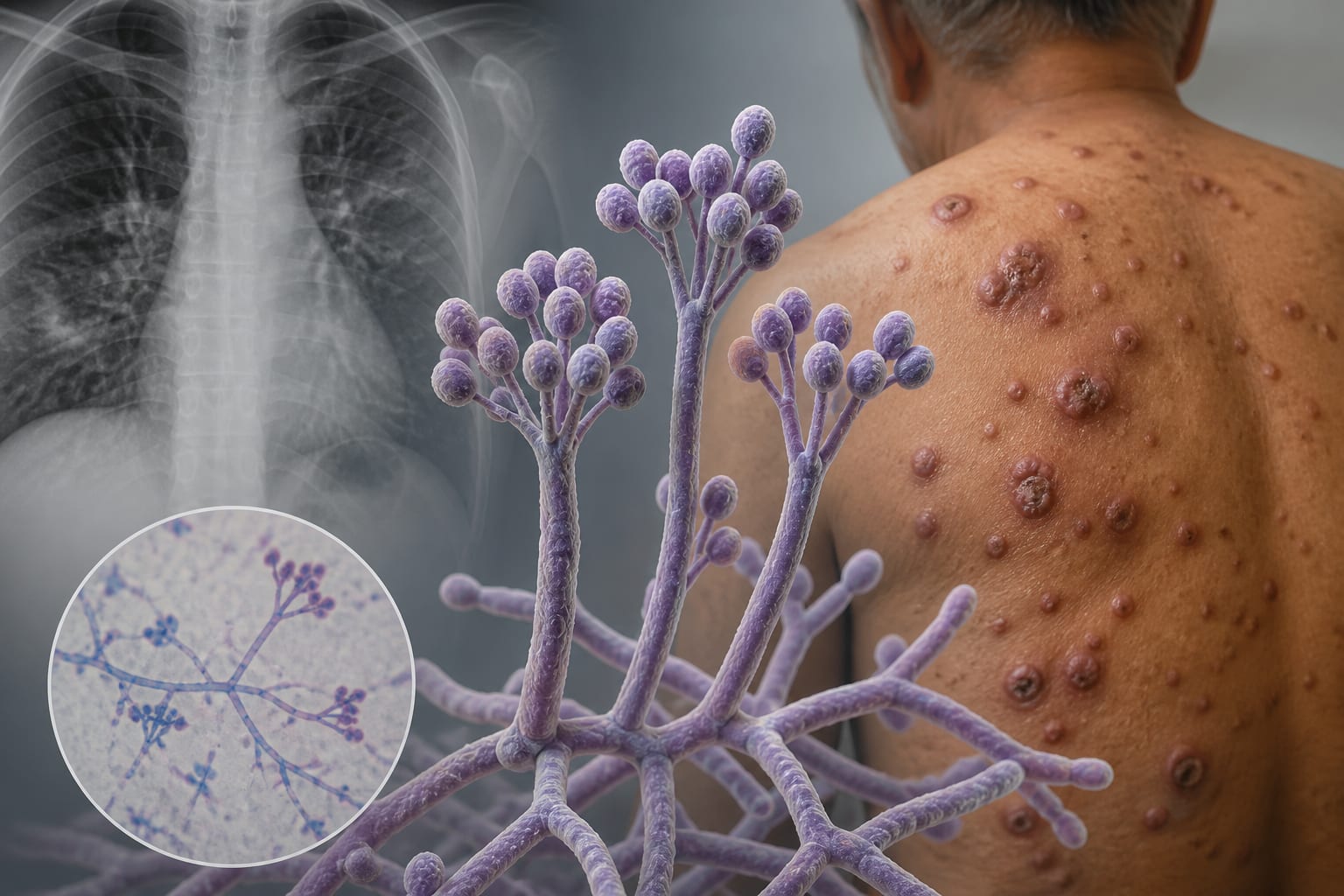
Disseminated Sporotrichosis Presenting as Tuberculosis in an Immunocompetent Patient: Challenges in Regions Endemic to Tuberculosis
-
By
-
Natthapong Suthammopasut
-
Athitaya Luangnara
-
September 8, 2026
Disseminated Sporotrichosis Presenting as Tuberculosis in an Immunocompetent Patient
Background
Sporotrichosis is an emerging mycosis caused by the Sporothrix schenckii complex and is increasingly reported worldwide, with the highest burden in South America and Asia. Most cases present as cutaneous or lymphocutaneous disease. Disseminated sporotrichosis is uncommon, occurs more often in immunocompromised patients, and can resemble tuberculosis (TB), creating diagnostic challenges in TB-endemic regions.
Data Highlights
The patient was a 78-year-old man with treated diffuse large B-cell lymphoma in complete remission for 10 years.
He reported contact with 16 stray cats, although sporotrichosis was not microbiologically confirmed in the cats.
Amphotericin B induction was administered for 14 days, followed by oral itraconazole at 400 mg/d for a total treatment duration of 12 months.
Key Findings
A 78-year-old man with a remote history of diffuse large B-cell lymphoma developed multiple painful subcutaneous nodules that progressively disseminated and later ulcerated.
Initial and repeat biopsies showed granulomatous inflammation without identifiable organisms. Because TB was endemic in the region and granulomas were present, empirical standard anti-tuberculous therapy was initiated, but the lesions continued to progress.
Fungal culture grew pigmented colonies identified as Sporothrix schenckii complex despite repeated stains failing to visualize organisms.
Treatment with amphotericin B followed by itraconazole was associated with healing of the cutaneous lesions, marked improvement in pulmonary abnormalities and abscesses, and absence of active skin lesions or respiratory symptoms at 12 months.
Clinical Implications
Disseminated sporotrichosis requires a high index of suspicion because it can resemble TB and other infections, particularly in TB-endemic settings. The authors emphasized identifying relevant risk factors and obtaining a comprehensive history to broaden the differential diagnosis.
Conclusion
Sporotrichosis remains diagnostically challenging in TB-endemic settings because of atypical presentations, unclear exposure histories, and diagnostic bias toward TB. Comprehensive history taking for possible risk factors remains important for identifying cases.
Related Resources & Content
Cutaneous Disseminated and Extracutaneous Sporotrichosis: Current Status of a Complex Disease — Bonifaz A, Tirado-Sanchez A; Journal of Fungi; 2017; 3(1):6.
Sporotrichosis: An Overview and Therapeutic Options — Mahajan VK; Dermatology Research and Practice; 2014; 2014:272376.
Disseminated Cutaneous Sporotrichosis in an Immunocompetent Individual — Yap FB; International Journal of Infectious Diseases; 2011; 15(10):e727-e729.
Pulmonary Cavitation and Skin Lesions Mimicking Tuberculosis in a HIV Negative Patient Caused by Sporothrix brasiliensis — Orofino-Costa R, Unterstell N, Carlos Gripp A, et al; Medical Mycology Case Reports; 2013; 2:65-71.
Cutaneous Disseminated Sporotrichosis in Immunocompetent Patient: Case Report and Literature Review — Queiroz-Telles F, Cognialli RC, Salvador GL, et al; Medical Mycology Case Reports; 2022; 36:31-34.
Clinical Practice Guidelines for the Management of Sporotrichosis: 2007 Update by the Infectious Diseases Society of America — Kauffman CA, Bustamante B, Chapman SW, Pappas PG; Clinical Infectious Diseases; 2007; 45(10):1255-1265.
Human Sporotrichosis: Recommendations From the Brazilian Society of Dermatology for the Clinical, Diagnostic and Therapeutic Management — Orofino-Costa R, Freitas DFS, Bernardes-Engemann AR, et al; Anais Brasileiros de Dermatologia; 2022; 97(6):757-777.
Based on findings from:
Disseminated sporotrichosis masquerading as tuberculosis in a patient without overt immunodeficiency: challenges in tuberculosis-endemic area
Natthapong Suthammopasut, Athitaya Luangnara. International Journal Of Infectious Diseases, 2026.
https://www.sciencedirect.com/science/article/pii/S1201971226006909
This content is an AI-generated, fully rewritten summary based on a published scholarly article. It does not reproduce the original text and is not a substitute for the original publication. Readers are encouraged to consult the source for full context, data, and methodology.