Smoldering Waldenström macroglobulinemia coexisting with myelodysplastic syndrome: a rare case report and literature review - Report - MDSpire

Smoldering Waldenström macroglobulinemia coexisting with myelodysplastic syndrome: a rare case report and literature review

  • By

  • Huanyuan Wang

  • Shuai Tan

  • Yumeng Li

  • Wanling Sun

  • May 25, 2026

  • 0 min

Share

Clinical Report: Coexisting Smoldering Waldenström Macroglobulinemia and MDS

Overview

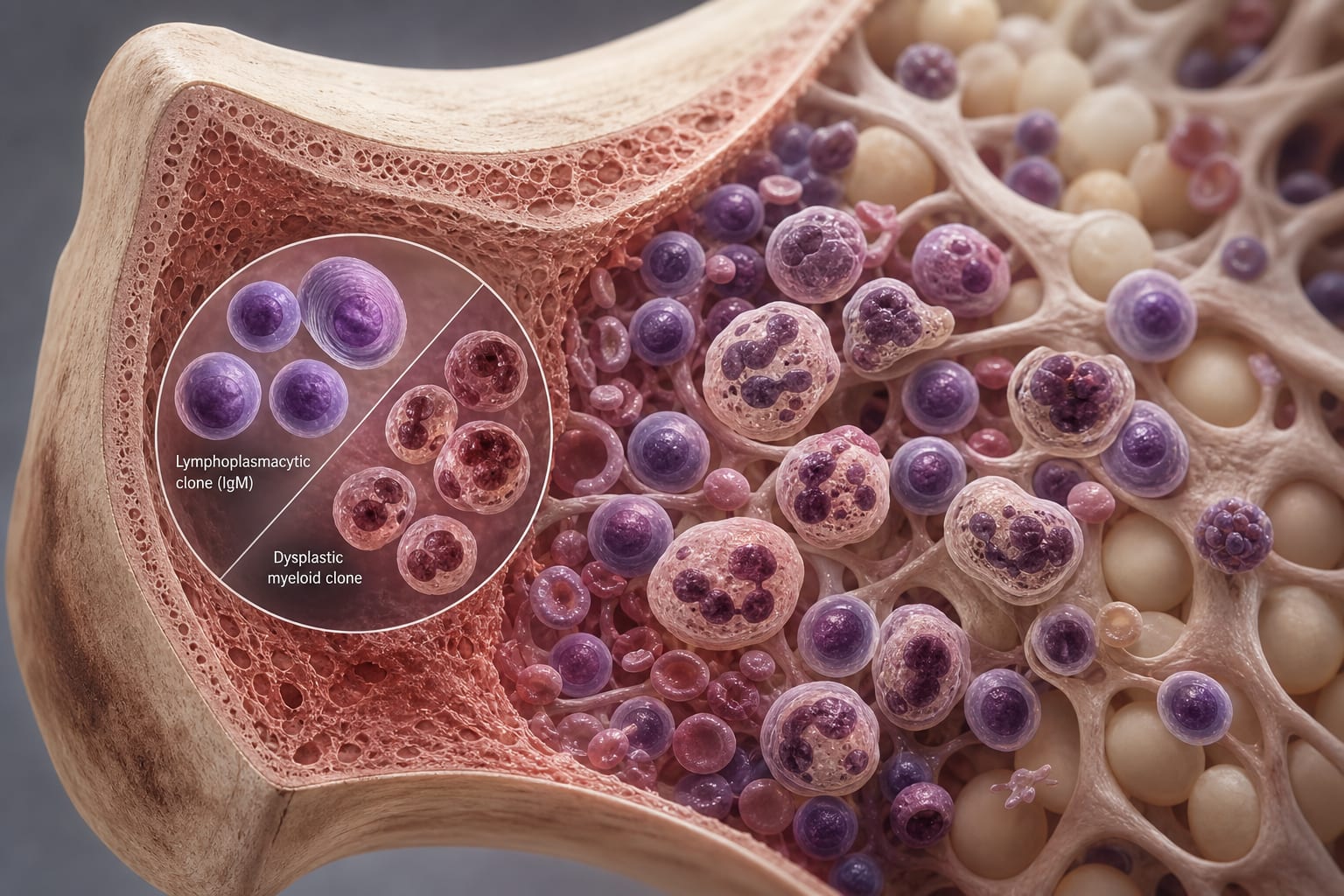
This report details a rare case of a 74-year-old woman with coexisting smoldering Waldenström macroglobulinemia (SWM) and myelodysplastic syndrome (MDS). The case highlights the importance of reevaluating persistent cytopenias during treatment, as they were attributed to MDS progression rather than SWM.

Background

Waldenström macroglobulinemia (WM) is a low-grade non-Hodgkin lymphoma characterized by monoclonal IgM production, while myelodysplastic syndrome (MDS) involves dysplastic changes in hematopoietic cells and an increased risk of acute myeloid leukemia (AML). The coexistence of these two conditions is extremely rare, making this case significant for clinical understanding and management.

Data Highlights

{'bone_marrow_blasts': {'MDS_low_blasts': '2.5%', 'MDS_increased_blasts': '6%', 'AML': '66%'}}

Key Findings

  • Persistent cytopenias during ibrutinib therapy were due to MDS progression, not SWM.
  • Clonal evolution was documented from 2.5% blasts to 6% blasts and ultimately to 66% blasts in AML.
  • The FLT3-ITD mutation emerged post-MDS remission, leading to rapid progression to AML.
  • The patient initially presented with macrocytic anemia and monoclonal gammopathy.
  • This case underscores the need for careful monitoring and reevaluation in patients with overlapping hematologic malignancies.

Clinical Implications

Clinicians should maintain a high index of suspicion for MDS in patients with SWM who present with persistent cytopenias. Regular monitoring and reevaluation are crucial to differentiate between disease progression and treatment-related effects.

Conclusion

This case illustrates the complexities of managing patients with coexisting SWM and MDS, emphasizing the need for vigilant clinical assessment and the potential for rapid disease evolution.
Related Resources & Content

  1. Blood Cancer Journal, 2024 -- Increased Presence of Tumor-Associated Polymorphonuclear Myeloid-Derived Suppressor Cells in Waldenstrom Macroglobulinemia Exhibits Immune Suppressive Properties
  2. Blood Cancer Journal, 2015 -- Waldenstrom macroglobulinemia: prognosis and management
  3. Blood Cancer Journal, 2011 -- MicroRNA expression in tumor cells from Waldenstrom's macroglobulinemia reflects both their normal and malignant cell counterparts
  4. Report of Consensus Panel 3 from the 12th International Workshop on Waldenstrom's Macroglobulinemia on the management of patients with high-risk disease - PubMed
  5. A 2026 update on myelodysplastic neoplasms: current state, challenges and future directions | Nature Reviews Clinical Oncology
  6. Blood Cancer Journal — From Waldenström’s macroglobulinemia to aggressive diffuse large B-cell lymphoma: a whole-exome analysis of abnormalities leading to transformation
  7. Smoldering Waldenström Macroglobulinemia Coexisting with Myelodysplastic Syndrome: A Rare Case Report and Literature Review
  8. Report of Consensus Panel 3 from the 12th International Workshop on Waldenstrom's Macroglobulinemia on the management of patients with high-risk disease - PubMed
  9. A 2026 update on myelodysplastic neoplasms: current state, challenges and future directions | Nature Reviews Clinical Oncology

Original Source(s)

Related Content