Prediction of histological grading in ductal carcinoma in situ based on mammographic signs and clinical information using machine learning models - Report - MDSpire
Advertisement
Prediction of histological grading in ductal carcinoma in situ based on mammographic signs and clinical information using machine learning models
Clinical Report: Utilizing Machine Learning Models to Forecast Histological Grading in DCIS
Overview
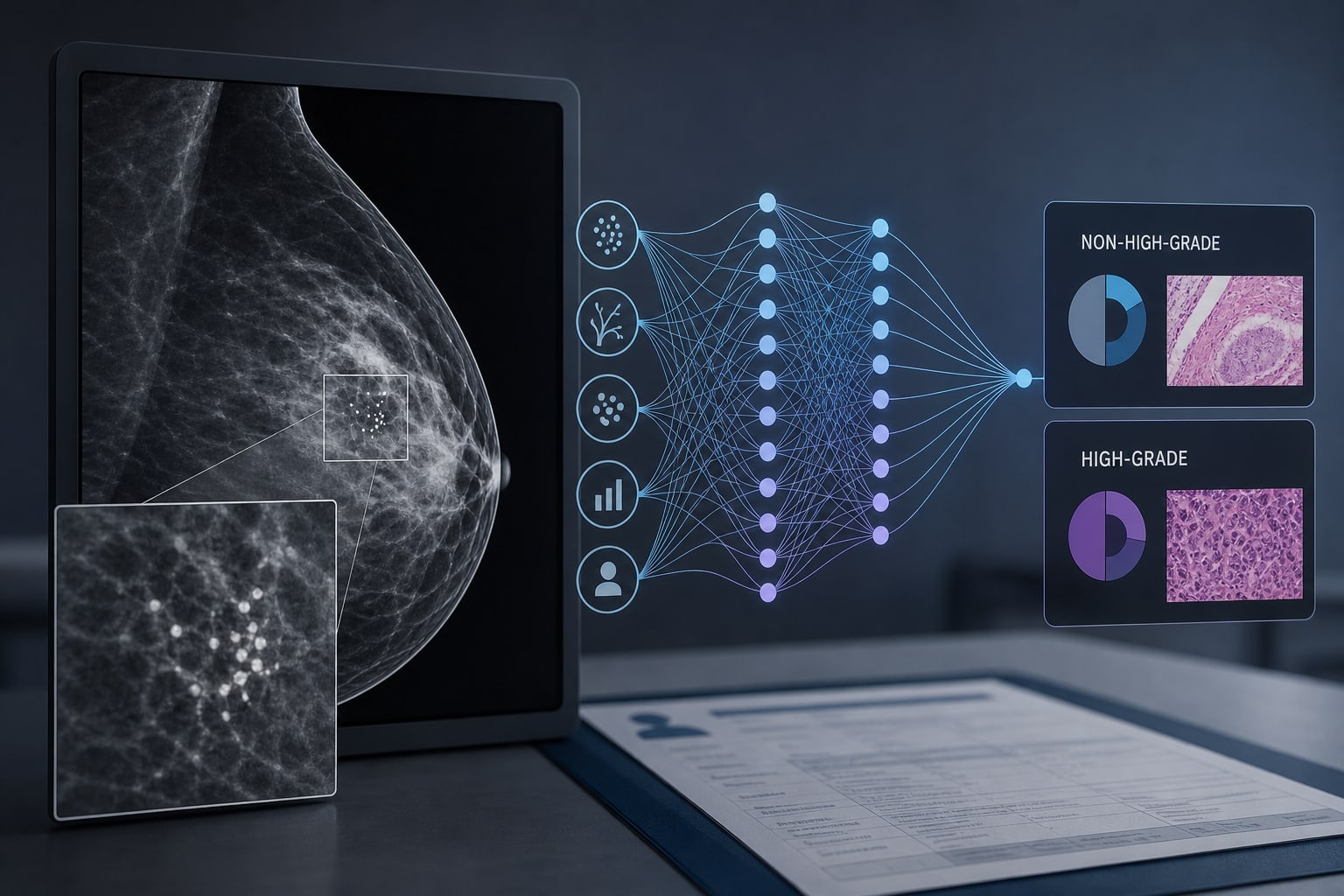
This study evaluates the use of machine learning models to predict histological grading in ductal carcinoma in situ (DCIS) using mammographic indicators and clinical data. The models demonstrated varying performance, with multinomial Naive Bayes achieving the highest area under the curve (AUC) values.
Background
Ductal carcinoma in situ (DCIS) is a non-invasive breast cancer that can progress to invasive disease if not accurately diagnosed and managed. Histological grading of DCIS is crucial for guiding treatment decisions, yet current grading methods face challenges such as inter-observer variability. The integration of machine learning with clinical and mammographic data may enhance the accuracy of DCIS grading.
Data Highlights
Model
Training AUC
Test AUC
Accuracy
Sensitivity
Specificity
XGBoost
0.788
0.763
0.761
0.726
0.725
Logistic Regression
0.796
0.756
0.758
0.824
0.692
Multinomial Naive Bayes
0.806
0.784
0.776
0.808
0.744
Key Findings
The study included 243 patients diagnosed with breast DCIS.
Histological grading categorized patients into non-high-grade (n=110) and high-grade (n=133) groups.
Machine learning models developed included eXtreme Gradient Boosting (XGBoost), logistic regression (LR), and multinomial Naive Bayes (MNB).
MNB achieved the highest training AUC of 0.806 and test AUC of 0.784.
All models showed comparable performance with no statistically significant differences in AUC (p > 0.05).
Integration of mammographic features and clinical data may enhance DCIS grading accuracy.
Clinical Implications
Further validation in multi-center studies is necessary to confirm these results.
Conclusion
Machine learning models show potential in predicting histological grading in DCIS, with MNB demonstrating the highest AUC values. Further investigation is warranted to validate their clinical utility.