Molecular changes during AT/RT progression associated with epithelial–mesenchymal transition and extracellular matrix changes - Report - MDSpire

Molecular changes during AT/RT progression associated with epithelial–mesenchymal transition and extracellular matrix changes

  • By

  • Lea Altendorf

  • Anton Althammer

  • Rajanya Roy

  • Karoline Hack

  • Flavia W. de Faria

  • Arend Koch

  • Vanessa Thaden

  • Melanie Schoof

  • Martin U. Schuhmann

  • Peter Hauser

  • Pascal D. Johann

  • Martin Hasselblatt

  • Michael C. Frühwald

  • Kornelius Kerl

  • Ulrich Schüller

  • July 1, 2026

  • 0 min

Share

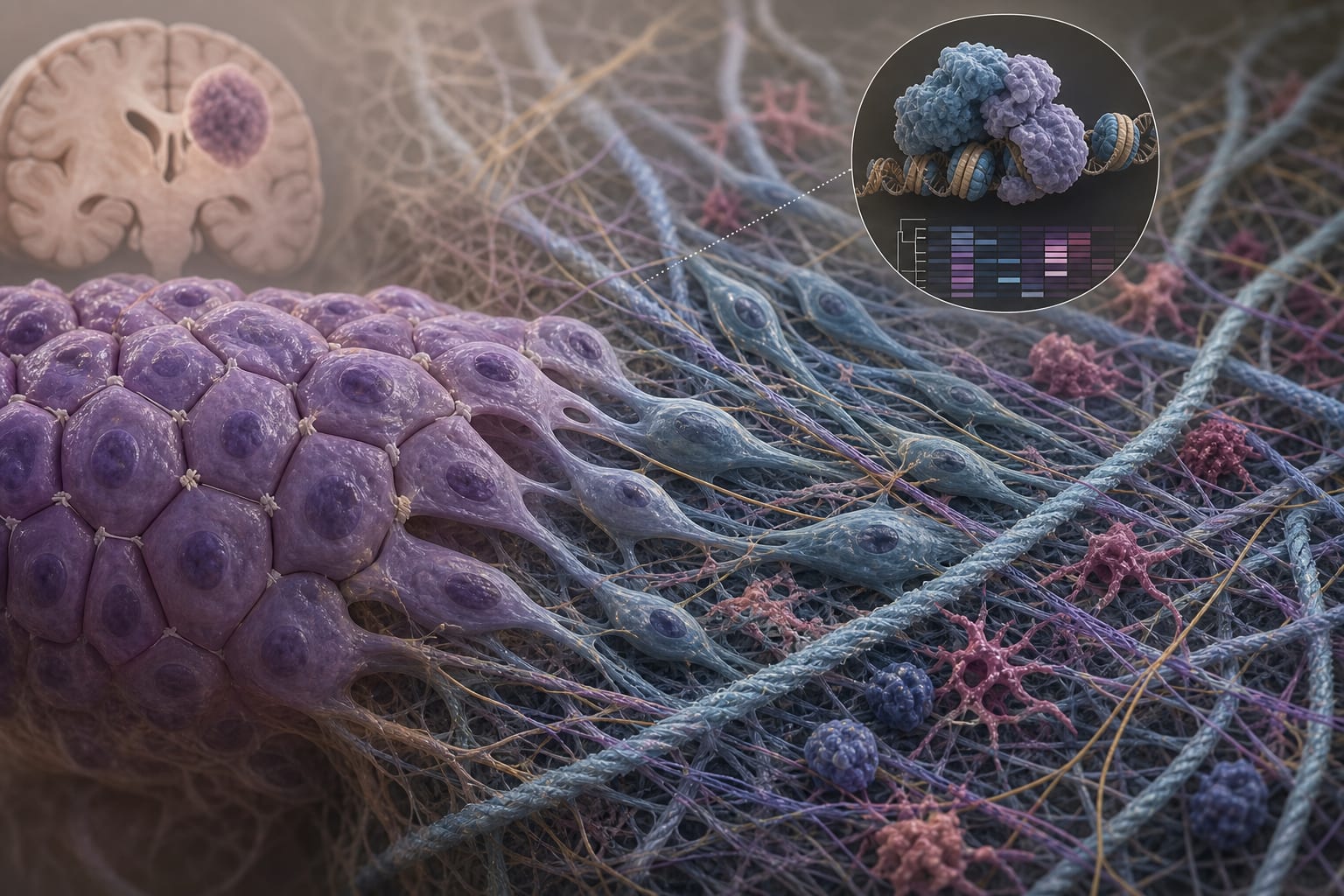
Molecular Alterations in AT/RT Progression Linked to Epithelial–Mesenchymal Transition

Overview

This study investigates the transcriptomic differences between primary and recurrent atypical teratoid/rhabdoid tumors (AT/RT) at a single-nucleus level, highlighting increased extracellular matrix (ECM) remodeling and epithelial-mesenchymal transition (EMT) in therapy-resistant cells.

Background

Atypical teratoid/rhabdoid tumors (AT/RT) are aggressive CNS tumors predominantly affecting young children, characterized by poor prognosis and high rates of recurrence. The study focuses on identifying therapy-resistant tumor cells and their associated molecular alterations.

Data Highlights

No numerical data or trial data were provided in the source material.

Key Findings

  • AT/RT are classified into four DNA methylation subtypes, with the majority associated with SMARCB1 mutations.
  • Therapy-resistant tumor cells were identified through transcriptomic analysis of paired primary and recurrent AT/RT tumors.
  • Increased ECM remodeling and pEMT were observed in therapy-resistant tumor cells.
  • Characterization of therapy-resistant cells may lead to the identification of novel therapeutic targets.
  • Current treatment strategies for AT/RT include surgery and chemotherapy, with limited options for targeted therapies.

Clinical Implications

The identification of molecular alterations associated with therapy resistance in AT/RT may guide future research.

Conclusion

This study provides insights into the molecular landscape of AT/RT progression.

Related Resources & Content

  1. NCI, Atypical Teratoid/Rhabdoid Tumors (AT/RT): Diagnosis and Treatment, 2023 -- https://www.cancer.gov/rare-brain-spine-tumor/tumors/atrt?utm_source=openai
  2. PMC, Efficacy of High-Dose Chemotherapy and Three-Dimensional Conformal Radiation for Atypical Teratoid/Rhabdoid Tumor: A Report From the Children’s Oncology Group Trial ACNS0333, 2023 -- https://pmc.ncbi.nlm.nih.gov/articles/PMC7145589/?utm_source=openai
  3. The ASCO Post — Extracellular Matrix Stiffness Promotes Malignant Progression Via PTEN-Reducing Effect of Micro-RNA
  4. Archives of Toxicology — Overcoming Drug Resistance in Cancer through EMT: Innovative Treatment Approaches
  5. The ASCO Post — Role of Epithelial-to-Mesenchymal Transition in Ovarian Cancer
  6. Archives of Toxicology — Influence of microRNAs on the response to cadmium chloride in pancreatic ductal adenocarcinoma
  7. Atypical Teratoid/Rhabdoid Tumors (AT/RT): Diagnosis and Treatment - NCI
  8. Efficacy of High-Dose Chemotherapy and Three-Dimensional Conformal Radiation for Atypical Teratoid/Rhabdoid Tumor: A Report From the Children’s Oncology Group Trial ACNS0333 - PMC
  9. Functional screening reveals genetic dependencies and diverging cell cycle control in atypical teratoid rhabdoid tumors | Genome Biology | Springer Nature Link

Original Source(s)

Related Content