Integrating Flexible Fall-Prevention Strategies Into Primary Care: Modest Changes, Wider Impact
-
By
-
Junyi Peng
-
Rebecca Ivers
-
Maoyi Tian
-
October 16, 2026
Clinical Report: Integrating Flexible Fall-Prevention Strategies Into Primary Care
Overview
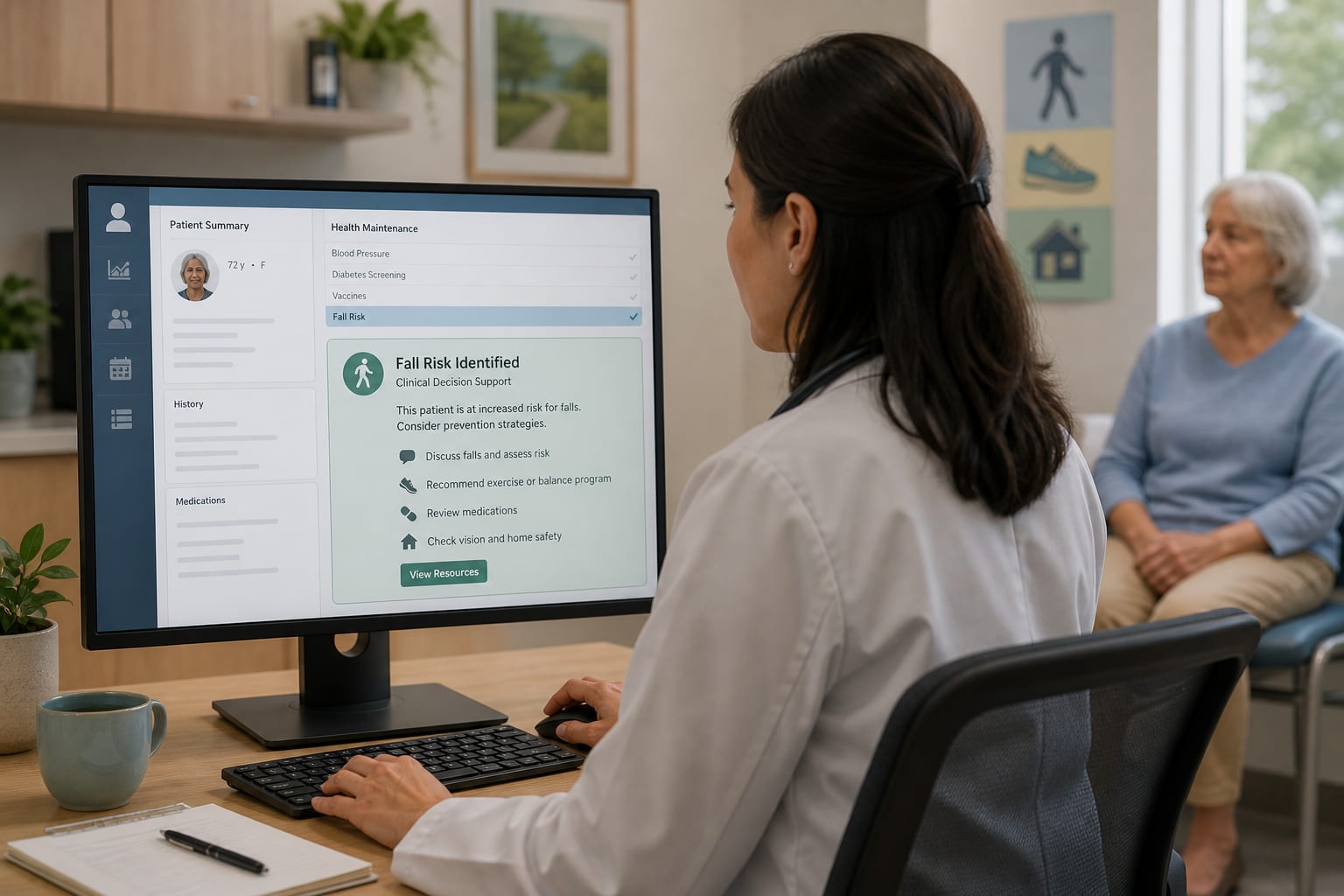
The eSTEPS matched-pair cluster randomized trial found lower adjusted rates of falls and fall-related injuries in primary care practices using EHR-integrated decision support than in control practices. The intervention combined a noninterruptive care-gap alert, individualized strength and balance exercises, optional physical therapy referral, and patient-facing resources; exercise prescriptions were provided to 22.1% of patients in intervention practices.
Background
Falls are a serious problem for older adults: among US community-dwelling older adults who fall, nearly 25% experience an injury requiring medical attention and approximately 14% receive care in an emergency department or hospital. Primary care is a potential setting for prevention, but clinician workload, tightly scheduled visits, and limited consultation time constrain delivery of preventive services. The eSTEPS report addresses not only intervention effectiveness but also how fall prevention may be incorporated into routine primary care workflows. The source contrasts this digital approach with the FAMILY trial in rural China, which relied mainly on village doctors, face-to-face engagement, and interpersonal and community support.
Data Highlights
| Measure | Intervention | Comparison | Context |
|---|---|---|---|
| Practices contributing to trial and analysis | 11 matched pairs | — | 24 practices were randomized as 12 matched pairs; one complete pair was excluded before enrollment |
| Enrolled participants | 11,945 adults aged 65 years or older | — | Mean age 77.1 years; 67.3% women; 81.6% had Charlson Comorbidity Index ≥2 |
| ICD-10–coded ≥1 fall, per 100 patient-years | 19.3 | 21.2 | Adjusted rates; mean follow-up approximately 622 days |
| ICD-10–coded fall-related injury, per 100 patient-years | 15.7 | 16.7 | Adjusted rates |
| Participant-reported fall or fall-related injury, per 100 patient-years | 17.5 | 19.2 | Adjusted rates |
| Patients receiving an exercise prescription in intervention practices | 22.1% | — | No economic evaluation was performed |
Key Findings
- eSTEPS was evaluated in a matched-pair cluster randomized trial across primary care practices in an integrated US health system; 11 matched pairs contributed to the trial and analysis.
- The EHR-integrated tool used a noninterruptive care-gap alert and offered individualized strength and balance exercises, optional physical therapy referral, and patient-facing materials through print resources, after-visit summaries, a website, and a mobile application.
- Adjusted rates favored intervention practices for all three reported outcomes: ICD-10–coded falls, ICD-10–coded fall-related injuries, and participant-reported falls or fall-related injuries.
- The source estimates absolute differences of approximately 1.9 fewer patients with a recorded fall and 1.0 fewer patients with a recorded fall-related injury per 100 patient-years.
- Exercise prescriptions were provided to 22.1% of patients in intervention practices, and the trial did not include an economic evaluation.
- The source compares eSTEPS with the FAMILY trial in rural China and notes that both incorporated fall prevention into established primary care systems, despite differing delivery methods and contexts.
Clinical Implications
The source describes eSTEPS as a potentially scalable, relatively low-burden approach that links fall-risk identification, clinical decision-making, exercise prescription, referral options, and patient resources within an EHR-supported workflow. It also cautions that issuing an exercise prescription alone does not establish sustained behavioral change and notes that long-term continuation of unsupervised exercise remains a concern in the provided text.
Conclusion
In the reported trial, EHR-integrated fall-prevention support was associated with modestly lower adjusted rates of falls and fall-related injuries in routine primary care. The source presents integration into established care systems as a shared feature of the eSTEPS and FAMILY approaches, while noting differences in setting and delivery.
Related Resources & Content
- Latham et al, JAMA Network Open, year not stated in supplied material — Clinical Decision Support for Fall Prevention in Primary Care: The eSTEPS Cluster Randomized Clinical Trial
- United States Preventive Services Task Force, 2024 — Falls Prevention in Community-Dwelling Older Adults: Interventions
- National Institute for Health and Care Excellence, 2025 — Falls: assessment and prevention in older people and in people 50 and over at higher risk
- Centers for Disease Control and Prevention, year not stated in supplied material — Outpatient Care | STEADI - Older Adult Fall Prevention
- American Geriatrics Society Workgroup, 2025 — Updating STEADI for Primary Care: Recommendations From the American Geriatrics Society Workgroup
- FAMILY trial, authors and year not stated in supplied material — A Randomized Trial of a Multifactorial Strategy to Prevent Serious Fall Injuries
- Journal of General Internal Medicine — The Missing Step in Fall Prevention: Why Recommendations Fail in Practice
- ASCO Publications — Predict, Then Act: Moving Toward Tailored Prevention
- JAMA Network Open — Collaborative Role of Emergency Medical Services in Preventing Falls Among Older Adults
- ASCO Publications — Are We Falling Short? Incorporating Falls Assessment Into Cancer Care for Older Adults
- Clinical Decision Support for Fall Prevention in Primary Care: The eSTEPS Cluster Randomized Clinical Trial
- Falls Prevention in Community-Dwelling Older Adults: Interventions
- Falls: assessment and prevention in older people and in people 50 and over at higher risk
- Outpatient Care | STEADI - Older Adult Fall Prevention
- Updating STEADI for Primary Care: Recommendations From the American Geriatrics Society Workgroup
- A Randomized Trial of a Multifactorial Strategy to Prevent Serious Fall Injuries
- Outpatient Care | STEADI - Older Adult Fall Prevention | CDC
- A Randomized Trial of a Multifactorial Strategy to Prevent Serious Fall Injuries - PMC
- Do multifactorial approaches (those tailored to a person’s individual risk factors) or multiple component approaches (where everyone receives the same treatment) prevent falls in older people living in the community? | Cochrane
Based on findings from:
Embedding Adaptable Fall-Prevention Interventions in Primary Care—Small Steps, Broad Reach
Junyi Peng, Rebecca Ivers, Maoyi Tian. Jama Network Open, 2026.
https://jamanetwork.com/journals/jamanetworkopen/fullarticle/2855393
This content is an AI-generated, fully rewritten summary based on a published scholarly article. It does not reproduce the original text and is not a substitute for the original publication. Readers are encouraged to consult the source for full context, data, and methodology.