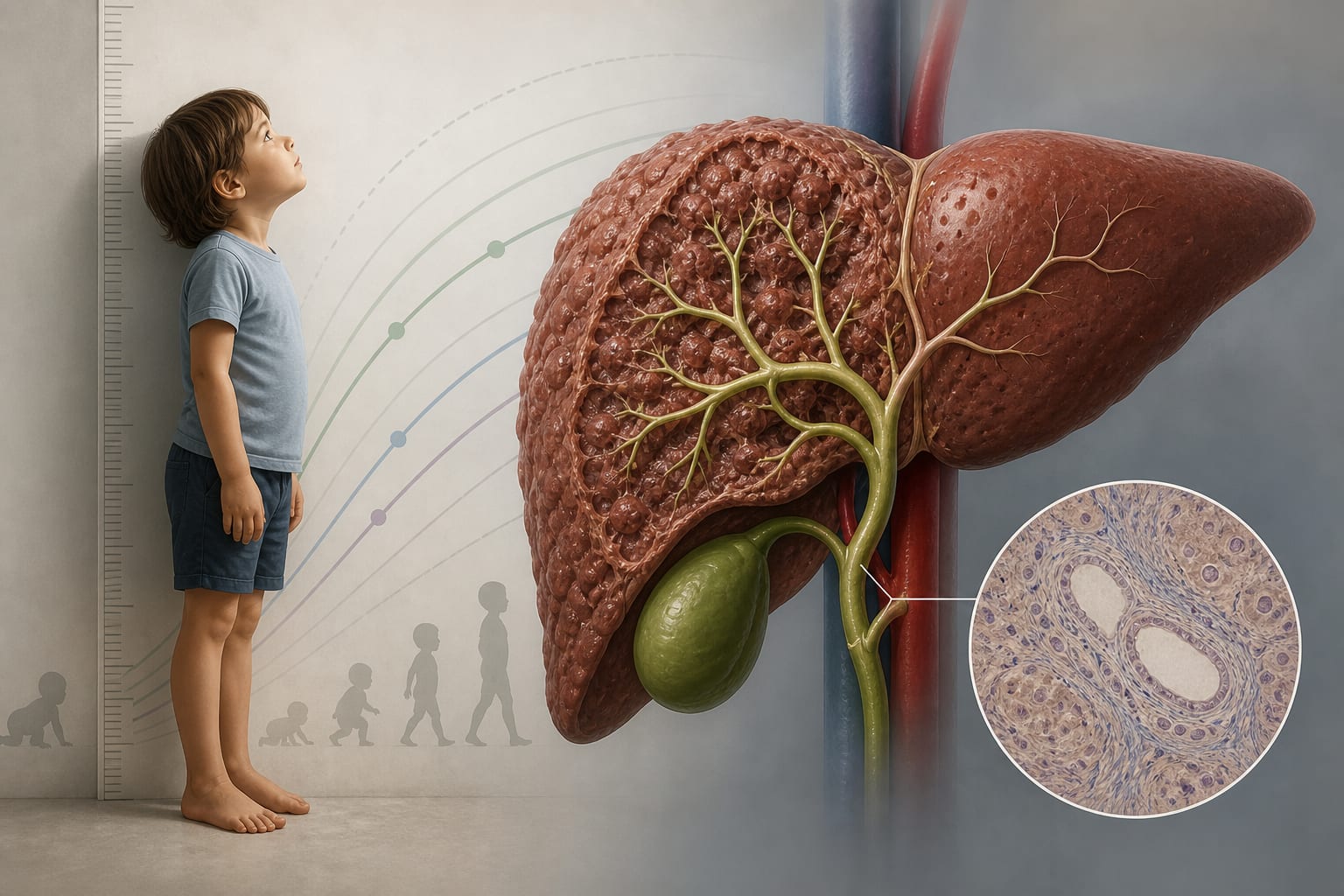
Clinical Report: Child Growth and Fibrosis Associated with Biliary Atresia
Overview
This study investigates growth patterns in children with biliary atresia (BA) in Denmark, focusing on catch-up growth and the impact of liver transplantation.
Background
Biliary atresia is a critical condition leading to liver failure in infants if not treated promptly. Early intervention, such as the Kasai procedure, is essential for improving outcomes.
Data Highlights
No numerical data or trial data were provided in the source material.
Key Findings
Biliary atresia is categorized into three types based on the site of bile duct obstruction.
Without treatment, children with BA develop cirrhosis within 6 months and liver failure within 1 year.
Growth during early childhood is a significant predictor of later development and height.
Insulin-like growth factor-1 (IGF-1) plays a role in growth hormone secretion and may influence catch-up growth post-transplant.
The study followed children from 2006 to 2024, collecting data on growth and liver function.
Clinical Implications
The severity of liver disease and the timing of liver transplantation may influence growth outcomes.
Conclusion
The findings highlight the relationship between growth dynamics in children with biliary atresia and liver transplantation.