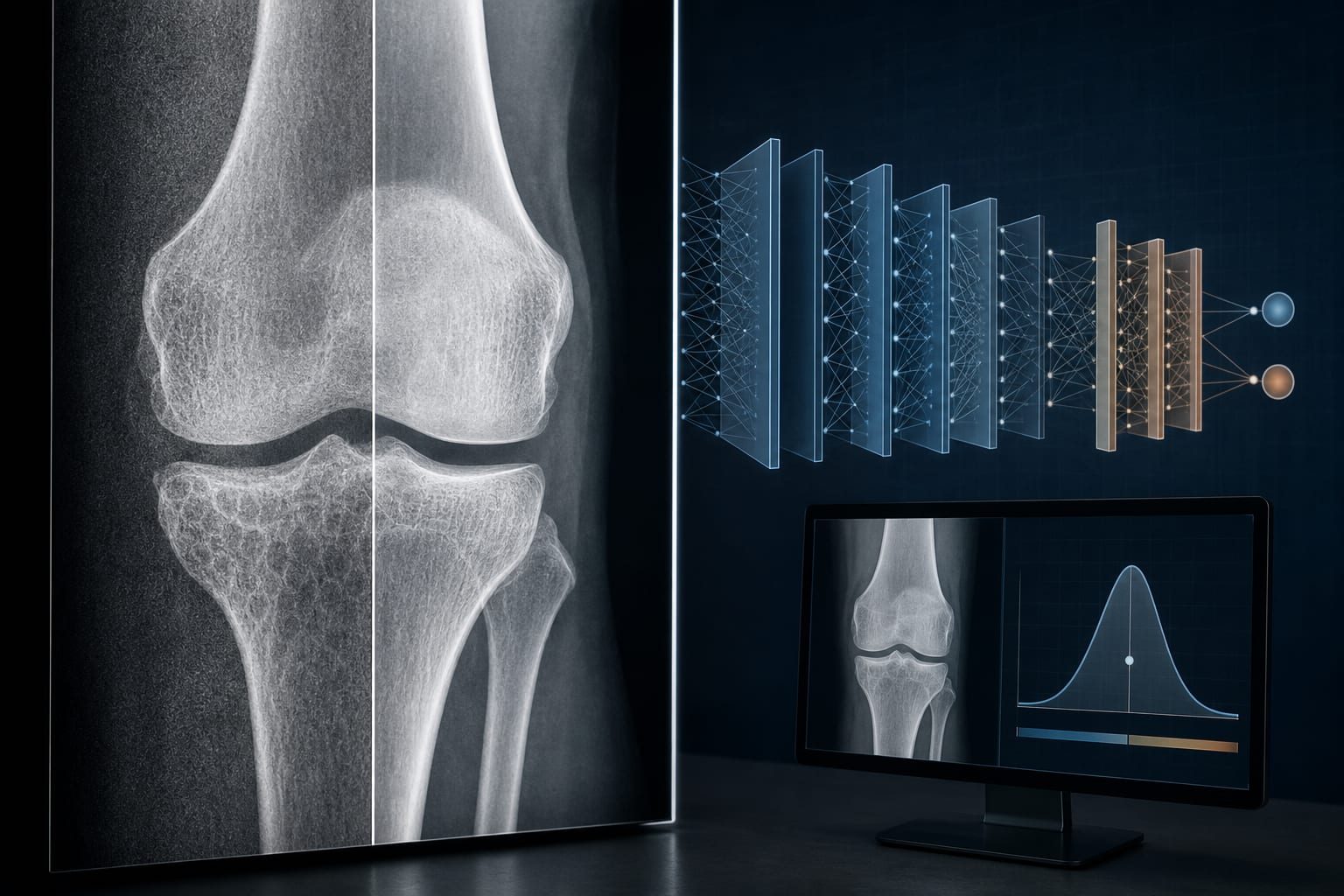
Clinical Report: A Transparent Deep Learning Framework for Osteoporosis Identification
Overview
This study presents a deep learning model that utilizes enhanced knee X-ray images for the automated detection of osteoporosis, achieving an accuracy of 96.5%. The model combines Rolling Guidance Filtering with pretrained convolutional neural networks to improve diagnostic performance.
Background
Osteoporosis is a significant global health issue characterized by low bone mineral density and increased fracture risk, particularly among the aging population. Early diagnosis is challenging due to limitations in traditional imaging methods and the insensitivity of radiographic features.
Data Highlights
Metric
Value
Accuracy
96.5%
AUC
0.97
F1-score
89.5
Key Findings
The proposed model integrates Rolling Guidance Filtering for image enhancement.
It utilizes a deep concatenated model combining MobileNetV2 and NASNetLarge for feature extraction.
The model achieved an accuracy of 96.5% in classifying osteoporosis.
AUC of 0.97 indicates high diagnostic performance.
Feature concatenation significantly improves classification accuracy compared to single models.
Clinical Implications
The automated detection framework can enhance early diagnosis of osteoporosis, particularly in areas with limited access to advanced imaging technologies. Its high accuracy may facilitate timely intervention and management of osteoporosis.
Conclusion
The study demonstrates a robust method for osteoporosis detection using knee X-rays.