Establishment of a novel lupus mesenteric vasculitis mouse model and exploration of its exacerbation mechanisms - Report - MDSpire
Coming Soon: Introducing MDSpire News. Learn more
Conexiant’s news site is now MDSpire News. Learn more

Development of a New Mouse Model for Lupus Mesenteric Vasculitis and Investigation of Its Aggravation Mechanisms

  • By

  • Maki Fujishiro

  • Kunihiro Hayakawa

  • Yuko Kataoka

  • Marina Shinoura

  • Hiroyuki Tomita

  • Yuna Saito

  • Takuya Nishi

  • Keigo Ikeda

  • Kenji Takamori

  • Iwao Sekigawa

  • Shinji Morimoto

  • September 9, 2026

Share

Clinical Report: Development of a New Mouse Model for Lupus Mesenteric Vasculitis

Overview

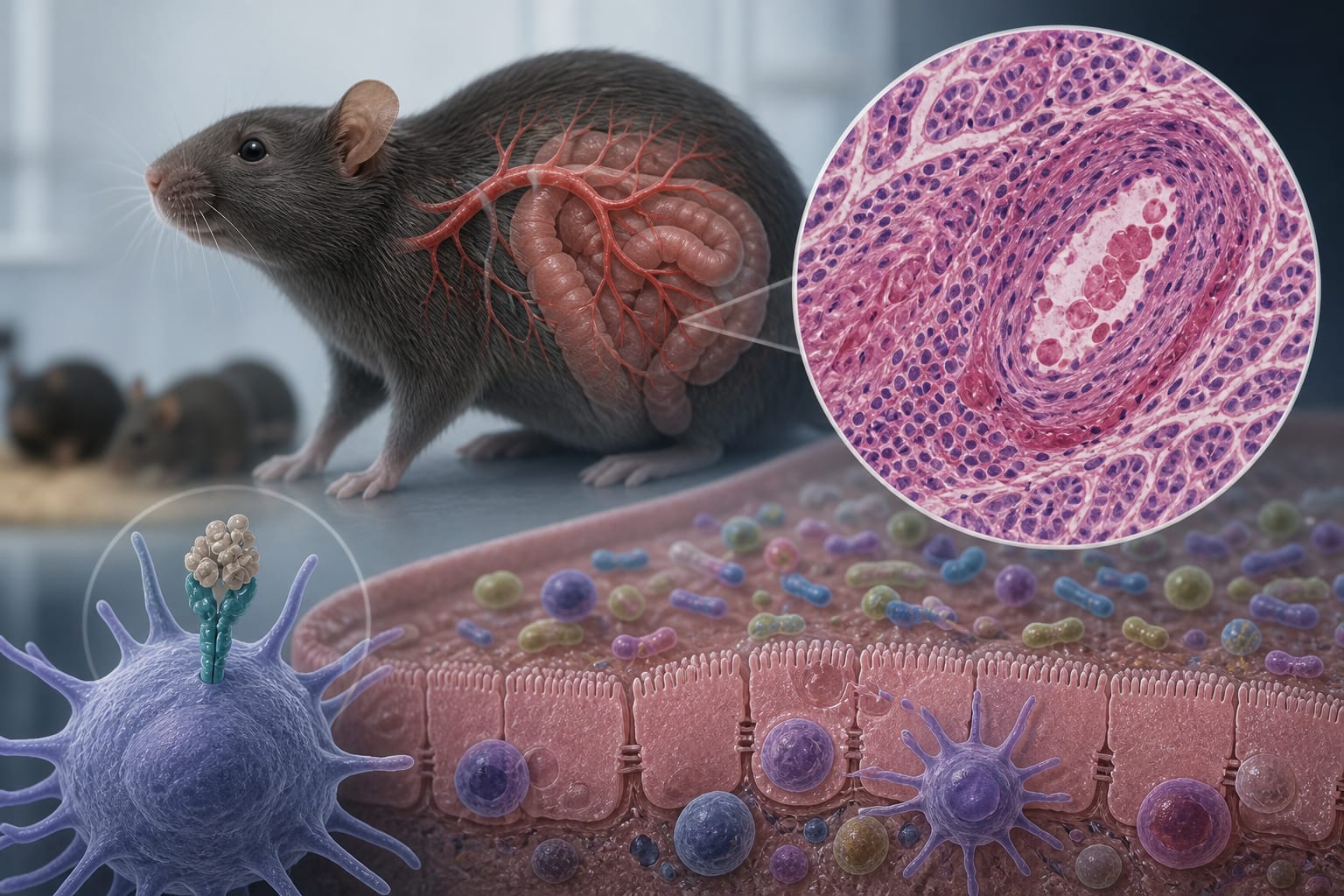
This study establishes an inducible mouse model for lupus mesenteric vasculitis (LMV) using R848, a TLR7/8 agonist. The model demonstrates significant intestinal vasculitis and elevated serum autoantibody levels.

Background

Lupus mesenteric vasculitis (LMV) is a rare but serious gastrointestinal complication of systemic lupus erythematosus (SLE), often presenting with acute abdominal pain and mimicking infectious enteritis. Accurate diagnosis is challenging due to the lack of specific clinical findings and the invasive nature of pathological assessments.

Data Highlights

ParameterFindings
R848 TreatmentInduced intestinal vasculitis in BWF1 mice
Serum Autoantibody LevelsSignificantly raised
Microbiota ChangesAlterations observed in LMV mice
Propionic Acid LevelsHigher fecal concentrations noted
Antibiotic TreatmentTended to suppress LMV pathology during early induction
Propionate AdministrationAppeared to attenuate intestinal vasculitis

Key Findings

  • R848 administration to BWF1 mice established an inducible LMV model.
  • Intestinal vasculitis was induced with significant elevation in serum autoantibody levels.
  • Microbiota alterations were observed in mice with R848-induced LMV.
  • Broad-spectrum antibiotics tended to suppress LMV pathology during the early phase.
  • Administration of propionate may play a role in maintaining intestinal homeostasis.
  • The model allows for detailed investigation of LMV pathophysiology.

Clinical Implications

The establishment of this mouse model for LMV may facilitate future research into the mechanisms underlying the condition.

Conclusion

The R848-induced mouse model provides a valuable tool for studying lupus mesenteric vasculitis and its underlying mechanisms.

Related Resources & Content

  1. Frontiers in Immunology, 2026 -- Development of an improved preclinical humanized mouse platform representing the diverse clinical phenotypes of Sjögren’s syndrome
  2. MDSpire News, 2023 -- Potential New Lupus Trigger Discovered
  3. Models for Assessing Intestinal Anastomosis Healing in Experimental Colitis, 2021
  4. Lupus enteritis: a narrative review | Rheumatology | Oxford Academic
  5. 2025 ACR Guideline for the Treatment of Systemic Lupus Erythematosus
  6. Acta Neuropathologica — LRRK2 Mutation Intensifies Immune Activation and Neurodegenerative Processes in a Chronic Experimental Colitis Model
  7. Lupus enteritis: a narrative review | Rheumatology | Oxford Academic
  8. https://assets.contentstack.io/v3/assets/bltee37abb6b278ab2c/bltdf97323a3723de0f/lupus-guideline-sle-2025.pdf
  9. Efficacy and Safety of Obinutuzumab in Active Systemic Lupus Erythematosus | New England Journal of Medicine

Original Source(s)

Related Content