Development and validation of a prediction model for 1-year all-cause rehospitalisation after discharge in patients with heart failure with preserved ejection fraction based on the systemic immune-inflammation index - Report - MDSpire
Advertisement
Development and validation of a prediction model for 1-year all-cause rehospitalisation after discharge in patients with heart failure with preserved ejection fraction based on the systemic immune-inflammation index
Clinical Report: Predictive Model for 1-Year Readmission in HFpEF Patients
Overview
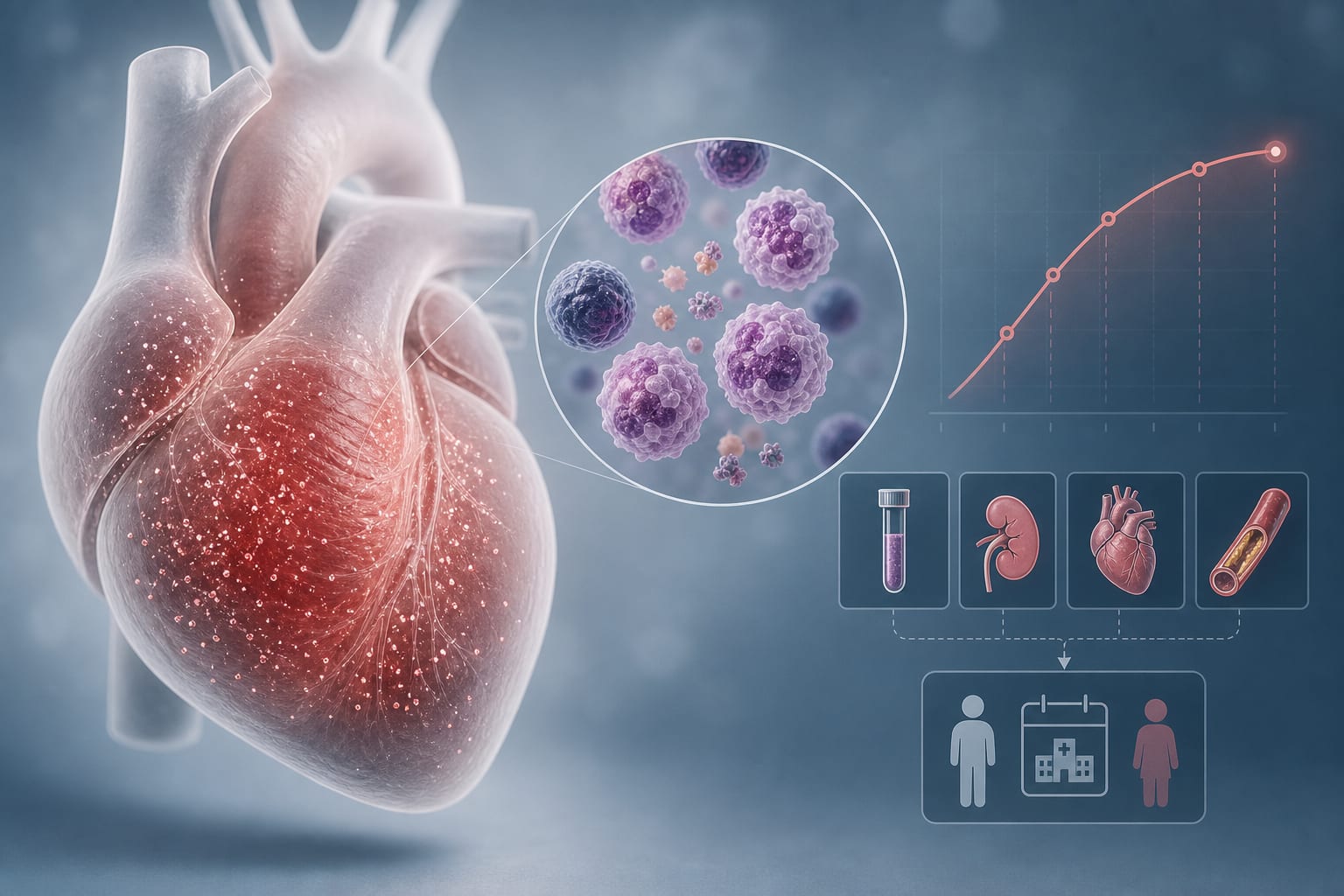
This study developed a predictive model for 1-year all-cause readmission in heart failure patients with preserved ejection fraction (HFpEF), utilizing the systemic immune-inflammation index (SII) among other variables. The model demonstrated strong discrimination and acceptable calibration, indicating potential clinical applicability.
Background
Heart failure with preserved ejection fraction (HFpEF) is associated with high rates of hospital readmissions, which pose significant challenges for healthcare systems. Current prognostic models vary in effectiveness, highlighting the need for reliable tools to assess readmission risk. The systemic immune-inflammation index (SII) has emerged as a promising marker for evaluating inflammatory status in HFpEF patients.
Data Highlights
Variable
Training Cohort AUC
Validation Cohort AUC
Sensitivity
Specificity
LnSII
0.8468
0.8302
0.7101
0.8993
Other Variables
-
-
0.5333
0.8750
Key Findings
The final predictive model included LnSII, LnNT-proBNP, LnLp(a), GFR, and hypertension.
The model achieved an AUC of 0.8468 in the training cohort and 0.8302 in the validation cohort.
At the optimal threshold, sensitivity and specificity were 0.7101 and 0.8993 in the training cohort.
Calibration was acceptable as per the Hosmer–Lemeshow test in both cohorts.
Decision curve analysis suggested potential clinical applicability of the model.
Clinical Implications
Healthcare providers can utilize this predictive model to identify HFpEF patients at high risk for readmission, allowing for targeted interventions. The incorporation of easily accessible clinical and laboratory variables enhances the model's practicality in routine clinical settings.
Conclusion
The developed model offers a promising approach for predicting 1-year all-cause readmission in HFpEF patients, warranting further external validation before broader implementation.
Researchers found that patients with higher waist circumference and lower grip strength had the greatest risk for developing type 2 diabetes during long-term follow-up.